
Project
Out of the water: Algae and Mosses adapt to living on Land
Project leader (coordination): Andreas Holzinger
Project members: Notburga Gierlinger (BOKU Vienna), Ingeborg Lang (University Vienna), John Dunlop (University Salzburg)
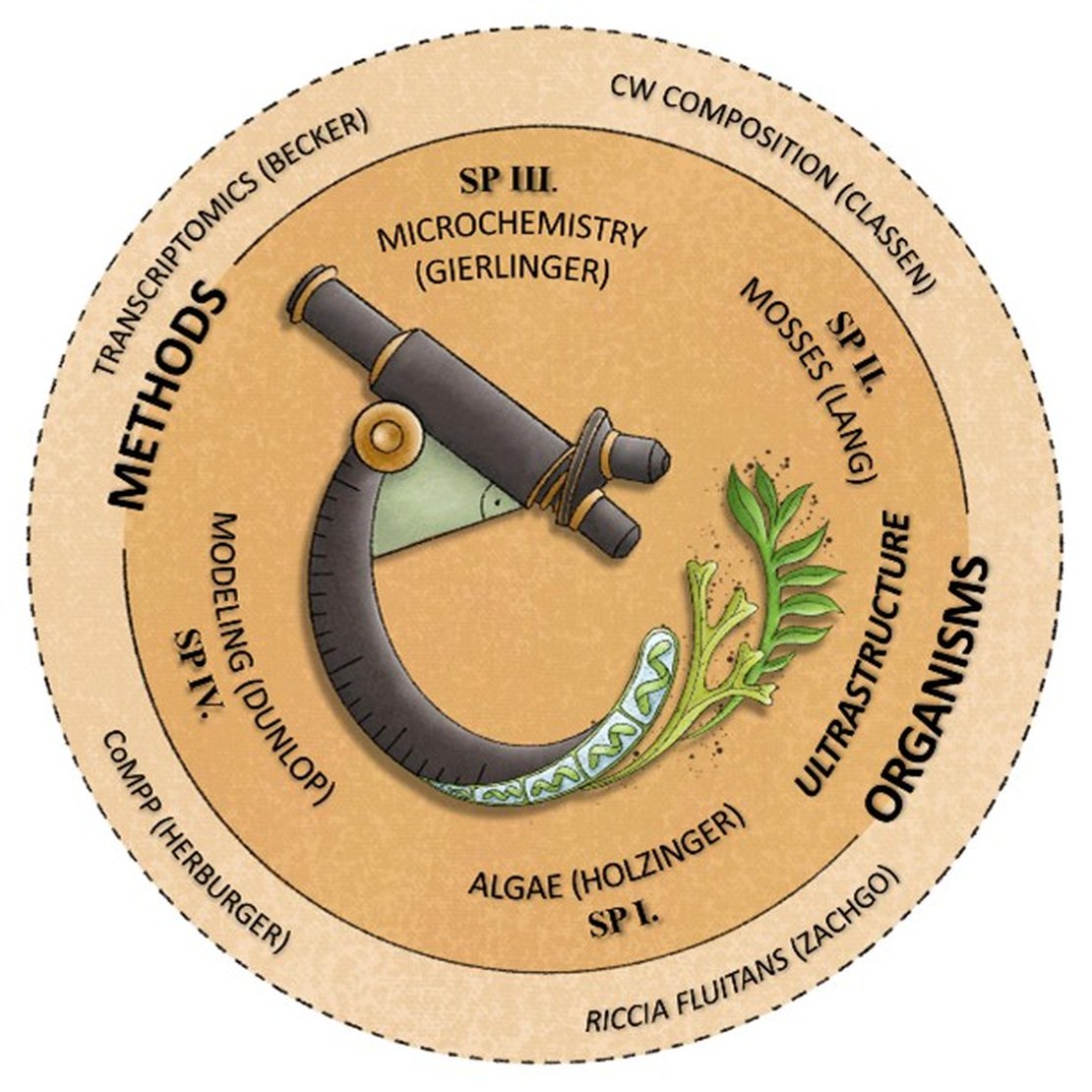
Cooperation partners: Burkhard Becker, Cologne, Germany; Klaus Herburger, Rostock, Germany; Birgit Classen, Kiel, Germany; Sabine Zachgo, Osnabrück, Germany; Peter Ulvskov, Copenhagen, Denmark.
Funding: FWF (FG 4100)
Duration: 2026-2031
Moving out of the water on to dry land was an evolutionary milestone of early land plants, that led the way for animals and eventually humans to follow. Despite its importance, little is known about how this step came to be. To fill this research gap, we investigate three flagship species groups of early settlers, streptophyte green algae, liverworts and moss. The species chosen are ideal models to study the adaptations and necessities for living on dry soil as they have different abilities to tolerate desiccation. In addition, these organisms range in complexity from simple filaments to multicellular 3-D bodies and are adapted to their habitat on different levels like tissues, cells, interfaces and the cell wall. Moreover, these organisms show complex life cycles with vegetative stages or permanent spores with a rigid cell wall. To understand the adaptations that led to the origin of plant life on land, we need an in-depth understanding of the different life forms of these pioneer species from micro to nano level and their physiological reactions upon drying out.
Key research questions to be answered within this project are: How are the outer surfaces and cell walls of algae and early land plants adapted to desiccation? How is the interaction of the outermost cytoplasm with the cell wall organized during water loss and which impregnation strategies are evident in vegetative stages or spores of early land plants? What are the advantages or constraints of multicellularity during desiccation? We tackle these fundamental research questions with innovative, multidisciplinary approaches from various angles to reveal essential information on the biochemical and biophysical adaptation of the outermost layers that protect plant cells to tolerate desiccation.
A consortium of four research groups with different expertise from the University of Innsbruck (Andreas Holzinger, BOKU University (Notburga Gierlinger), University of Vienna (Ingeborg Lang) and University of Salzburg (John Dunlop) will closely work together to investigate these different and burning research questions. The research group project is coordinated by Andreas Holzinger.

Research Group logo

Schematic illustration of the four research group subprojects (SP I- IV), main methods and cooperation partners

Schematic illustration of the life cycle of algae (left) and mosses (right).