
UPSHIFT - Effects of air pressure on UPwards SHIFTing alpine ecosystems

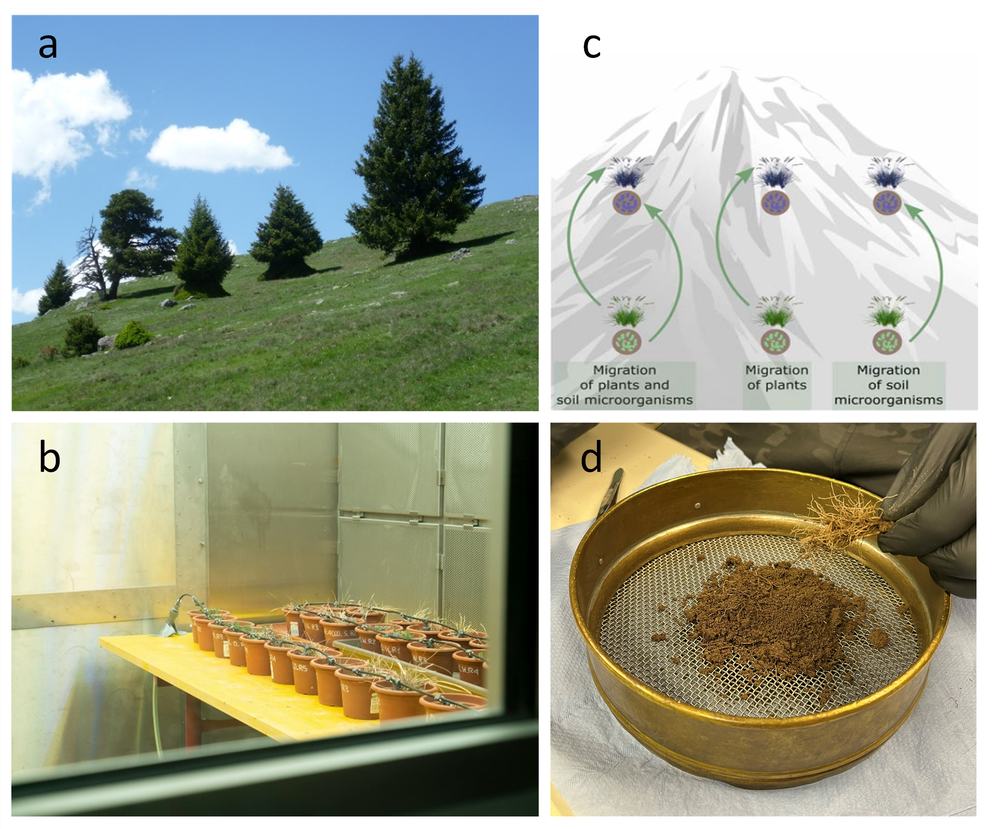
Climate change is altering the elevation range limits of many organisms, often driving upward range shifts. In this context, reduced air pressure poses a potentially novel environmental problem for upwards migrating organisms to solve if they are to persist at high elevation as climate change continues.
The goal of the project is threefold: 1) to understand how upwards migrating soil microorganisms and plant species react to lower air pressure; 2) to assess how upwards migrating soil microorganisms and plants perform with resident plants and soil microorganisms that have persisted in place under lower pressure; 3) to evaluate the effect of lower air pressure on the ecosystem water balance. The project integrates a unique extreme environment simulator (terraXcube) to simulate different alpine climate conditions, pot and mesocosm (lysimeter) experiments to disentangle the effects, and field observations from the LTSER site in Matsch/Mazia to validate the reliability of the obtained results.
a: Experimental site at 2000 m a.s.l., Matschertal, Italy (credit: Paul Illmer); b: Hypobaric chamber set to conditions simulating 4.000 m a.s.l. (credit: Eurac Research, Annelie Bortolotti); c: Schematic scheme of migration scenarios for plants and soil microorganisms in alpine ecosystems; d: Extraction of rhizosphere soil from plant roots (credit: Nadine Praeg).
Funding: FWF
Publications:
Lembo, Silvia; Niedrist, Georg; El Omari, Bouchra; Illmer, Paul; Praeg, Nadine; Meul, Andreas; Dainese, Matteo (2025): Short-term impact of low air pressure on plants' functional traits. In PloS one 20 (1), e0317590. DOI: 10.1371/journal.pone.0317590.
Lembo, Silvia; Niedrist, Georg; El Omari, Bouchra; Illmer, Paul; Praeg, Nadine; Meul, Andreas; Dainese, Matteo (pre-print): Low air pressure reduces gas exchange and alters plant physiology and metabolic responses in a controlled environment. DOI: 10.22541/au.175022688.84840365/v1
Rzehak, T., Praeg, N., Meul, A. et al. Air pressure as a driver of plant-specific microbial responses in the rhizosphere. Environmental Microbiome 20, 145 (2025). https://doi.org/10.1186/s40793-025-00805-3
Links:
Für Pflanzen wird die Luft immer dünner – Universität Innsbruck
Für Pflanzen wird die Luft immer dünner - Eurac Research