
RESTORE
Resilience Enhancement of Urban Stormwater systems

Funding: FWF - Austrian Science Fund (DOI)
Project team: Robert Sitzenfrei, Mohsen Hajibabaei, Mohammad Rajabi
Project duration: 09/2023- 09/2027
Research context
Urban drainage networks (UDNs) are critical infrastructures that play a vital role in safeguarding our communities against hygiene risks and flooding but also to protect nature from human impacts. These networks are designed to efficiently manage the flow of stormwater and wastewater away from urban areas, preventing waterlogging and protecting public health. Proper design, maintenance, and rehabilitation of UDNs are crucial to ensure they can effectively handle the challenges posed by rapid urbanization, climate change, and aging infrastructure. One of the key concerns with UDNs is their resiliencethe ability to withstand and recover from various threats and disruptive events. Two common types of threats affecting UDNs are functional failures and structural failures. Functional failures occur when the system faces increased loads due to factors like climate change-induced rainfall, urban development, and additional infiltration. On the other hand, structural failures result from disruptions to specific components of the network, such as pipe or inlet blockages and pump failures. Both types of failures can compromise the system`s ability to function properly and exacerbate flooding risks. Achieving resilience in UDNs is a challenging task due to the complex and unpredictable nature of the impacts. With graph theory, any kind of networks can be efficiently analyzed based on vertices and edges connecting them. Within the realm of urban drainage, researchers have been using graph theory to explore various aspects of UDNs. However, most of these studies have focused on topological characteristics, neglecting the physical attributes of the network, especially when considering failures and adaptation mechanisms. A promising advancement in graph theory for UDN analysis is the "hydraulically informed graph analysis (HIGA)." HIGA incorporates hydraulic and hydrological characteristics into the graph weighting functions. This approach enhances the accuracy and physical meaning of the graph analysis, enabling researchers to study the behavior and resilience of UDNs more effectively. Another crucial aspect of improving UDN resilience is understanding how failures from different sources (e.g., heavy rainfall, urbanization) and adaptation strategies (e.g., green infrastructure, storage tanks) propagate through the UDNs and beyond, impacting other critical infrastructures like road networks or water distribution networks. Studying these interdependencies is vital as urban infrastructures coexist and affect each other. Therefore, this project explores ways to develop generic models that account for interdependencies between infrastructure systems at various scales. Therefore, this research is essential for a better basic understanding of how to improve urban drainage systems, ensuring the safety and well-being of our communities, and protecting them from the adverse effects of flooding and other related risks.
Research questions
-
What is the role of weights on graph-based resilience assessment of UDNs?
- What is the role of network topology on impact propagation?
- Multiplex/multi-utility networks: what is the impact of failures on other spatial infrastructure?
- What accounts to robust, resilient and flexible (future) conditions of UDNs?
Methods
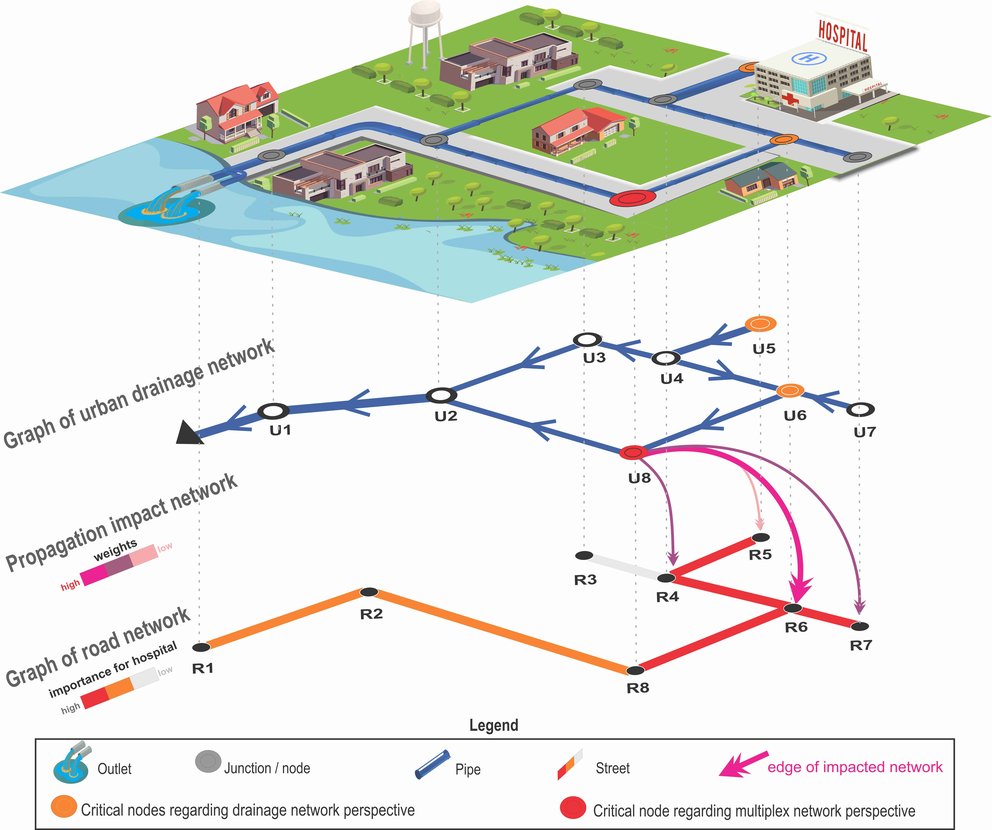
Complex network analysis can be utilized to enhance understanding of topological characteristics of UDNs with much less computational burden. However, hydraulic principles in graph analysis are usually neglected. Therefore, hydraulically informed graph analysis of UDNs is proposed, where different hydraulic characteristics are used to weight edges in graphs. Furthermore, the characteristics of spatial consequence patterns of failure modes are systematically evaluated with graph theory and novel so-called ‘Impact Networks’. The effect of UDNs failures on other infrastructures, like RNs, is assessed with a novel ‘Multiplex network model’. This enables us to develop an optimal expansion/adaption of the UDNs using the novel (dynamic) graph analysis to improve resilience.
Level of originality and innovation
-
Novel hydraulically informed graph analysis for resilience assessment of UDNs is established
- Simultaneous cascading effects on the resilience of UDNs are investigated leveraging the novel concept of “Impact Network”.
- New multiplex/multi-utility consideration of UDNs with other infrastructures (e.g., roads).
- An innovative (temporal/dynamic) multiplex model is developed to identify optimal and resilient future UDNs.
Articles in journals and conferences
- Dastgir A, Satish R, Hajibabaei M, Oberascher M, Sitzenfrei R. (2024). Modeling multiple-pipe failures in stormwater networks using graph theory. Journal of Hydroinformatics, (11). (DOI)
- Dastgir A, Satish R, Hajibabaei M, Oberascher M, Sitzenfrei R. (2024). A Hybrid Graph Hydrodynamic Method for Modelling Multiple Pipe Failure in Stormwater Networks. Engineering Proceedings 69/1, Nr. 97. (DOI)
- Hajibabaei M, Hesarkazzazi S, Sitzenfrei R. (2025). Filling data gaps in urban drainage networks: An automated graph theory framework for data collection and reconstruction. Water research, 287(Pt A), pp. 124272. (DOI)
- Hajibabaei M, Hesarkazzazi S, Sitzenfrei R. (2025). Retrieval of Missing Data in Urban Stormwater Networks Based on Graph Theory. European Geosciences Union (EGU) General Assembly 2025. (DOI)
- Rajabi M, Hajibabaei M, Sitzenfrei R. (2025). Urban Drainage Network Modeling Based on Physics-Informed Graph Analysis. European Geosciences Union (EGU) General Assembly 2025. (DOI)