
Neuropeptides, Stress & Brain Function - Karl EBNER group
Priv.-Doz. Mag. Dr. Karl Ebner
Principal Investigator
MAIN RESEARCH INTEREST
Understanding the Brain’s Response to Stress: Our research investigates how neuropeptides - small signaling molecules in the brain - regulate stress, anxiety, emotional behaviour and higher brain functions. We aim to understand how neuropeptides shape neuronal communication and modulate brain circuits that control emotional and physiological responses to stress. We also investigate endogenous brain mechanisms designed to control physiological responses to stress, focusing primarily on stress inhibitory mechanisms that promote adaptive stress coping and resilience. A central focus of our research is to uncover why some individuals are more vulnerable to stress while others remain resilient, and how these mechanisms contribute to psychiatric disorders such as anxiety, depression and post-traumatic stress disorder (PTSD).
MAIN RESEARCH FOCUS
- Neuropeptide signaling (e.g. VIP, PACAP, Substance P) in stress and brain functions
- Neural circuits (incl. Neuropetidergic pathways) controlling stress vulnerability and resilience
- Identification of stress-inhibitory brain mechanisms that protect against excessive stress responses
- Neurobiology of emotional behaviour and stress adaptation
- Molecular and cellular mechanisms underlying stress-related psychiatric disorders
- Translate fundamental neuroscience into innovative therapeutic strategies
- Discovery of novel therapeutic targets for precision medicine
MAIN TECHNOLOGIES
- Animal models of acute and chronic stress
- Behavioural analysis of stress, anxiety and cognition
- Molecular biology and gene expression analysis
- Histology and immunohistochemistry
- Neurochemical techniques
- Targeted neuropharmacological interventions
- Chemogenetics and neural circuit manipulation
CURRENT RESEARCH PROJECTS
Neuropeptide Signaling in Stress Circuits
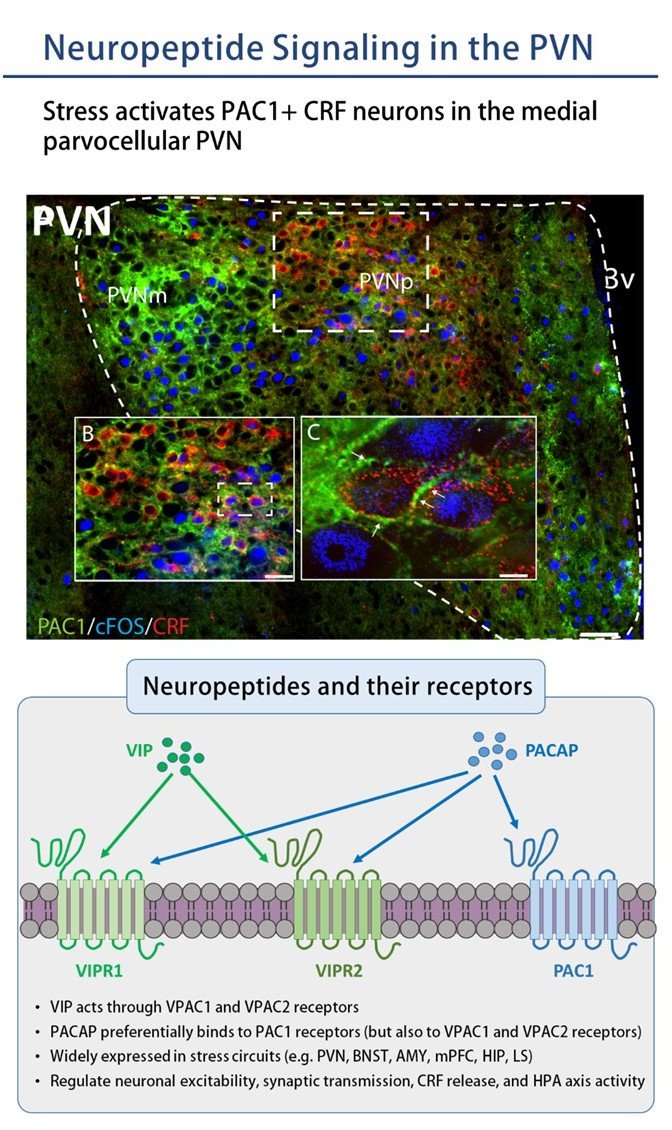
Please take a closer look to the illustration
A major focus of our work is to understand how neuropeptides such as VIP, PACAP and Substance P regulate communication within brain networks controlling emotion and stress. We investigate how these signaling systems influence the hypothalamus, amygdala, lateral septum and other limbic brain regions to shape anxiety, coping behaviour and hormonal stress responses.
Stress Vulnerability and Resilience
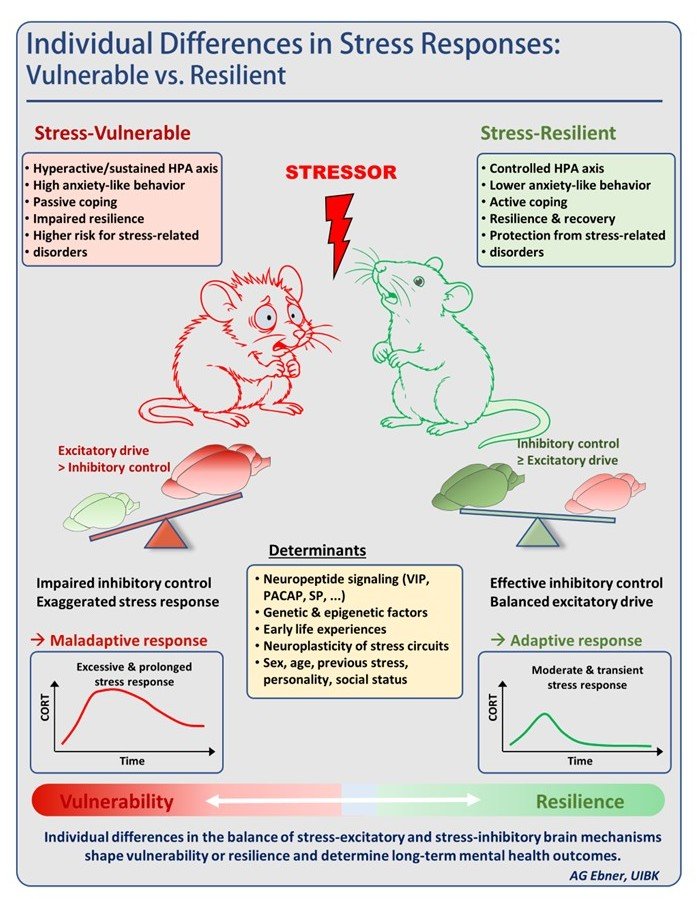
Please take a closer look to the illustration
Stress and early-life adversity can permanently alter the brain and increase the risk of psychiatric disorders. In this project, we investigate why some individuals remain resilient while others develop stress-related diseases. Using a novel mouse model of chronic social stress, we combine behavioural, molecular and circuit-based approaches to determine how neuropeptide signaling (e.g. VIP, PACAP) controls adaptive versus maladaptive stress responses. Our goal is to identify new biological mechanisms that promote resilience and provide novel therapeutic targets for stress-related psychiatric disorders.
Stress-Inhibitory Brain Mechanisms
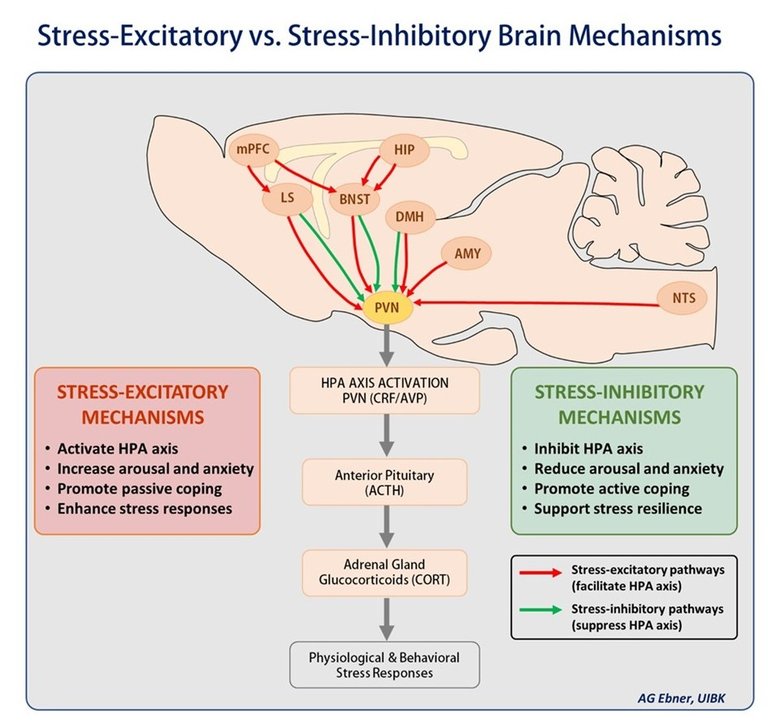
Please take a closer look to the illustration
One hallmark of our research is the identification of intrinsic stress-inhibitory brain circuits that actively suppress excessive stress responses. We investigate how these protective pathways regulate activity of the hypothalamic-pituitary-adrenal (HPA) axis and promote resilience. Understanding these endogenous protective mechanisms may open new avenues for the prevention and treatment of stress-related disorders.
GOALS & VISION
Stress-related disorders are among the fastest growing health challenges worldwide, affecting millions of people and placing an increasing burden on society. Although chronic and unpredictable stress is one of the strongest risk factors for mental illness, the biological mechanisms that determine why some individuals develop disease while others remain resilient are still poorly understood. Our goal is to uncover the neural and molecular mechanisms that determine stress vulnerability and resilience, with a particular focus on neuropeptide signaling and stress-inhibitory brain circuits. By integrating neuroscience, molecular biology and systems-level approaches, we aim to identify novel biomarkers and therapeutic targets that enable innovative pharmacological interventions for treatment stress-related psychiatric disorders or to strengthen resilience before disease develops. Ultimately, our vision is to generate fundamental neurobiological insights that pave the way for precision medicine approaches to improve the prevention and treatment of stress-related psychiatric disorders.
RESEARCHERS EBNER GROUP
ALUMNI
- Veronica FONTEBASSO
- Federico FERRO
TECHNICAL RESEARCH ASSOCIATES
Gospava STOJANOVIC
RESEARCH NETWORK
SELECTED PUBLICATIONS
-
Fontebasso V, Ferro F, Basille-Dugay M, Vaudry D, Hannibal J, Singewald N, Ebner K (2026) Lateral septal PACAP signaling regulates stress and anxiety reactions. 2026 Apr 21. Neuropsychopharmacology. doi: 10.1038/s41386-026-02409-y.
- Ferro F, Fontebasso V, Basille-Dugay M, Vaudry D, Ebner K (2026) Stress-type specific changes of VIP signaling in limbic regions of the rat brain. Neurosci Lett Jan 1:870:138430. doi: 10.1016/j.neulet.2025.138430. Epub 2025 Oct 31.
- Ebner K, Fontebasso V, Ferro F, Singewald N, Hannibal J (2025) PACAP regulates neuroendocrine and behavioral stress responses via CRF-containing neurons of the rat hypothalamic paraventricular nucleus. Neuropsychopharmacology 50(3):519-530. doi: 10.1038/s41386-024-02016-9.
- Ebner K, Sartori SB, Murau R, Kopel F, Kalaba P, Dragačević V, Leban JJ, Singewald N, Engelmann M, Lubec G (2022) The Novel Analogue of Modafinil CE-158 Protects Social Memory against Interference and Triggers the Release of Dopamine in the Nucleus Accumbens of Mice. Biomolecules Mar 27; 12(4):506. doi: 10.3390/biom12040506.
- Leschik J, Gentile A, Cicek C, Péron S, Tevosian M, Beer A, Radyushkin K, Bludau A, Ebner K, Neumann I, Singewald N, Berninger B, Lessmann V, Lutz B (2022) Brain-derived neurotrophic factor expression in serotonergic neurons improves stress resilience and promotes adult hippocampal neurogenesis. Prog Neurobiol. 2022 Oct;217:102333. doi: 10.1016/j.pneurobio.2022.102333. Epub 2022 Jul 22.
- Ebner K, Singewald N (2017) Individual differences in stress susceptibility and stress inhibitory mechanisms. Current Opinion in Behavioral Sciences 14:54-64. doi: 10.1016/j.cobeha.2016.11.016.
- Ebner K, Muigg P, Singewald N (2013) Inhibitory function of the dorsomedial hypothalamic nucleus on the hypothalamic-pituitary-adrenal axis response to an emotional stressor but not immune challenge. J Neuroendocrinol 25(1):48-55. doi: 10.1111/j.1365-2826.2012.02369.x.
- Singewald GM, Rjabokon A, Singewald N, Ebner K (2011) The modulatory role of the lateral septum on neuroendocrine and behavioral stress responses. Neuropsychopharmacology 36(4):793-804. doi: 10.1038/npp.2010.213. Epub 2010 Dec 15.
- Ebner K, Sartori SB, Singewald N (2009) Tachykinin receptors as therapeutic targets in stress-related disorders. Curr Pharm Des 15(14):1647-74. doi: 10.2174/138161209788168074.
- Berton O, Covington HE 3rd, Ebner K, Tsankova NM, Carle TL, Ulery P, Bhonsle A, Barrot M, Krishnan V, Singewald GM, Singewald N, Birnbaum S, Neve RL, Nestler EJ (2007) Induction of deltaFosB in the periaqueductal gray by stress promotes active coping responses. Neuron 55(2):289-300. doi: 10.1016/j.neuron.2007.06.033.
- Ebner K, Rupniak NM, Saria A, Singewald N (2004) Substance P in the medial amygdala: emotional stress-sensitive release and modulation of anxiety-related behavior in rats. Proc Natl Acad Sci U S A 101(12):4280-5. doi: 10.1073/pnas.0400794101. Epub 2004 Mar 15