
Bearbeitete Forschungsvorhaben
Am Stubaier Gletscher sind bereits einige Liftanlagen erfolgreich direkt am Gletschereis fundiert worden. In diesem Projekt werden wissenschaftliche Grundlagen zur Dimensionierung dieser Fundamente nach dem neuen Sicherheitskonzept entwickelt.
Bearbeiter: W. Fellin
Forschungsschwerpunkt: Alpine Infrastructure Engineering

Die gegenwärtig zur Verfügung stehenden technischen Lösungen zur Auffindung von Lawinenopfern ohne Verschüttensuchgerät sind unzufridenstellend. In diesem Projekt wird die Anwendung eines Georadars zur automatisierten Aufindung von Lawinenopfern während einer Helikopterbefliegung entwickelt.
Bearbeiter:W. Fellin, A. Heilig
Forschungsschwerpunkte:

Modelling of squeezing phenomena in anisotropic rock
Foliated rocks such as micaceous schists are particularly prone to anisotropic creep. This fact may cause severe problems of squeezing when driving deep tunnels, especially when the tunnel axis is not perpendicular to the foliation planes. A rational approach to the prediction and assessment of squeezing as a process in time and, therefore, also pertinent experimental results are still missing. Starting from a simple approach to anisotropic creep/relaxation we investigate its implications for tunnelling by means of numerical simulations.
Bearbeiter: D. Kolymbas, A.Blioumi
Forschungsschwerpunkte:

Tunnels with low cover are very often headed using the shield technique in order to prevent excessive ground movements during tunnel advance and to secure a safe working environment for the support works. Therefore the correct application of a face support pressure is of great importance.
In this project the stability of the tunnel face is investigated by means of laboratory experiments and three-dimensional finite element computations.
Bearbeiter: A. Kirsch
Forschungsschwerpunkte:


3D Finite Element calculations of shallow tunnels
Bellow you will find an animation of a 3D FE simulation of the excavation process.
According to a realistic excavation scheme following the NEW AUSTRIAN TUNNELLING METHOD, the following steps are shown:
- Excavation (advance) of one meter of the upper part of the crown within one hour.
- Application of shotcrete in this section within 2.5 hours.
The above two steps are repeated four times. - After an advance of four meters, the remaining part of the crown was excavated.
Afterwards the excavation in the bench was carried out in an similar way.
The calculations were done with ABAQUS 5.8-10. For the soil different constitutive models can be used (e.g. classical Mohr-Coulomb yield criterion or Hypoplasticity). For the shotcrete time dependent linear elastic behavior was assumed. The modell has 106.200 d.o.f. (8814 elements, 30819 nodes) and the 129 steps were running within an total CPU time of 122. hours on an silicon graphics o200 (524 MB RAM).
By clicking at the projector you can either download the animation in avi format or play it (depending on the plug-ins you have installed).
FE-Modell during the excavation process.
Multimedia in engineering education - Examples
One of our research fields is the introduction of multimedia and computer animation in engineering education.
- GEOTECHNIK Multimedia Lehrsoftware für Bodenmechanik, Geotechnik und Tunnelbau
Please, take into account large files containing animations - a fast internet connection is necessary for this application (another solution is to download an ISO-file of a CD or a file archive) - The example of an anchor installation is not yet ready, but it illustrates our intention.
By clicking at the projector you can either download the animation in avi format (650 Kb) or play it (depending on the plug-ins you have installed).
The other example is one of "low pressure grouting":
Searchable database of pictures of geotechnical problems (german only)
FAME
Introduction
FAME is a program to analyze limit states with the kinematical method. The considered failure mechanism is a chain of rigid blocks (bodies) that slide relatively to each other. The blocks are separated with planar surfaces that correspond to shear bands in reality. The restriction to planar surfaces implies that the individual blocks undergo translations but not rotations. As a consequence, only force equilibrium but not moment equilibrium can be considered. The considered failure mechanisms have only one degree of freedom, i.e. the motion of one block determines the motion of all other blocks. The considered motions do not include formation of gaps or interpenetration of bodies. Note that edges are allowed to squeeze. The motion of the blocks relative to each other mobilizes shear resictances (due to friction and cohesion) at the interfaces. A limit state is obtained when the interface forces are equal (and opposite) to the fully mobilized shear resistances (i.e. shear strength). If a configuration is stable, then the shear resistances will not be fully mobilize. To achieve full mobilization of shear resistance we need to apply an additional force. This is the force which will cause collapse of the structure. The orientation of this force has to be determined by the user. FAME will then calculate the value of this force ("F_limit"). This value can be compared with the actual force ("F_actual") to give the factor of safety (FOS): FOS = F_limit / F_actual The user-defined failure mechanism (i.e. the geometry of the individual blocks) has to be varied to find that mechanis which gives the minimum limit load F_limit. The program contains an algorithm to search the minimum of F_limit. This algorithm varies the coordinates of the vertices of the blocks in a defined way and looks for the geometry with minimum or maximum collapse load (limit load). The program is able to display the failure mechanism and the calculation results in 3D using OpenGL library.
Manual
Downloads
Version 1.0
Binaries for RedHat 7.x | Source | Manual for offline reading | Examples
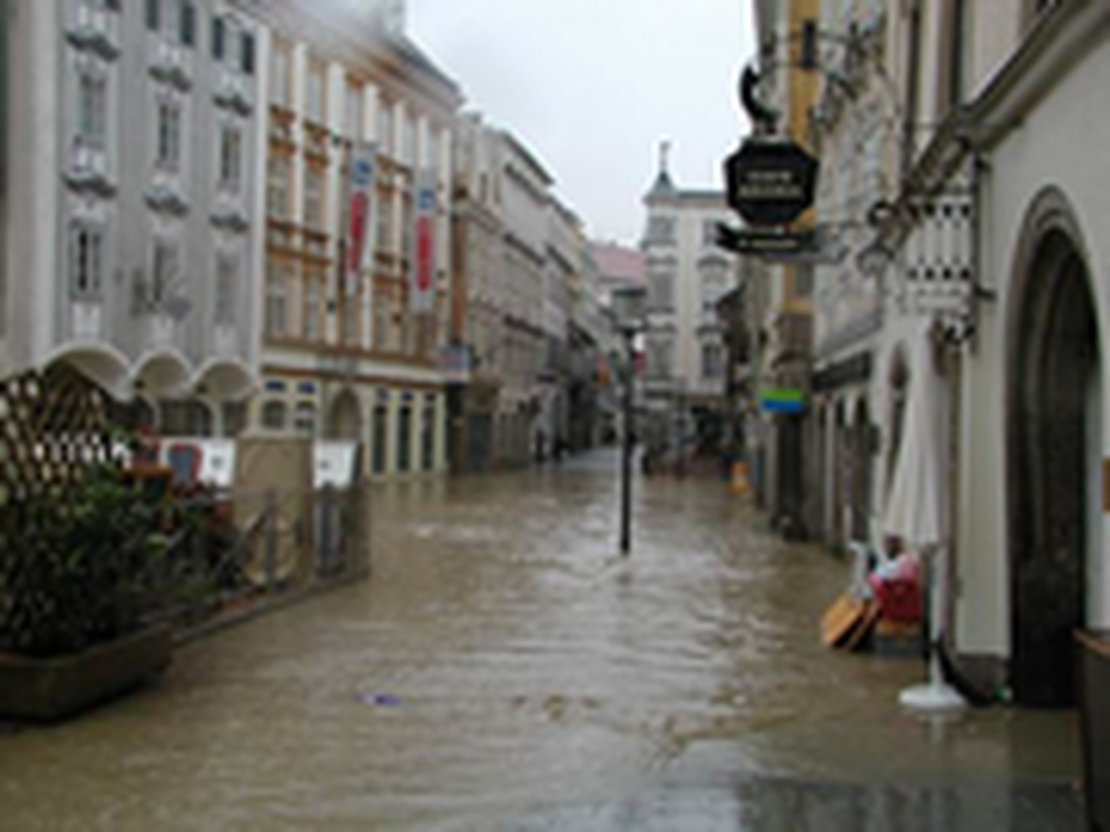
The CHEF initiative aims at preventing moveable and immoveable cultural heritage from damage caused by flooding. Risk assessment and emergency measures as well as damage evaluation and restoration and repair techniques are considered in the frame of the project.
Homepage:CHEF
BearbeiterInnen:D. Kolymbas, A. Blioumi, M. Holzmann
Forschungsschwerpunkt(e):

Bei oberflächennahen Tunnelbauprojekten kommen oft Tunnelvortriebsmaschinen zum Einsatz, die über eine Flüssigkeits- oder Erddruckstützung ein Versagen der Ortsbrust vermeiden. Dabei kommt der Bestimmung des einzustellenden Stützdruckniveaus eine besondere Bedeutung zu.
Im Rahmen dieses Forschungsprojekts wird anhand kleinmaßstäblicher Laborversuche und numerischer Berechnungen das Verständnis für die beim Versagen ablaufenden Vorgänge verbessert werden. In den Laborversuchen kommen sowohl optische Verfahren (Particle Image Velocimetry) als auch die direkte Messung der Stützkraft zum Einsatz. Mittels dreidimensionaler Finite Element-Berechnungen soll das Ortsbrustversagen auch numerisch nachvollzogen werden. Dabei geht es um eine Variation der verwendeten Materialmodelle, aber auch um eine Nachrechnung der experimentell durchgeführten Analysen.
Bearbeiter: A. Kirsch
Forschungsschwerpunkt(e):
- Alpine Infrastructure Engineering
- Computational Engineering
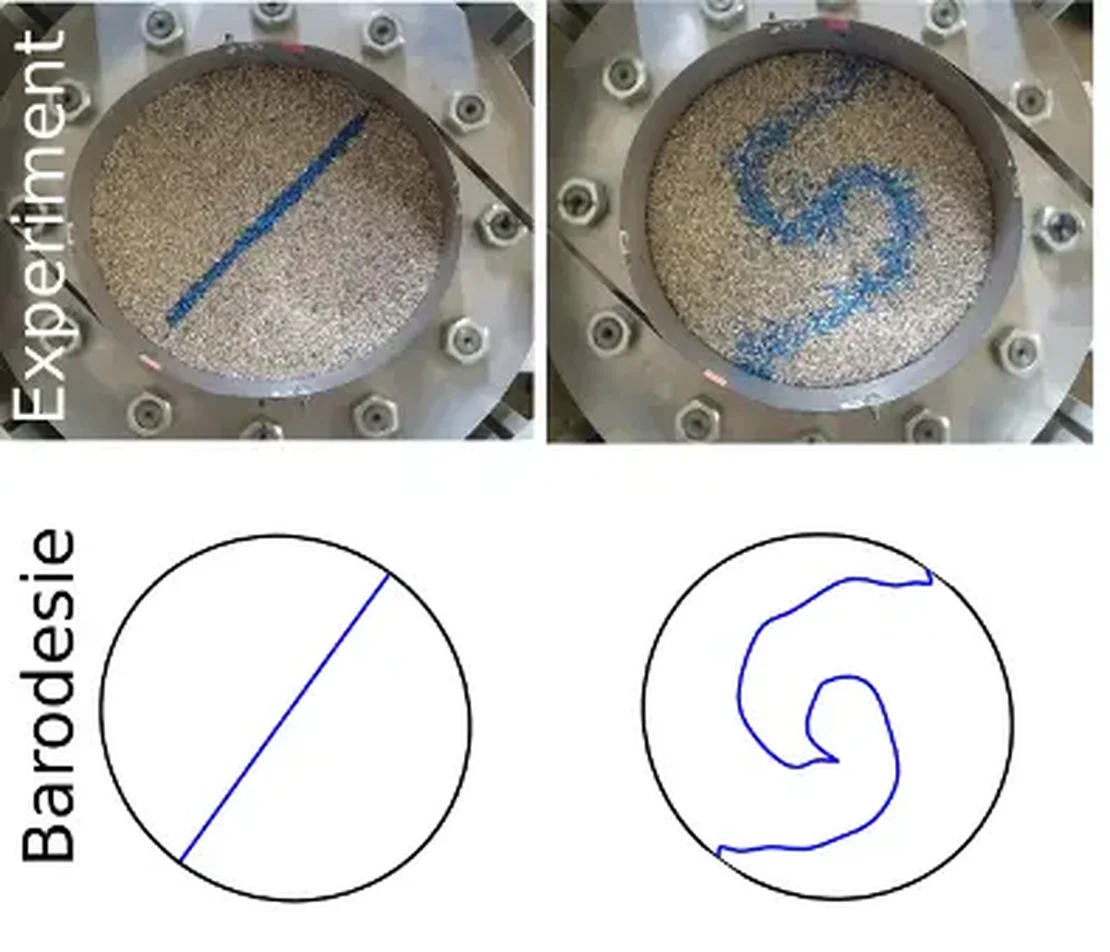
Die mechanischen Eigenschaften von Sand werden im Versuchsgerät "Vertushka" untersucht, welches die Gezeitendeformation der Erde modelliert. Das Versuchsgerät wurde erstmals in Novosibirsk von Herrn Prof. Dr. Revuzhenko konzipiert (Video). Der netzfreie Programmcode SPARC wird erweitert, um die großen Verformungen des Sandes im Versuchsgerät zu reproduzieren. Die Barodesie bildet die Eigenschaften der Sandprobe gut ab, insbesondre das allmähliche "Vergessen" des Ausgangszustandes.
Bearbeiter: I. Polymerou, D. Kolymbas
Forschungsschwerpunkt(e):
Computational Engineering

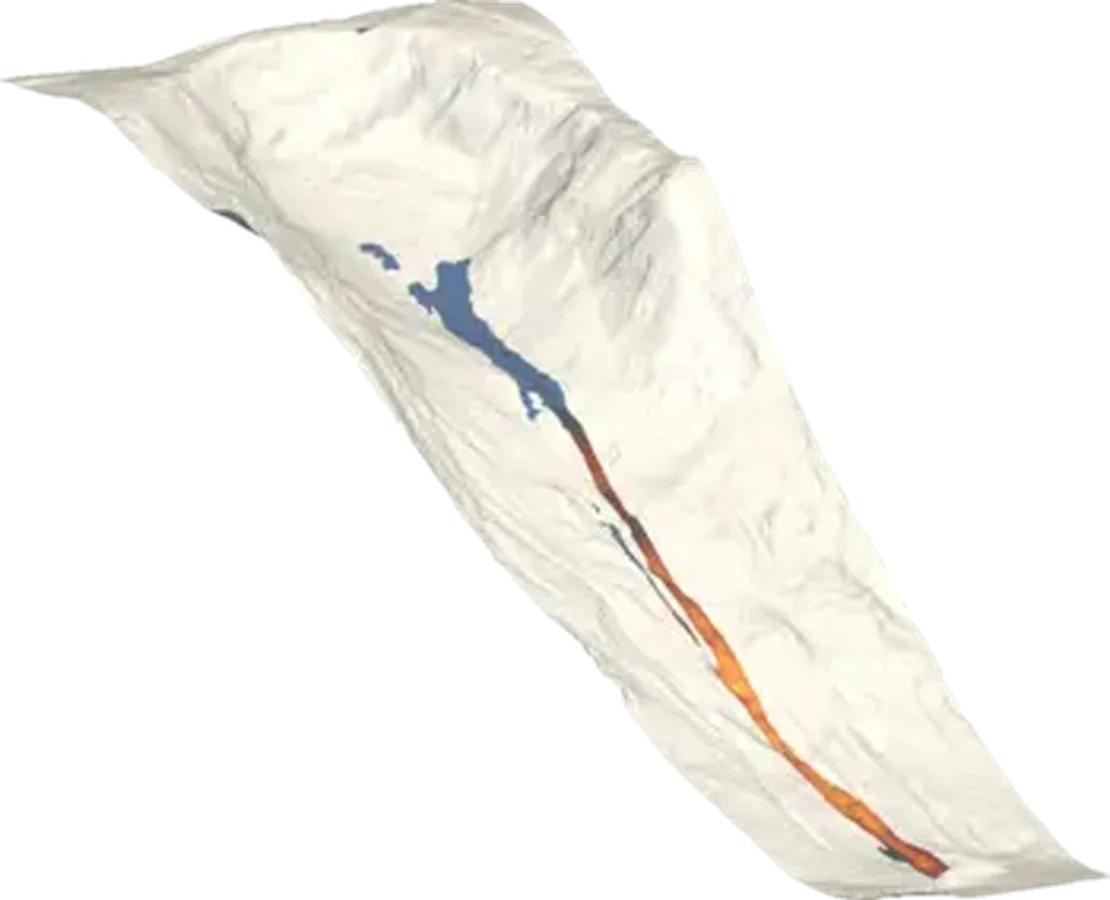
Zur Evaluierung der Gefährdung von Siedlungsgebiet durch Lawinen, werden seit einiger Zeit computergestützte Simulationen eingesetzt. Im Rahmen des Forschungsprojekts "beyond dense flow avalanches" werden neue Modelle und numerische Methoden für Staub- und Mischschneelawinen entwickelt, welche die Ergebnisse solcher Simulationen verbessern sollen.
Bearbeiter: M. Rauter, W. Fellin
Forschungsschwerpunkt(e):
- Alpine Infrastructure Engineering
- Computational Engineering

Axialsymmetrische Simulation der quasistaschichen Penetration in trockenen und wassergesättigten Sand mit dem netzfreien Soft PArticle Code (SPARC).
Bearbeiter: I. Bathaeian, D. Kolymbas
Forschungsschwerpunkt(e):
- Computational Engineering
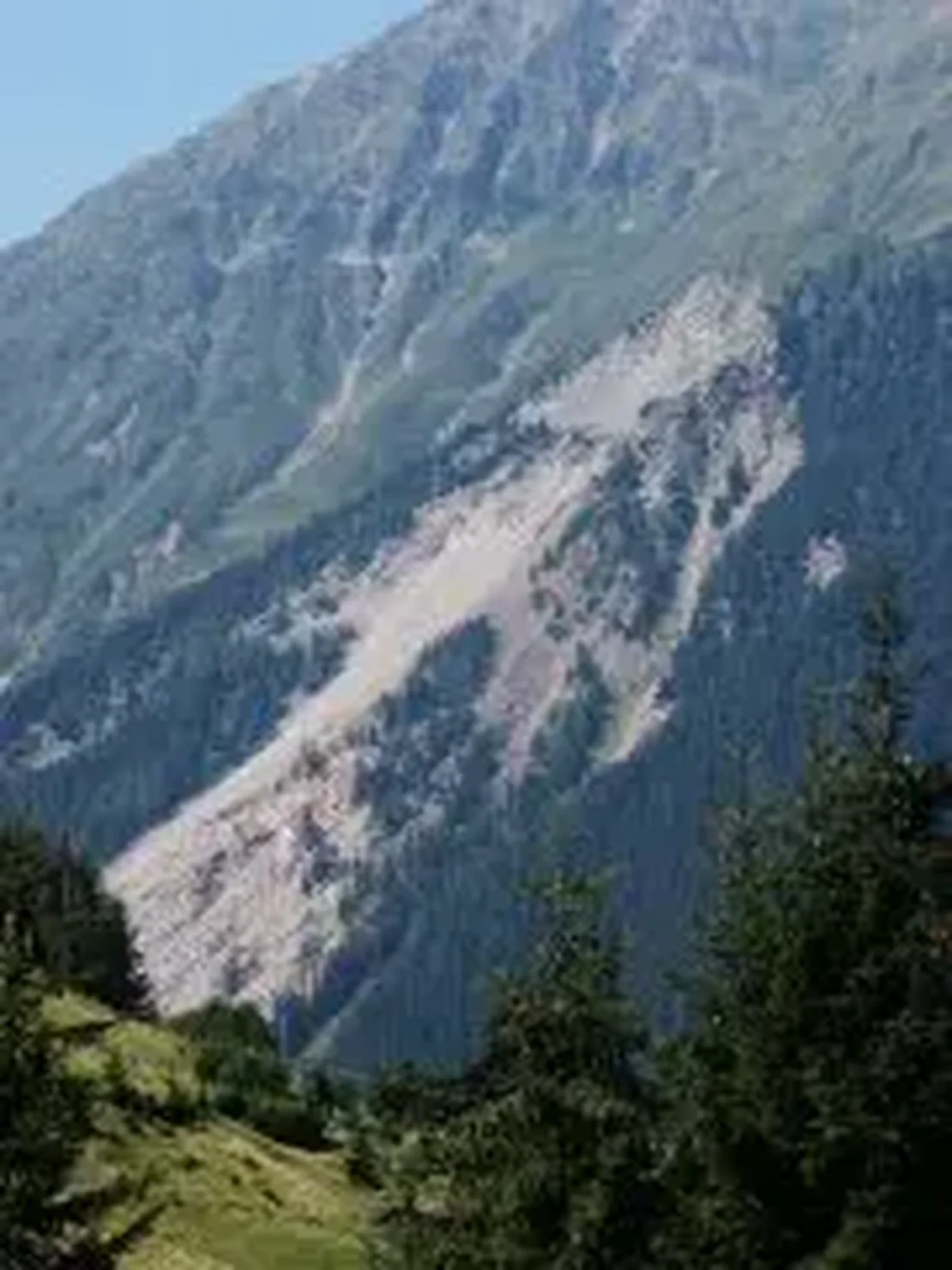
An glazial überstellten Hangflanken alpiner Täler treten häufig tiefgreifende Massenbewegungen unterschiedlicher Ausprägungen auf. In diesem Projekt soll ein Prognosesystem zur Abschätzung des Gefährdungspotenzials solcher Hänge entwickelt werden.
BearbeiterInnen:B. Schneider-Muntau, W. Fellin
Forschungsschwerpunkt(e):

Durch die Adaption bestehender Laborversuche soll ein einfacheres und robusteres Verfahren zur Bestimmung der notwendigen Parameter Critical State Line entwickelt werden.
Bearbeiter: F. Schranz, W. Fellin
Forschungsschwerpunkt(e):
- Computational Engineering