
The Pahlavi Papyri Project: A Treasure from Sasanian Times, brought to Light by Milad Abedi
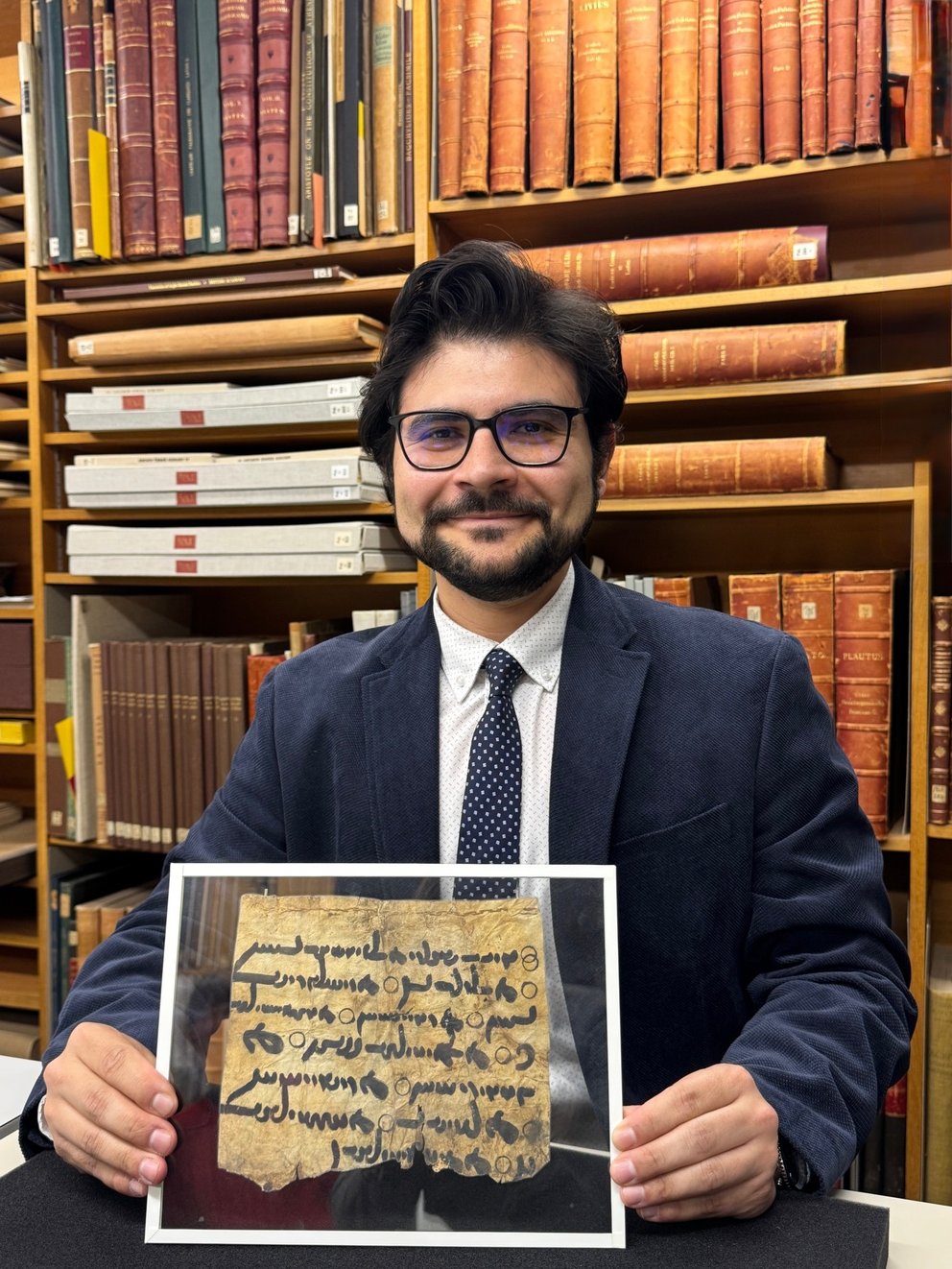
Dr. Milad Abedi is a linguist and postdoctoral researcher with the Pahlavi Papyri Project at the University of Innsbruck, where he serves as the project’s primary reader and translator of Pahlavi papyri. He earned his PhD in Linguistics from the University of Zurich in 2025 (magna cum laude), following research stays in Zurich, Paris, London, and Vienna, and previously worked as a researcher on the Swiss National Science Foundation project Sino-Indo-Iranica Rediviva. He is a contact linguist specializing in Old and Middle Iranian languages and their contact environments, his work integrates philology, historical linguistics, and contact linguistics to reconstruct the cultural history of lexical exchange across Eurasia. He trained in ancient Iranian languages at Allameh Tabataba'i University (BA/MA, Tehran) and at Leiden University, and brings longstanding passion and expertise in Book Pahlavi and Middle Persian. He has also contributed to the development of online datasets on Pahlavi lexical items and loanwords across multiple languages.
Image: In the library of University of Basel, holding Basel’s Pahlavi document from Sasanian Egypt (P 55)
The Pahlavi Papyri of the Austrian National Library: The Only Extant Administrative Archive of the Last Pre-Islamic Iranian Empire from Sasanian-Ruled Egypt (619–629 CE)
Historically and legally anchored in Vienna; researched and edited at the University of Innsbruck, the Middle Persian (“Pahlavi-cursive administrative documents”) documentary record is vanishingly rare worldwide. The largest coherent cache—roughly 600 papyri and parchments—belongs to the Papyrus Collection of the Austrian National Library (Vienna) and originates from Egypt during the brief Sasanian occupation, a narrow decade around 619–629 CE amid the Sasanian–Byzantine wars. In total, just a little over 1,000 Pahlavi documents are known globally, and fewer than five percent of Vienna’s collection have been published. Unlike most surviving Middle Persian documents, which stem from the early Islamic period, the Vienna papyri stand on the eve of the Islamic conquests, capturing the Sasanian Empire at its political and military apex—and preserving the only direct remnants of its complex bureaucracy.
Read closely, these texts are almost cinematic: arrest warrants and executions, court cases, long itineraries linking Egyptian cities to central Iran, and even moments of leisure on the Nile. They might also illuminate the high politics of the late 620s: conversion of a Persian elite to Christianity, a marriage alliance that tied the Persian governor to the Byzantine imperial family, and a coup at the heart of the empire against the Shah. This internal vantage point provides an essential counterweight to the Greek and Coptic narratives, allowing us to recalibrate what Sasanian rule in Egypt actually looked like—and to trace how the first Islamic administration rose swiftly on existing Iranian foundations, with lasting consequences for the linguistic and cultural landscape of the Middle East, especially Iran.
Project Aims
- Complete documentation (Vienna corpus): Item-level recording of all Pahlavi papyri and parchments in the Austrian National Library’s Papyrus Collection, building on early 20th-century notes and the collection’s internal inventory.
- Open-access discovery layer: A searchable database with key metadata and thumbnail images for rapid fragment identification and cross-referencing.
- Critical editions with translation & commentary: Publication of the most important and best-preserved documents, establishing readings of Book Pahlavi, reconstructing administrative procedures, and contextualizing legal and fiscal terminology across Middle Persian, Greek, and Coptic sources.
- Research integration: Comparative analyses of Sasanian governance in Egypt, its terminal phase, and the administrative continuities into early Islamic rule; targeted studies in historical linguistics (terminology, formulae, code-switching, loanwords).
Anticipated Impact
The Pahlavi papyri provide new, internal evidence for Sasanian rule in Egypt and for the empire’s fiscal–legal machinery. By anchoring the chronology of the 620s and detailing administrative procedures later adapted by the early Islamic state, the project will recalibrate narratives of late antique governance and illuminate long-term linguistic and cultural transformations across the Middle East, especially in Iran. The corpus also has the potential to clarify the final decades of the Sasanian polity and the dynamics surrounding the Arab–Muslim conquests. As the first systematic study of the Vienna collection of Pahlavi papyri, this project will bring this material to light and clarify the status of the Sasanian empire on the eve of Islam.
Find out more on our project page !
