

The gathering was part of the European Forum Alpbach Euregio Days and featured Euregio higher education institutions that are members of European University Alliances, an initiative of the European Commission designed to promote transnational cooperation in research, education, and innovation. These alliances aim to strengthen the competitiveness of the European Higher Education Area, create shared curricula, and foster joint research on global challenges. The partner institutions represented at the event were the University of Innsbruck (Aurora Alliance), Free University of Bozen-Bolzano (SUNRISE Alliance), MCI Innsbruck (Ulysseus Alliance), and the University of Trento (ECIU Alliance).
Chaired by Prof. Matthias C. Kettemann (University of Innsbruck), the evening followed a structured foresight approach—Framing, Scanning, Futuring, Visioning, Designing—to explore four strategic technological domains. Each university provided an expert perspective, highlighting how academic institutions can act as conveners of foresight and engines of regional resilience.
Quantum Futures: Collaboration as a Cornerstone
Prof. Tracy Northup (University of Innsbruck) emphasized Innsbruck’s global leadership in quantum science, the product of decades of collaboration between theoretical and experimental research groups. She outlined three plausible scenarios for the coming decades: domination of the field by international technology companies, Innsbruck maintaining its role within a diverse research ecosystem, and quantum technologies underperforming relative to expectations. While acknowledging the inherent uncertainty of emerging technologies, she identified the second scenario as the preferred pathway. To pursue it, she stressed the importance of sustained collaboration, stronger industry-academia partnerships, new approaches to quantum education, and a culture that accepts risk and failure as part of progress.
Data as the New Production Factor
Prof. Erwin Rauch (Free University of Bozen-Bolzano) explored intelligence and data-driven innovation in manufacturing, framing data as the fourth key production factor—alongside materials, machines, and labor. He argued that the evolution towards “intelligent factories” marks the next industrial step, with Industry 5.0 expanding the focus from efficiency to resilience, sustainability, and human well-being. Rauch noted the challenges facing the region’s SME-based economy, from limited budgets to skills shortages, but presented clear recommendations: expanding regional data spaces, embedding AI into SMEs, and investing in digital skills. “Sovereign and sustainable technological futures,” he concluded, “will not be built by machines alone, but by empowering people and SMEs.”
AI-Powered Excellence for Regional Resilience
FH-Prof. Christian Ploder (MCI Innsbruck) presented a framework for AI-powered excellence, drawing from his expertise in operational excellence and information systems. His contribution emphasized sovereignty and resilience across four dimensions: sovereignty and strategic autonomy over data and infrastructure, tailoring AI systems to local contexts as testbeds for responsible innovation, prioritizing local resilience over dependence on global systems, and building economic strength through regional AI clusters and talent development. By anchoring AI in the needs of regional industries, he argued, Euregio can build excellence that is both resilient and globally relevant.
Cyber-Physical Futures
Prof. Marco Formentini (University of Trento) closed the futuring sequence with a focus on cyber-physical systems and infrastructure. He highlighted Trento’s expertise in digital twins and AI for manufacturing, supporting smart factories and improving processes such as demand forecasting and inventory management. Research is reinforced by strong industrial collaborations, such as the partnership with Adige BLM. He also pointed to the Augmented Healthcare Environment Lab, where students and professionals train in simulated operating room settings, and the Trentino Data Mine, a sustainable data center that provides advanced computing power for research, business, and public services. Formentini stressed that such resilient and sustainable infrastructures—whether in manufacturing, healthcare, or data—are indispensable for technological sovereignty and democratic, sustainable futures.
A Shared Reflection
The evening concluded with a collective discussion on “How to Build and Leverage Future Power in EuRegio.” Across domains, the shared vision was clear: sovereignty is not only about independence from global dependencies but about aligning technology with regional values and long-term resilience.
By combining excellence in quantum technologies, industrial intelligence, artificial intelligence, and cyber-physical infrastructures, the event illustrated how the Alpine region can act as a European model - where local strengths translate into global contributions, and “Future Power” is defined by sustainability, democracy, and collaboration.
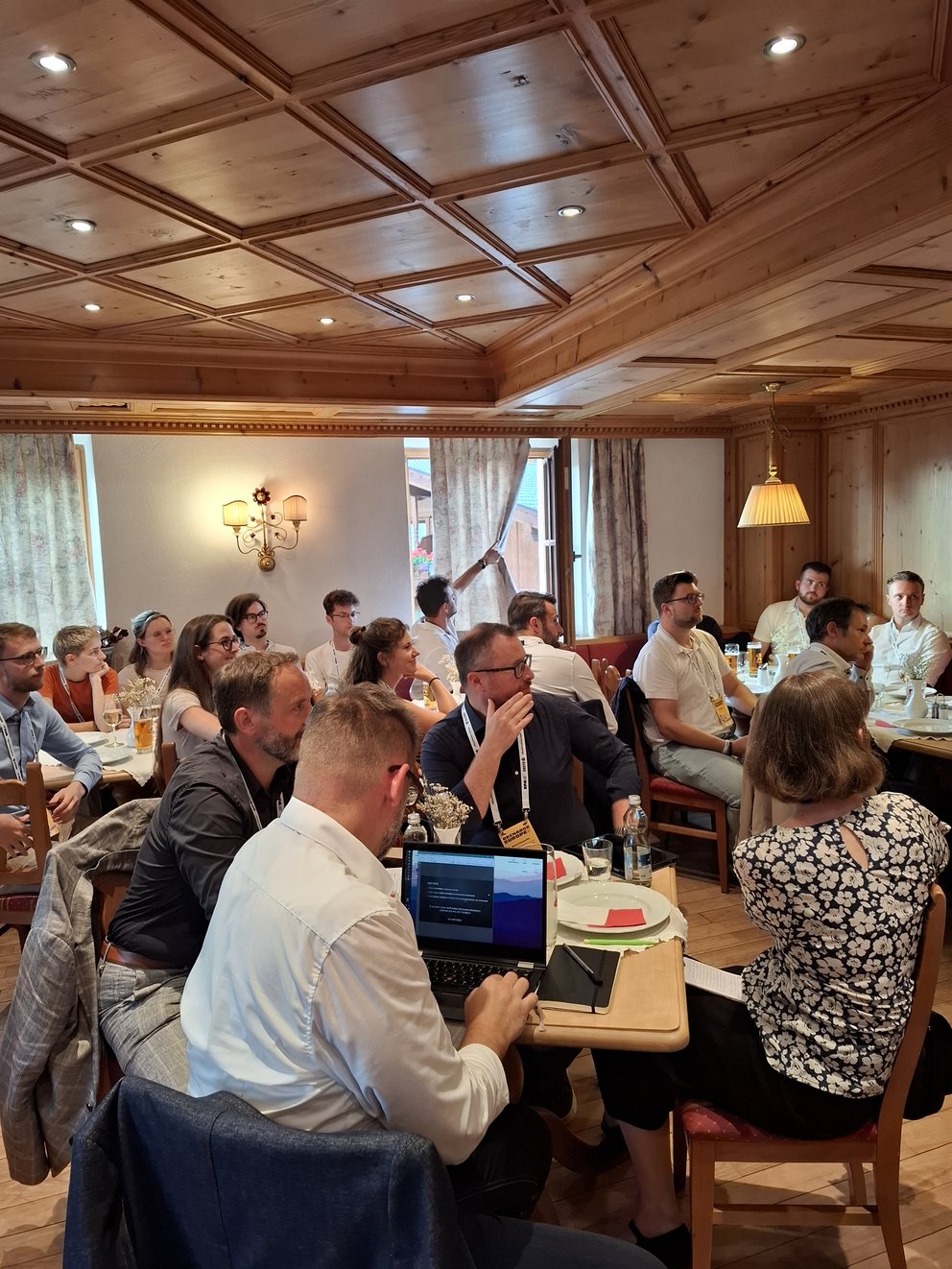
Audience at the Dine & Discuss Event
Background: European University Alliances
Aurora Alliance (University of Innsbruck) – A network of research-intensive universities committed to societal impact, sustainability, and inclusive education.
https://aurora-universities.eu
SUNRISE Alliance (Free University of Bozen-Bolzano) – A consortium that provides a voice to smaller-sized universities in the non-metropolitan areas, aligned to European values.
https://www.sunrise-alliance.eu
Ulysseus Alliance (MCI Innsbruck) – An international, open-to-the-world, person-centered, and entrepreneurial University that will shape Europe’s future.
https://ulysseus.eu
ECIU University (University of Trento) – The European Consortium of Innovative Universities, known for challenge-based learning and fostering industry-academic cooperation across Europe.
https://www.eciu.org
About Euregio Tyrol–South Tyrol–Trentino
The Euregio Tyrol–South Tyrol–Trentino is a cross-border cooperation structure founded in 2011 by the Austrian state of Tyrol and the Italian provinces of South Tyrol and Trentino. With a combined population of around 1.8 million, the Euregio promotes collaboration in culture, education, mobility, environment, and research, strengthening ties across borders while respecting regional autonomy. Its goal is to foster shared prosperity and position the Alpine region as a hub of innovation and sustainability within Europe.