


We are pleased to introduce: Rocío Suárez Vallejo, PhD
Rocío Suárez Vallejo holds a PhD in Ancient History and History of Religions from the University of Málaga and the University of Padova (April 2025). Rocío specialises in the construction of ‘paganism’ as a polemical tool in Late Antique and Early Medieval Christian sources in the Western Mediterranean, as well as in ritual strategies in the post-Roman rural world, with a special focus on Visigothic Hispania and Merovingian Gaul. Her recent book Stones, Trees and Springs in the Ritual Landscape of Late Antique Gaul and Hispania (Routledge, 2026) explores how condemnations of rituals in natural spaces (such as stones, trees and springs) reveal deliberate ecclesiastical strategies to control devotion, redefine sacred landscapes and consolidate episcopal power across rural territories. Her latest publications seek to challenge conventional views of rural ‘paganism’, offering a novel perspective on the dynamic negotiation of doctrinal boundaries in Late Antiquity.
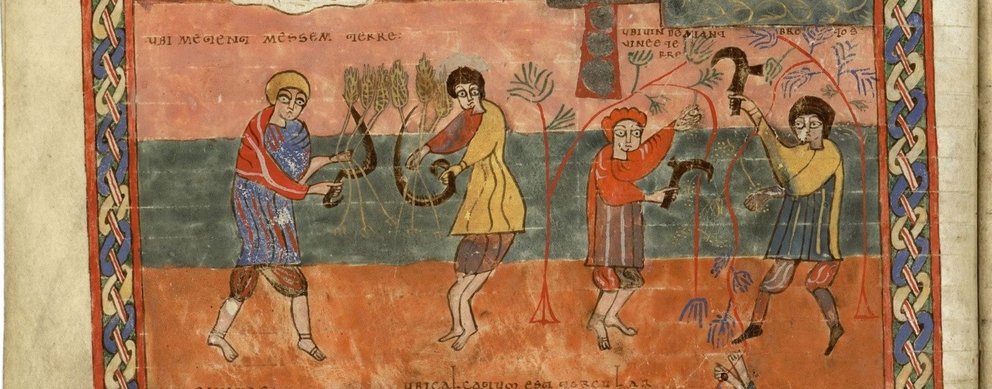
Grape harvest. Blessed of Valcavado (In Apocalipsin). 10th century. Library of Saint Cross College. Valladolid. Spain.
At the Department of Ancient History and Ancient Near Eastern Studies in Innsbruck, Rocío will carry out the research project Networks of Sanctity, Lived Religion and Climate Risk in the Post-Roman West (6th–7th Centuries) (NEXUS), supported by the FemCareer Fellowship (Host: Roland Steinacher). This project investigates how Christian communities in Hispania, Gaul and Britain responded to climate-related challenges such as droughts, floods and crop failures during the sixth and seventh centuries. By combining Lived Ancient Religion (LAR) and Network analysis, the project explores the dynamic relationship between Christian religious practices, symbolic strategies in hagiographical narratives and environmental uncertainties. NEXUS examines how bishops and other religious leaders navigated the challenges of climate crises and how rural populations, often perceived as passive, actively negotiated between official orthodoxy and local religious customs in response to environmental threats.
The project aims to offer fresh insights into the intersection of climate risk, religious authority and the lived experiences of communities in Late Antiquity. It also seeks to contribute to broader discussions on socio-religious innovation, highlighting the adaptive responses of communities to environmental challenges and their role in reshaping religious landscapes.
