
Quantum Physics at the University of Innsbruck
Excellence in research, teaching and innovation
The University of Innsbruck is one of the leading international centers for quantum physics and quantum science.
For decades, outstanding research achievements, excellent education and strong international cooperation have shaped Innsbruck's profile as a globally recognised hot spot of quantum research.
Quantum Physics in Innsbruck offers ...
- internationally visible cutting-edge research
- a close connection between basic research and tech innovation
- state-of-the-art laboratory and research infrastructure
- an international and diverse research environment
- attractive career opportunities for students from all over the world
Quantum research in Innsbruck
Theoretical depth and experimental excellence at one location - this is what characterises quantum research in Innsbruck. Central questions of modern quantum physics are researched at the University of Innsbruck - from the control of individual quantum systems to the understanding of complex multi-particle phenomena, from the construction of quantum computers to the development of the quantum internet. Researchers from Innsbruck regularly publish in leading international journals such as Nature and Science and shape key developments in modern quantum research.
The focus is on research into quantum optics and quantum information, quantum matter and the theoretical description and experimental control of complex quantum states. This work has contributed significantly to today's understanding of entanglement, quantum dynamics and quantum simulation and at the same time forms a basis for future quantum technologies.
The research is carried out at the Department of Experimental Physics and the Department of Theoretical Physics of the University of Innsbruck and the Institute for Quantum Optics and Quantum Information (IQOQI) at Austrian Academy of Sciences in Innsbruck. The scientists are part of Research Area Physics at the University of Innsbruck and the Austria-wide Cluster of Excellence Quantum Science Austria (QuantA).
Innsbruck has been internationally characterised by outstanding personalities such as Nobel Prize winner Anton Zeilinger, who carried out decisive research at the University of Innsbruck, as well as Rainer Blatt, Hans J. Briegel, Rudolf Grimm, Peter Zoller and others, whose work on quantum computers, quantum communication and quantum metrology has set standards worldwide. This scientific tradition continues to shape quantum research in Innsbruck today and makes the location an internationally recognised center of quantum science. This is confirmed by high-ranking awards and funding, including the Wolf Prize for Physics and numerous ERC grants.
Quantum physics in Innsbruck is part of an excellent international network and is firmly anchored in global cutting-edge research. Long-standing collaborations with leading universities and renowned research centers worldwide, active participation in international research initiatives and a central role in European research programmes create a dynamic environment for scientific exchange, innovation and excellent basic research.
Excellent research infrastructure
The alpine-urban campus of the University of Innsbruck offers a globally unique research environment for physics, which will be raised to a new level in 2028 with the opening of the physics building:
- highly specialised optical laboratories
- clean rooms and cryotechnology
- functional quantum computers for teaching and research
- computing resources for quantum and many-body simulations
- a quantum optical ground station at 2265 metres above sea level
- a spacious and pleasant working environment
Study quantum physics in Innsbruck
The University of Innsbruck offers a in-depth training in quantum sciences at all academic levels:


Master’s Programme Physics
Specialisation in Quantum Sciences

Students benefit from ...
the specialisation Quantum Sciences in the Master's programme,
early involvement in active research groups,
international exchange programmes,
supervision by world-renowned scientists and
the Doctoral Programme Atoms, Light and Molecules (ALM), which offers students from all over the world an ideal research and training environment.
Innovation, knowledge transfer & quantum technologies
At the University of Innsbruck, excellent research results from quantum physics are consistently translated into innovation. They form the foundation for quantum technologies of the future, successful technology transfer and close cooperation with industrial partners.
Visible expressions of this innovative strength are successful spin-offs such as Alpine Quantum Technologies (AQT), ParityQC and Quantum Network Design (QND), which market quantum technologies from Innsbruck internationally, as well as co-operations with international tech firms such as AWS, IBM or Infineon.
Career & Working in Innsbruck
At the same time, the University of Innsbruck offers excellent conditions for academic careers: attractive jobs for PhDs and postdocs, an international and diverse research environment and an exceptionally high quality of life in an alpine-urban setting make Innsbruck a first-class location for professional and personal development.
News on Quantum Physics

AI: The price of remembering
AI systems operate using accumulated knowledge. However, they are subject to physical limitations, as researchers from the University of Innsbruck demonstrate in a recent study. Within a framework describing the thermodynamic limits of information processing, they provide mathematical proof that, in some cases, agents who interact with their environment can only operate as energy-efficiently as possible if they forget information—even information that would improve their predictions.

Quantum internet prototype takes shape in Innsbruck
The University of Innsbruck will link together trapped-ion quantum processors across hundreds of kilometers of optical fiber within a prototype for a future quantum internet. To this end, Innsbruck quantum researchers are receiving a total of €5.4 million from the EU. The project is being carried out by University of Innsbruck and AQT as part of the Quantum Internet Alliance (QIA), a consortium of over 50 European research partners.

Bethe strings observed in ultracold atoms
Nearly a century after they were predicted by Nobel laureate Hans Bethe, a team led by quantum physicist Hanns-Christoph Nägerl has observed so-called “Bethe strings” in ultracold atoms. The ultracold gas provides an ideal platform for further investigation of these quantum many-body states.

Three ERC Starting Grants for Scientists in Innsbruck
Chemist Andrea Auer, physicist Simon Baier, and political scientist Fabian Habersack from the University of Innsbruck each receive an ERC Starting Grant —a generously funded European grant for early-career researchers in the field of fundamental research.

One step closer to the ideal glass
In 1948, chemist Walter Kauzmann published experimental data that could point to the existence of an “ideal glass”: a hypothetical fourth state of matter in which a solid, despite having an amorphous structure, is in thermodynamic equilibrium. Using computer simulations, a team led by Innsbruck physicist Gerhard Jung has now observed for the first time a “Kauzmann transition” from a liquid to an ideal glass.

Quantum simulators get error bars
Researchers have developed a method for determining the accuracy of quantum simulations. The new method not only reconstructs the dynamics of a quantum system from experimental data, but can also quantify the uncertainty of the predictions derived from it. The verification method was demonstrated in Innsbruck, Austria, on an ion-trap quantum computer with up to 51 qubits.

Not all quantum measurements are created equal
Proving that one quantum measurement is more powerful than another has long been difficult. Physicists from Heinrich Heine University Düsseldorf, Lund University, and the University of Innsbruck have now developed and demonstrated a simple technique to certify that a certain class of measurements has properties that cannot be mimicked by simpler means.

New blueprint for exotic quantum states
Researchers led by Francesca Ferlaino and Luca Barbiero have developed a new theoretical model for ultracold magnetic atoms in a one-dimensional quantum structure, revealing seven exotic phases of matter. Most remarkably, one phase combines topological order and superconductivity, with potential applications in quantum computing. They provide a detailed roadmap for realizing and detecting these using existing experimental techniques.

A novel critical quantum phase
In a new study published in Physical Review Letters, a team of the Nägerl group jointly with theory collaborator Alvise Bastianello from the CNRS and the Université Paris-Dauphine demonstrates that highly unusual quantum states known as "fractional Fermi seas" can be quantum engineered.

Feltrinelli Prize awarded to Hannes Pichler
Quantum physicist Hannes Pichler was awarded the Antonio Feltrinelli Giovani Prize in Physics on June 12 in Rome. The 50,000-euro award, presented by the Italian Academy of Sciences, honors researchers under the age of 40 who have achieved exceptional and internationally recognized success in their field.

Peter Zoller elected Fellow of the Royal Society
Peter Zoller, professor emeritus at the University of Innsbruck and scientific director emeritus at the Institute for Quantum Optics and Quantum Information of the Austrian Academy of Sciences, has been elected a Fellow of the Royal Society (FRS). The Royal Society is the national academy of sciences of the United Kingdom and the oldest scientific society in the world.
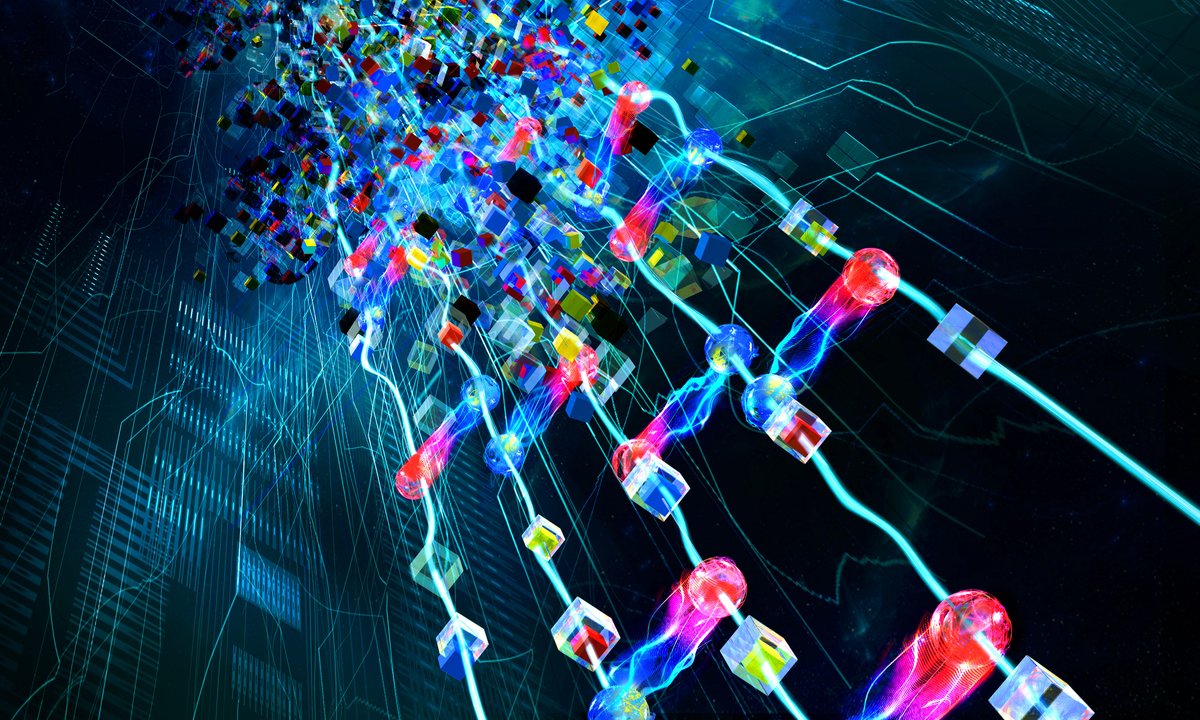
Designing better quantum circuits with AI
Researchers from the group of theoretical physicist Hans Briegel have collaborated with NVIDIA to develop an AI method that automatically generates efficient quantum circuits, a key bottleneck in making existent quantum computers practically useful.
FAQs on quantum physics in Innsbruck
Quantum physics describes the laws of nature on the smallest scales - of atoms, electrons and light - and is fundamentally different from our everyday physics. It explains how matter and energy work at this level and forms the basis of many modern technologies.
We encounter quantum physics every day in technologies such as smartphones, computers and the internet, whose semiconductors and transistors are based on quantum physical effects. LEDs, lasers, solar cells and magnetic resonance imaging also only work thanks to quantum physics. The quantum technologies of the future are being researched and developed at the University of Innsbruck today - from quantum computers and the quantum internet to high-precision quantum sensors.
The University of Innsbruck is one of the leading international locations of quantum physics. The close cooperation between experimental and theoretical physics, the active role in European and global research programmes and the successful transfer of research results into quantum technologies and spin-offs create a unique environment for innovation, scientific excellence and sustainable cutting-edge research.
Quantum physics in Innsbruck covers a broad spectrum of research fields, from quantum optics, quantum information and quantum networks to many-body physics and quantum matter as well as theoretical methods and models for all these areas.
Yes, quantum physics is a central component of physics studies at the University of Innsbruck and is studied in depth, particularly in the Master's programme "Quantum Sciences". This programme enjoys a very good reputation due to its high scientific quality, good supervision and livable location.
A degree in quantum physics opens up a wide range of career paths in research, high-tech industry and data-driven professional fields. Graduates are in demand in areas such as quantum technology, IT, simulation, medical technology, finance and technology consulting - thanks to their strong analytical and mathematical skills. At the University of Innsbruck, students receive an internationally recognised education with excellent future prospects.