Maimonides and Jewish Mysticism: Reason on the Edge of the Unspeakable
Philosophy – Jewish Thought – Middle Ages
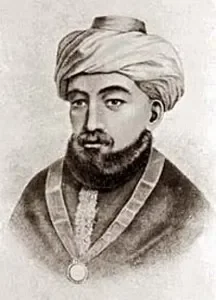
Anyone who sees Maimonides as the antithesis of Kabbalah is not entirely wrong — and yet this view falls short. Moses ben Maimon (1138–1204), known as Rambam, is generally regarded as the most sober-minded rationalist of medieval Jewish thought: trained in Aristotelian philosophy, influenced by al-Farabi and Ibn Sina, and convinced that reason and the Torah cannot ultimately conflict. Nevertheless, his magnum opus, the Moreh Nevuchim (Guide for the Perplexed), contains a dimension that eludes simple categorisation as ‘rationalist’ — an apophatic theology which, in its radical consistency, has more in common with the mystical silence of the ineffable than is apparent at first glance.
Negative theology as a borderline
The core of Maimonides’ doctrine of God lies in negative theology, the via negationis: no positive attributes can be ascribed to God without jeopardising his unity (Hebrew: ejchad). If one says that God is ‘wise’, strictly speaking one merely means that he is not ignorant; if one says he is ‘good’, one is merely negating evil as a possibility within his nature. This consistent apophasis leads to a concept of God that lies beyond any linguistic grasp. Language becomes a vehicle of failure — a paradoxical instrument that points to its own limits.
Here lies a structural affinity with Jewish mysticism, particularly with later Kabbalah: The Kabbalistic concept of Ein Sof (literally: ‘without end’, the Infinite) also embodies the idea that the divine being itself remains completely transcendent and, by definition, inaccessible. The Sefirot — the ten divine emanations — are necessary precisely because Ein Sof cannot reveal itself directly to the human mind. What Maimonides achieves through rational negation, Kabbalah attains through a symbolic system of mediation. The objective is different; the fundamental epistemological tension — the desire to conceive of God, which transcends thought — is the same.
Prophecy, Intellect and Mystical Experience
Another point of contact lies in the doctrine of prophecy. Maimonides understands prophecy not as a supernatural intervention from without, but as the perfection of the human intellect: the prophet is that person whose sekhel (intellect) has attained the highest level of connection with the Active Intellect (sekhel ha-po’el, in Aristotelian terminology: nous poietikos). Prophecy is thus first and foremost an epistemic event — but not one without ecstatic implications. It is precisely in the more difficult-to-access sections of the Moreh that Maimonides suggests that the highest intellectual insight merges into a kind of contemplative absorption that at least touches upon what others would call mystical union.
Gershom Scholem, the founder of modern Kabbalah research, precisely identified this ambivalence: Maimonides was no mystic, but the consequences of his philosophy had — against his will, one might say — opened up mystical spaces of thought.
His pupils and followers, particularly within the Andalusian-North African tradition, have not infrequently filled these openings with mystical speculation.
The esoteric silence
Not least, the structure of the Moreh Nevukhim itself is revealing. Maimonides writes explicitly for those who are ‘confused’ — educated readers torn between philosophical reason and religious tradition. At the same time, he warns against teaching the deepest chapters — particularly those on the Ma’ase Bereshit (the work of creation) and the Ma’ase Merkava (the work of the Chariot) — in public. In the rabbinic tradition, these two areas are regarded as the most esoteric parts of Jewish tradition; the Ma’ase Merkava is nothing other than the foundation of early Jewish Merkava mysticism.
Maimonides’ silence on the matter is therefore no accident: he writes about the ineffable by marking it as ineffable and yet partially circling around it. This, too, is a form of mystical thinking — not experience in the ecstatic sense, but an epistemically humble pause before that which lies beyond the sayable.
Conclusion
Maimonides and Jewish mysticism do not form a harmonious pair — Kabbalah developed partly in dialogue with him, and at times in opposition to him. And yet it would be a mistake to treat the two currents as simply opposed. Rambam’s apophatic theology, his teaching on the prophets, and his esoteric silence regarding the Merkava tradition reveal that rationalist philosophy and mystical thought in medieval Judaism were not separated by a clear dividing line — but by a zone of productive tension in which both drew upon one another, without always being willing to admit it.
Further reading: Gershom Scholem, ‘On Kabbalah and its Symbolism’ (1960); Sara Klein-Braslavy, ‘Maimonides as Biblical Interpreter’ (2011); Kenneth Seeskin, ‘Maimonides on the Origin of the World’ (2005).
Dissertation project by: Mag. Gaetano Liguori
Supervisor: Univ. Prof. Mag. Dr. Christian Kanzian, Institute for Christian Philosophy