
University of Birmingham
Laura Frischmann, SS 2026
Spending a semester abroad at the University of Birmingham, was an experience I had been looking forward to for a long time. Living in the UK had always been one of my dreams, so being accepted for an exchange semester in Birmingham was incredibly exciting.
Of course, moving to another country also came with a few uncertainties. I was curious about what university life in the UK would be like, where I would live and whether it would be easy to meet new people or not. Luckily, most of these worries disappeared very quickly after my arrival. Birmingham, also often called „Brum“ by the locals, is a large and multicultural city with a lot to discover. At the same time, the university campus almost feels like its own little town. It did not take long before I started feeling comfortable there and found my place within the student community.
Meeting People and Student life
One of the best things about studying at UoB was how easy it was to meet new people and make friends. Especially during the first few weeks, the university and different student organisations arranged a huge number of events.
There were welcome events, social evenings like bingo or quiz night, campus activities and trips to meet both international and local students. Since almost all exchange students arrived without knowing many people, everyone was very open and interested in making new friends. This made starting conversations and finding a group much easier than I had expected. The University of Birmingham also has a huge number of clubs and societies. There are societies for different sports, countries, cultures, languages, hobbies and academic interests. Whether you enjoy travelling, music, dancing, sports or simply meeting people with similar interests, there is probably a society for it. Joining a club or attending some of their events is definitely something I would recommend. It is one of the easiest ways to meet people outside your courses and to experience more of British student life.
Some of my favourite memories from Brum were not necessarily the biggest events or trips. They were often the simple moments, such as meeting friends for coffee, studying together, painting mugs at events or cooking and baking in our accommodations.
Accommodation
The University of Birmingham offers many different accommodation options, both on and close to the campus. However, students arriving for the spring or summer semester should try to organise their accommodations as early as possible. The number of available rooms can be more limited during this semester so it is important to react quickly once applications open because not everyone is guaranteed a room in university accommodation. However, the university provides support if you need to search for private accommodation and can help students understand the different options available. During my semester, I first lived in Mason and later moved to Chamberlain. both places were beautiful and spacious and had everything I needed for everyday life. The flats usually had a shared kitchen and living area while some rooms offered private bathrooms.
Depending on the accommodations students could choose between a mix-gender flat or a women/men-only flat. Most flats were shared by around four or five people. Living with other students was also a great way to make friends because there was almost always someone around to talk to, cook with or make plans with. For me living in a student accommodation was a very important part of the exchange experience. It made it much easier to connect with other students, especially during the first few weeks.
The campus
The University of Birmingham campus is huge and honestly, one of the most beautiful university campuses I have ever seen. It combines historic buildings with modern university facilities. At first the size of the campus can feel slightly overwhelming and it might take some time to find a different buildings and lecture rooms, however you get used to it quite quickly. There are also campus maps, signs and usually plenty of students around who are happy to help you. There are many cafés around the campus where students can meet, study or simply get a coffee and a snack between classes. We also had opportunities to sign up to the campus gym or go to the free sports classes the student living team offered. The campus also has two small supermarkets which are very useful when you only need a few things largest supermarkets such as Aldi and Morrisons are approximately a 15 minute walk away so grocery shopping is quite easy even without a car.
The campus felt very lively, but there were also many quiet places where you could sit, study or relax especially when the weather was nice. Many students spent their brakes outside on the green areas around the campus.
Studying at the University of Birmingham
Studying at UOB gave me the opportunity to experience a different university system and a new way of learning. The lecturers and teaching staff were always extremely friendly approachable and helpful. I never felt uncomfortable asking questions or requesting support. The relationship between students and lecturers often seem more lax and personal than what I had previously experienced. Some classes did not even feel like typical university lectures. There was often a stronger focus on discussions, sharing ideas and participating in class. This made the courses feel more interactive and gave students the chance to express your own opinions.
My timetable was also relatively relaxed, which gave me enough time to complete my university work well and to also enjoy my semester abroad. This was something I really appreciate it because studying abroad is not only about courses and credits. I spent many weekends exploring cities like London and Manchester and also travelled to Wales, for example. It is also about experiencing a new country, meeting people and becoming part of a different everyday life.
Looking back at my time abroad
Looking back at my time abroad I can honestly say that my semester at the University of Birmingham was one of the best experiences I have ever had. Before arriving, I was mainly thinking about practical questions. Where would I live? Would I like to courses? Would I find friends in the end? All of these things worked out much more easily than I had expected.
Thanks to the many events, clubs and social activities. It was very easy to meet people and become part of the student community. The beautiful campus and supportive lecturers and comfortable accommodation also made Brum a great place to study and live.
However, the most important part of my semester was definitely the people: sharing everyday life, travelling together and experiencing so many new things created friendships and memories that I will always associate with Birmingham.
Living abroad also helped me become more independent, confident and open-minded. It showed me that leaving your comfort zone can sometimes lead to the best experiences.
For students considering an exchange semester at the University of Birmingham, I would definitely recommend applying. Try to organise your accommodation early, attend as many events as possible during the first weeks and do not be afraid to talk to new people. Almost everyone is in the same situation and looking for friends.
I arrived in Birmingham excited but also unsure about what to expect. I left with new friendships, unforgettable memories and a city that had started to feel like a second home. Birmingham will always have a special place in my heart, and I am incredibly grateful that I had the chance to spend my semester abroad there.

University of Birmingham
Tanja Niederkofler, SS 2026
A semester abroad is an experience I can only recommend to everyone. It broadens your horizons, strengthens your skills, and allows you to grow both academically and personally. It is a wonderful opportunity that you should definitely take if you have the chance.
The University of Birmingham was very supportive throughout the preparation process. Before the semester began, the university provided online presentations covering topics such as visa requirements, student accommodation, and course selection, which helped me to organize everything.
I stayed in the student accommodation “Belgrave View”, which was about a 27-minute walk from Birmingham city centre and around a 40-minute walk from the university. Although it was a little farther from campus than some of the other student residences, I really enjoyed living there. One of the biggest advantages of staying in university-owned accommodation is the variety of free events organized for residents. For example, I attended pottery sessions where we painted clay donuts while eating real donuts and made clay figures while enjoying burgers. There were also outdoor cinema nights with free popcorn and ice cream. In addition, the university offers the Active Residences program, which allows students living in university accommodation to take part in free fitness classes. I joined Pilates and dance fitness, both of which I really enjoyed.
At the University of Birmingham, students typically take three modules. Each module consists of a two-hour lecture and a one-hour seminar every week, with the lecture and seminar forming a single graded course. I chose Psycholinguistics, AI in Linguistics, and Modern Britain from the Margins. Each module was worth 10 ECTS credits, and the assessment for all three consisted of writing an essay.
Despite the coursework, I still had plenty of free time. Many exchange students used this opportunity to travel, and I mainly explored destinations within the UK. I visited London, Oxford, Cornwall, Stratford-upon-Avon, the Cotswolds, and Worcester. I also discovered places closer to Birmingham, including Kingswinford, Tanworth-in-Arden, and Shropshire, where we climbed Long Mynd and saw wild ponies with their cute babies, and lots of sheep. One of my favourite memories was visiting a pub in Romsley called The Swallow's Nest, where I met the cutest cat!
The university also offers a wide range of student-led societies. I joined Writers' Bloc, a creative writing society, but there are many different societies catering to a wide variety of interests. Another important part of student life is the Guild of Students, which organizes numerous events and parties throughout the semester, including the popular Welcome FAB event.
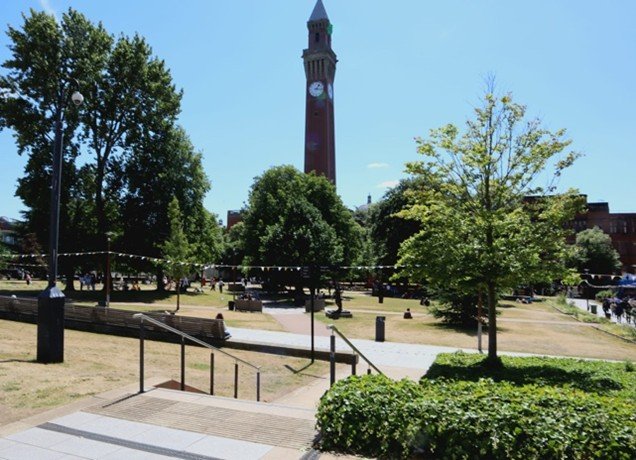
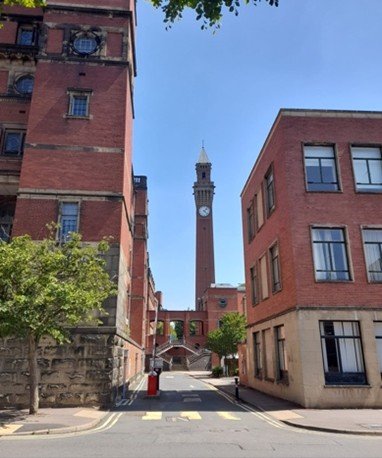
Lastly, I must mention the university's beautiful campus. Instead of the buildings being spread out across the city, the University of Birmingham has a spacious campus, where all the buildings are in one place. At its heart stands Old Joe, the university's famous clock tower. There is even a legend about it! If a student who has not yet graduated walks underneath Old Joe, while its bells are ringing, they will not graduate, so beware! During the summer, the clock tower is also home to a pair of peregrine falcons, and the university even provides a livestream where you can watch the chicks hatch and grow.
Overall, my semester at the University of Birmingham was an unforgettable experience. I made wonderful memories, met people from all over the world, improved my academic skills, and had the opportunity to explore many beautiful places across the UK. I met such kind and wonderful people there and made deep connections that feel as though they will last a life long. I would highly recommend the University of Birmingham to anyone considering spending a semester abroad.

University of Birmingham
Hannah-Lena Ripper, SS 2025
The first thing that comes to my mind whenever someone asks me about my semester at the University of Birmingham is the stunning campus and, of course, the clock tower at the centre of it, Old Joe. It is a place bustling with activity and in the warmer months, a great place to soak up some sunbeams. There are a lot of events happening on campus during the semester; personally, I really enjoyed the artisan market taking place every first Tuesday of the month. There are also events organised by the University Housing and the Guild of Students, which also offer a lot of social clubs to join. Some events or clubs that I used to go to are the free Active Residence Basketball lessons and the Crotchet Club meetings, which are also a great way to get to know other students outside of your courses. All the clubs are run by a committee of students for students, and at the beginning of the semester, they held an info event where you can check out the different clubs.
In total I took three courses worth 10 ECTS each. Each course is split into a one-hour lecture and a two-hour seminar and meets twice a week. I really liked the courses I ended up with, even though getting my schedule finalised was a bit stressful. I’d recommend not getting your heart set too much on specific courses since they shuffle them around quite a bit, but the staff is really helpful and won’t mind helping you sort any mix-ups or try to sign you up for other courses. The first few weeks were a little taxing, as the welcome week started on the 13th of January and classes on the 20th, and I still had to finish my courses at home while starting the courses at Birmingham while also being in a new environment. All my grades were 100% dependent on a final essay, although I also met people in whose courses other assignments counted as well.
Going to university in Birmingham is completely different to going to university in Innsbruck. Living on campus has been a big part of that for me. I stayed at Tennis Court in a flat with four other exchange students. Everyone had their own bedroom, but the kitchen and bathrooms were shared. At Tennis Court, we were provided with basic necessities like bedding, plates and kitchen utensils, although we still had to get some extra stuff. Living together worked pretty well, all things considered. Some of my roommates were hardly ever home since they spent a lot of time travelling Europe, being from the Americas, and for many of them it was their first time in Europe. Other European students focused more on travelling in the UK, as did I. Birmingham is in a good location for travelling; by train it takes about one and a half to two and a half hours to reach London and about four hours in the other direction to reach Edinburgh. I also had quite some time off, so I was able to travel a lot. I visited London, Brighton, Edinburgh, Glasgow, Liverpool and more. Once I even took a three-hour ferry from Holyhead to Dublin and travelled around Ireland to visit a friend doing Erasmus there.
I can really recommend doing an Erasmus semester in Birmingham as I had a great time there. The courses and campus life at the University of Birmingham were a great experience and I’m grateful for the opportunity to get to know so many people from different places and to discover Birmingham and the UK with them.
University of Birmingham
Katharina Gruss, SS 2024
There’s something magical about stepping into the unknown—an adventure that begins the moment you pack your bags, leaving behind the familiar to embrace the unexpected. Living in the UK had always been a dream of mine, and being accepted for this exchange was a delightful surprise because I was in the lucky position of doing a second exchange. A year ago, I had the chance to live in Jerusalem, Israel, where I became best friends with a girl from... (drum roll, please)... Birmingham! So, while moving to the UK had its share of unknowns, it also felt a bit like coming home—because I had already forged deep friendships with people from ‘Brum’ (as Birmingham is also called).
Administrative Process
As most former exchange students will tell you, the administrative process is always more time-consuming and challenging than it initially seems. That said, everyone working both in Innsbruck and Birmingham is incredibly open-hearted and always ready to help. If you have any questions, the offices at UOB (incoming-europeanexchange@contacts.bham.ac.uk) or UIBK (international-relations@uibk.ac.at) are more than happy to assist.
In terms of organizing my housing, this might not be very helpful for you because, due to my connections, I lived with a couple of friends off-campus, which strongly influenced my exchange experience. I lived in Harborne, a decent area with the wonderful Grove Park at my doorstep.
Studying at UOB
My first day at the University of Birmingham (UOB) kicked off with a welcome fair, an excellent way to meet other international students and get organized. It was on this first day that I truly fell in love with UOB—who wouldn’t, after meeting Old Joe J, exploring the impressive Uni gym, or discovering the 24/7-open library?
The academic system at UOB differs from Innsbruck in terms of credits: 20 UOB credits are equivalent to 10 ECTS, so to fulfil the 30 ECTS requirement, you need to take three courses. As a teacher training student for English and Religious Education (Catholic) at Innsbruck, I chose courses that aligned with my studies and were called: “Fundamentals of Language: Grammar and Discourse,” “American Literature and Culture,” and “God, Freedom, and the Meaning of Life.”
At UOB attendance is compulsory, and students are responsible for tracking their attendance through the UOB app— a system I found to be very professional. Courses normally consist of a one-hour lecture and a two-hour seminar each week, adding up to roughly nine “contact hours”. One might ask how these few hours can cover the workload of 30 ECTS. The answer is simple: a lot of self-study. In my eyes, this encourages critical thinking and self-responsibility, which I found refreshing and enriching.
Assessments were primarily essay-based, often requiring students to go beyond the material covered in lectures. I appreciated how UOB handled grading anonymously, with submissions identified only by student numbers. Another highlight was the vibrant array of societies—like the Tea Society, Yoga Society, Hiking Society, and Baking Society— each offering a unique opportunity to broaden one’s horizon. The larger societies even hosted one-week festivals in front of Old Joe, providing free food and talks.
In general, I had a sense that UOB was aware of the proximity to the Universities in Oxford and Cambridge, which led to high-quality teaching and professional performance.
What to do in Brum?
Beyond academics, Birmingham has much to offer, from a lively nightlife with many great pubs, museums and lovely green spaces – you will never get bored. I highly recommend spending some time in the nearby hills and woods. On my second day, I bought a second-hand bike, which made getting around the city, exploring nature, and commuting to campus both convenient and enjoyable.
I also started volunteering with “Let’s Feed Brum,” a local charity that provides food and clothing to the homeless. Whether you join through the “End-Poverty Society” at UOB or reach out to the charity directly, they’re always looking for volunteers. I loved doing it, because their main focus was on building a relationship with the people, and the warm food and drink were only a way to get in contact. Many enriching conversations happened on the streets of Brum and besides that, it was a free listening exercise with challenging accents J.
Living with friends had a profound impact on my experience, and something unique happened because I nearly only became friends with people from the UK. During my first exchange in Israel, I also lived in student accommodation and made friends with people from all over the world, however, this time my dear friend, whom I met in Israel, introduced me to all of her friends, who then also became my friends. This summer many of them visited me in Austria, and we have already made plans for next summer. I am in the lucky position to say I have made friends for life.
Conclusion
Looking back, my time in Birmingham was much more than just an academic journey—it was a personal adventure filled with warmth, discovery, and unforgettable friendships. The vibrant campus life, the welcoming community, and the city itself all contributed to an experience that exceeded my expectations. Birmingham felt like a second home to me, a place where I grew both academically and personally. If you're thinking about studying abroad, I wholeheartedly recommend Birmingham. It’s a city full of opportunities, cultural experiences, and for me, lasting memories that will stay with me forever.

A semester abroad at the University of Birmingham
Marco Kreutner, WS 2023/24
Studying abroad can be a daunting prospect, but have you ever heard someone who did a semester abroad with the Erasmus+ programme speak negatively about their experience? If you are a person who loves travelling and has always wanted to experience life in different places, I likely will not need to convince you to submit your application. On the other hand, if you are a person that is, just like I was, not quite sold yet on whether it is a good idea to commit oneself to an adventure of such a sizeable scale, ask yourself the question I posed at the beginning. My experience was no different to the ones I had heard and read of and confirmed to me that stepping out of one´s comfort zone by studying abroad is a valuable experience that can be beneficial in various aspects of life, so set your doubts aside and simply go for it. With that out of the way I´d now like to focus more on what life at UOB is like and share what I think can be helpful for you ahead of your journey.
Administrative processes
To begin with, just some quick words on administrative matters. As far as signing up at UOB is concerned, just keep a close eye on your emails and do exactly what is asked of you. You will be guided step by step and receive all information you need, and I highly recommend checking out some of the websites that will be advertised in order to be as prepared as you can. Should you at any point have any questions you can always email incoming-europeanexchange@contacts.bham.ac.uk, but only do so if you feel it is absolutely necessary as they get peppered with emails (meaning you may not get an answer in weeks). One thing I do want to specifically point out is that you want to be quick when selecting your room (if you live on campus, which I personally think you should 😊) as it kind of is a first come first served principle. To do that, just be aware of times and dates and keep an eye on the student accommodation website (which you will be familiar with at that point) to see if you can already book a room. https://studentaccommodation.bham.ac.uk/StarRezPortalX/Login
Also, download the “My UOB” app and log in with your UOB credentials as soon as you can to familiarize yourself with the app and to not miss out on emails that you may at this point already be receiving here. The app has a bunch of different functions, but the main ones you´re going to be using are the timetable and “my attendance” where you need to enter an attendance code which you will be given for each session of your modules. If you fail to do so your attendance will not be captured, so make sure to get that code (this can also be done after a session has already finished). I personally find that system quite weird and soon got tired of 5 people asking for the attendance code each session. It can also quite easily be exploited, but I´ll leave that to you to find and test out.
Accommodation
In terms of accommodation, I can only talk about the options on campus. As already hinted, I can only recommend to make use of the student living offers at UOB, not least because as an exchange student you are guaranteed a room! If you´d rather choose something private you can of course do that as well. The process of booking your room on campus is quite straightforward – you´ll get all the necessary information and there will also be dedicated zoom meetings where you´ll get a presentation and can ask questions. In contrast to the process of booking itself, actually choosing what room will fit you best can be quite tricky, so let me try to roughly explain what your options are. There are three university owned student villages called “The Vale”, “Pritchatts Park” and “Selly Oak”.
I personally lived on The Vale, which is the greenest out of the three and even has its own lake. This is where most freshers (first year students) live. It has lots of different housing options to choose from, ranging from “Tennis Court” which is generally cheaper and less modern, to “Chamberlain” which is a 20-storey tower built not too long ago. The biggest downside to the Vale is that it is the furthest walk to campus (about 10 to 20 minutes depending on where exactly you live, want to go and how fast you walk) and that it only has one small shop (Costcutter) which is quite pricey.
Pritchatts Park is the one I can say least about as I only ever went there around a handful of times for the “Metchley” sports pitches. It is quite a bit smaller than the Vale and the walk to campus is about 10 minutes, so about as long as it would take you from the closest housing option on the Vale, which is Tennis Court. It is also not as green as the Vale and there is definitely the least going on (in terms of community) at Pritchatts, which is down to it being by far the smallest of the villages. As far as I know there are also no shops.
Finally, there is Selly Oak which is located south from campus (the others are north) and is by far the most urban – imagine it as a sort of suburb of Birmingham. Thus, the number one argument for Selly Oak is that it contains plenty of shops, restaurants, pubs and so on, while at the same time being only about 5 minutes from campus. Just like the Vale, Selly Oak also has a thriving community and due to its proximity to all the facilities is for sure the most convenient place to live. It is also the place where most second year or above students live. Selly Oak´s biggest flaw is that it´s not visually appealing as it is quite dirty with lots rubbish on the streets, so it really is a rather nasty place in that regard.
When it comes to the flats themselves, one of the main decisions you will have to make is if you want an en-suite or if you are okay with sharing a bathroom with (usually) four others. You can also choose a meal plan (aka student living plus) with which you will get around 250 pounds onto your student ID card for you to spend at various restaurants and at a huge cafeteria at Shakleton on the Vale called Infusion, which serves great value for money meals for dinner. Generally, the more expensive your flat is the more modern it will be. On the Vale, for example, flats in Chamberlain tower or in Mason will generally be more modern than those in Maple Bank or Tennis Court, and that is reflected in their costs. The cheapest flats, which I believe are those in Maple Bank (Vale), will cost you about 100 pounds per week. If you want something on the Vale with a bit more comfort and a lot closer (5-8 minutes less walking) to campus I can only recommend staying at Tennis court for about 140 pounds per week (as advertised online, there should be cheaper ones as well). Flats in Chamberlain are advertised at about 200 pounds a week, and so are most options in Selly Oak, so if you want something on the cheaper end, the Vale is the place for you. Laundrettes are nearby for any accommodation.
I lived in a mixed sex, shared bathroom apartment in Tennis Court with four others and we, to my surprise, had no issues whatsoever in sharing our bathroom, which may have also been a lucky coincidence as we all seemed to shower and brush our teeth at different times. What also helped was that there were two toilets, one in our main bathroom and one in its own dedicated room. My flatmates were all international students, which I was a bit sceptical about at the beginning as my plan was to expose myself to as much “Englishness” as possible. In the end, at least in terms of language I kind of got the best out of both worlds as two of my flatmates were from Australia, with the other two coming from Italy and Ecuador. Two important aspects to consider when choosing if you want to live with international or English students are age and cleanliness. The vast majority, if not all the English students will start their studies at 18 or 19 years of age, whereas in Austria the average age is without a doubt a bit higher. That can result in quite significant age gaps so keep in mind whether you think that may be a problem for you, depending on your own age. That also ties into the aspect of cleanliness. Though I do feel like people in England are more mature at 18 than they are in Austria, keeping their flats tidy does not seem to be a strength of theirs. This will obviously depend on luck as you can also get international flatmates that are super lazy or vice versa, but generally I found all-international flats to be a lot less of a mess then the all-English flats. You will be able to see a short bio of people that have already booked a room in potential flats of interest during your process of booking. If you book early you will of course not be able to influence who you´re staying with as you may be the first one to book a room in a certain flat. Nevertheless, being early is, for obvious reasons, still a good idea, but keep that in mind.
As far as shopping is concerned, if you don´t live in Selly Oak you can of course go to the Costcutter at Shakleton at the centre of the Vale for groceries you urgently need like milk or bread. For proper shopping, however, I do recommend making your way to Selly Oak every now and then with a big shopping bag to do your proper shopping at Aldi, (which is said to be the cheapest) Sainsbury´s, etc. You can also do online shopping and order your groceries straight to your door, as one of my flatmates did every now and then. This will of course be more expensive and you won´t have the full range to choose from.
For more information on accommodation you can check out UOB´s YouTube channel, their website, or simply look at some pictures on Google to get a feel for how things look. Another useful tool is UOB´s campus map, on which all housing options are coloured purple: https://www.birmingham.ac.uk/contact/directions
Finally, if you have any specific requests you can drop the accommodation team a ticket for any requests – they are usually quite swift to respond as well: https://universityofbirmingham.service-now.com/living
Studying at UOB
At the University of Birmingham you will be classified as an affiliate student with the department you have chosen during the sign-up process as well as a second department with which you may also take one module. All modules (a module is what most of us would refer to as a course, whereas a course refers to the degree you are studying e.g. Lehramt, …) are worth either 20 or 10 credits, which translate to 10 or 5 ECTS, so exactly half. Generally speaking, I got the impression that at UOB and likely in all of England, studying involves a lot more independent work with less help from professors during regular sessions. You can get any help you need if you ask for it, but that will often lead to tutors advising you to come to their office hours rather than being able to work on whatever needs help during a session. Keep in mind that what I am saying is highly subjective, though, and things may be completely different depending on what course you study.
Nevertheless, let me talk you through what my academic experience was like. I was affiliated with the English literature department and had sport and exercise science as my secondary. I chose three modules for 20 credits each (so 60 credits in total ->30 ECTS) – two in English literature and one in sports. All three of them had two separate sessions of between one and two hours per week. In concrete terms, I did “Earliest English”, “Discourse Analysis” and “Introduction to Teaching and Coaching” so for any specific questions on those feel free to reach out to me. Teaching in all of them involved a lot of reading we had to do outside of class, with some of it being labelled “essential” and some “recommended”. In all of my modules grading was solely based on essays between 2000 and 3500 words, which I believe is not quite effective as these essays only cover a minor proportion of what is covered in class. It also means that in class teaching becomes less relevant in the context of passing a module – make of that what you want. In my sports module there was also an exam at the end of the semester, but as an international student your semester will finish before Christmas as opposed to regular students who have examinations in January (more on that later). Therefore, you will get an alternative form of assessment, which for me simply meant having to write about double the words everyone else had to write in an essay (about the same topic). The highlight of my academic experience was a four-day field trip I did with my sports module, on which we did all kinds of fun outdoor activities like kayaking or canyoning, among others. The main aim of this trip was to bond people closer together and that target has definitely been met as I met who would soon become my best friend for the remainder of my semester.
Outside of the academic world
Now onto what a semester abroad is really all about, which is the spent away from uni. Making friends with international people is like a walk in the park as everybody is in the same boat. Just be open and talk to as many people as you can and you will find yourself at a flat party with dozens of “strangers” in no time. What I will say as well, though, is that bonding with English students is not always as straightforward which, in my opinion, is mainly down to two reasons. One of those is the issue of potential age gaps, as already alluded to earlier. When I was at UOB I was 24, so some students were up to six years younger than me which, as you can imagine, does at times mean that personalities simply don´t match. That does not usually happen with internationals as the majority of them is in their early 20s. The other main reason is that many English students already have established friend groups when coming to UOB, meaning they don´t necessarily need to talk to everyone to make friends. Another minor reason could be that to English people you will obviously be a foreigner, and the English seem to think very highly of their nationality. Minor language barriers, even if you study English, are to be expected as well and simply coming from another culture plays its part, too. By no means does that mean that making English friends is impossible, it´s actually quite the opposite. I just want you to be aware of what exactly may be hindering you.
This is where what I loved most about the University of Birmingham comes in: sports clubs and societies. English Universities offer the possibility to basically spend your entire time under their flag. Sure, there may be the odd sports club in Innsbruck that is related to uni, but that is nothing compared to what is on offer at a gigantic English University like the UOB. There are dozens of sports clubs to choose from, ranging from popular ones like football or rugby, to more niche ones like Gaelic Football or American Football. For societies, the landscape is even wider and there are literally hundreds on offer. Be it an exchange student society, a motorsport society, Harry Potter, Pokemon, dancing, skiing or Darts, UOB has a society for almost anything. If you do not wish to practice your favourite sport competitively, there are social forms of lots of sports, too, like social Netball, 6 a side football leagues and countless others, so there really is no reason to ever be bored. To help you decide what club or society you want to join there will be a sports fair where most clubs will be present and advertise their teams, as well as a societies fair. These, among many other student orientation events will take place in welcome week, which will be the first week you will be present and take place a week before teaching starts.
What I would recommend is that you join at the very least one sports team or society, as the people you meet there can very easily become your best friends for your time in England. It also makes making English friends a whole lot easier as you`ll have something to bond over right off the bat. In my case, I ended up joining both the Darts society as well as the universities American Football team. It was the latter that ended up significantly shaping my experience as almost all of my friends were lads that were part of the team. What trying to play a new sport at a competitive level meant as well, however, was that it consumed almost all my time, whether that was at practice, in classroom (for the sport) in the gym, at games, or at socials that bonded us closer together. I was fully aware that if I wanted to be part of the team, I had to fully commit to it and I am beyond glad that I did. That of course meant I had less time for other social activities or for travelling the country, but you don´t have to structure your experience at UOB the way I did – and that´s the beauty of it! There are unlimited options to use your time – whether you want to be physically active, go out a lot, have chill social nights at people´s flats, travel the country, … you name it.
While we´re at it, Birmingham also has a thriving nightlife, just as you´d expect from England´s second largest city and one with a very young population. It won´t be too long until you hear of clubs like Rosie´s, Snobs, Heidi´s or Pryzym, some of which are located at Birmingham´s main party location: broad street. There are, of course, countless pubs and other recreational facilities as well. If you are into raves, also keep the name Digbeth in mind, which is a part of Birmingham a bit further out from the centre of the city. Speaking of the city centre, there is a Bus stop at the Vale which will take you directly into the heart of Birmingham within 5 to 10 minutes, depending on traffic. You can also jump on at Selly Oak, of course. A bus ride costs 2 pounds and you can pay contactless via your credit card (which I highly recommend you get if you don´t yet have one), cash or pre-purchase your ticket on the NX bus app. The app also offers day saver tickets for 4,50 with which you get unlimited travel on all national express buses in the West Midlands. The university also has its own train station at the west end of campus from which you can travel to the city centre, but also to any destination in all of England. When making your way back home after a longer night, sharing an uber is of course also a convenient option and can sometimes even be cheaper than the bus.
Other useful tips
As briefly touched upon already, as an international student your winter term will end halfway through December and you will not be returning after Christmas. That means you will only get 3 months in England. Summer term is a bit longer and lasts from February until June – whether internationals leave early or not I do not know unfortunately.
If you choose a flight that lands at Birmingham International, take the monorail to the airport´s train station. From there, get on a train to Birmingham New Street and finally, hop on one last train to university station. Get tickets for your trains via the Trainline app. You could also take the bus from New Street, but with all your luggage that is a terrible idea.
As mentioned, get a credit card because paying that way evokes the smallest fees for paying in a foreign currency.
Official word is that if you show your student ID on the bus, you get a small discount. That memo has not yet reached the bus drivers, though, so don´t even bother trying. It would also mean you´d have to pay the exact amount in cash which you may not always have on you.
Don´t forget to bring or buy an umbrella, especially in winter.
In conclusion I want to say that I can only recommend the University of Birmingham to anyone looking to study abroad, especially if you want to stay in the UK or an English-speaking country in general. Not only is it an enormously large university that has something to offer for everyone, but it is also located right in the heart of England, making it an ideal starting point for any travels through the country. If you properly grasp the opportunity you have, are open, adventurous, and ready to step out of your comfort zone, there will be nothing to prevent you from having an unforgettable time.
Should you have any specific questions, you can also reach out to me personally.
