
Manchester
Gloria Buchner, WS 2025/26
I spent a semester in Manchester as an Erasmus student and it was honestly one of the most amazing experiences of my life.
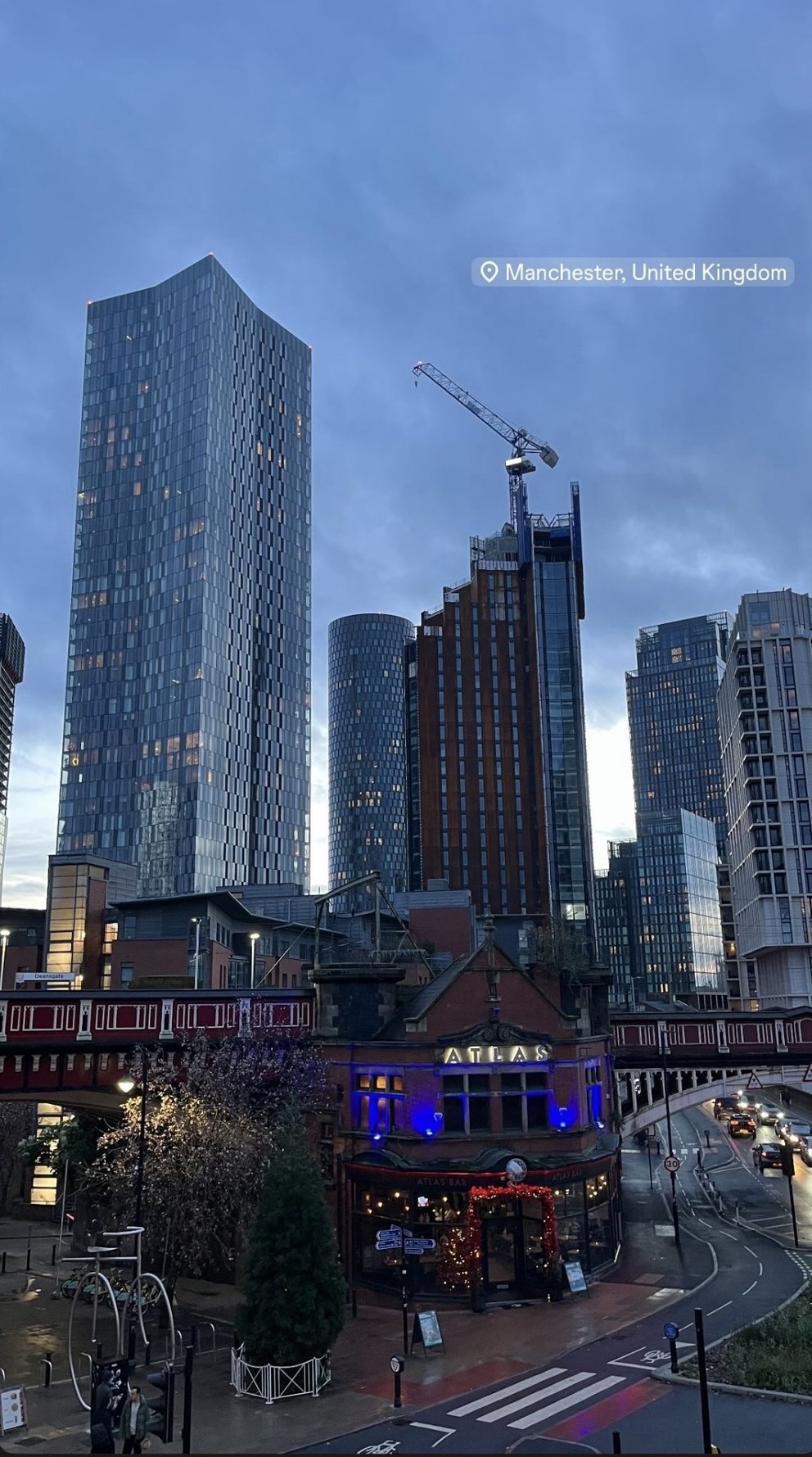
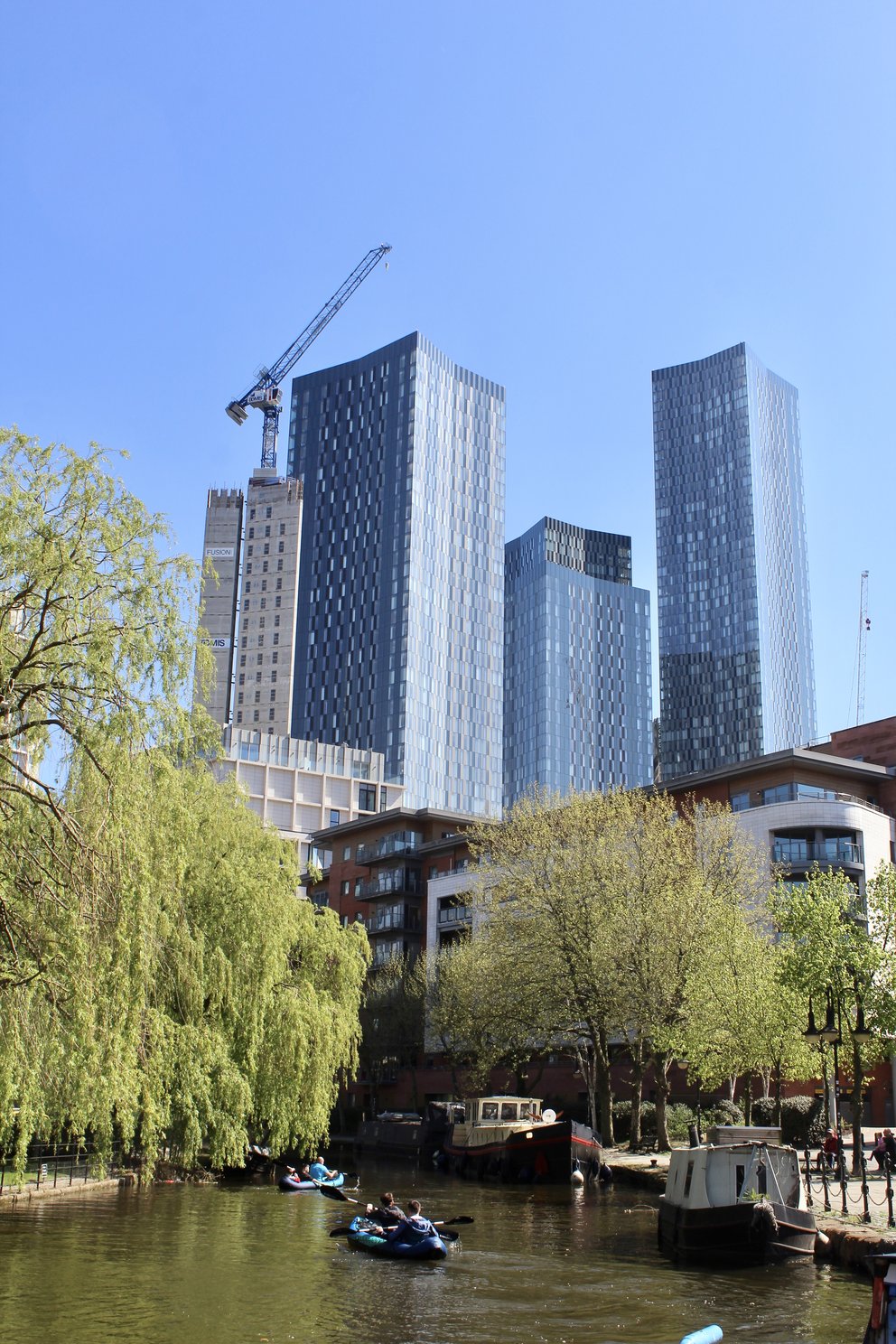
Manchester is such a vibrant and exciting city. Even though it’s bigger than Innsbruck, it’s very easy to get around. After a few days, I felt completely at home. I loved exploring the different neighbourhoods such as Deansgate and Castlefield with their modern skyscrapers and canals. But my favourite part of the city was the Northern Quarter, which has a really creative and alternative vibe with street art, independent shops and cafés. I really think Manchester has something for everyone.
I loved walking around the city on nice days and just soaking up the vibe of Manchester. The city is very walkable, so exploring different areas by foot on a sunny day was always fun. Of course, sometimes the classic UK rain and clouds appeared, but a good umbrella and a rain jacket usually helped. Otherwise, I could easily take the bus, because the so-called bee network is very reliable and the connections are excellent. Buses and bikes made getting around easy, which was great even on rainy days.
Manchester is also very well connected to other cities and regions, which made day trips so easy. I visited York, Liverpool, London, Edinburgh, the lake district and the Peak District, which is only about 40 minutes away by train. Hiking there was beautiful, and after walks we could stop in cosy pubs or cafés for a Sunday roast or coffee.
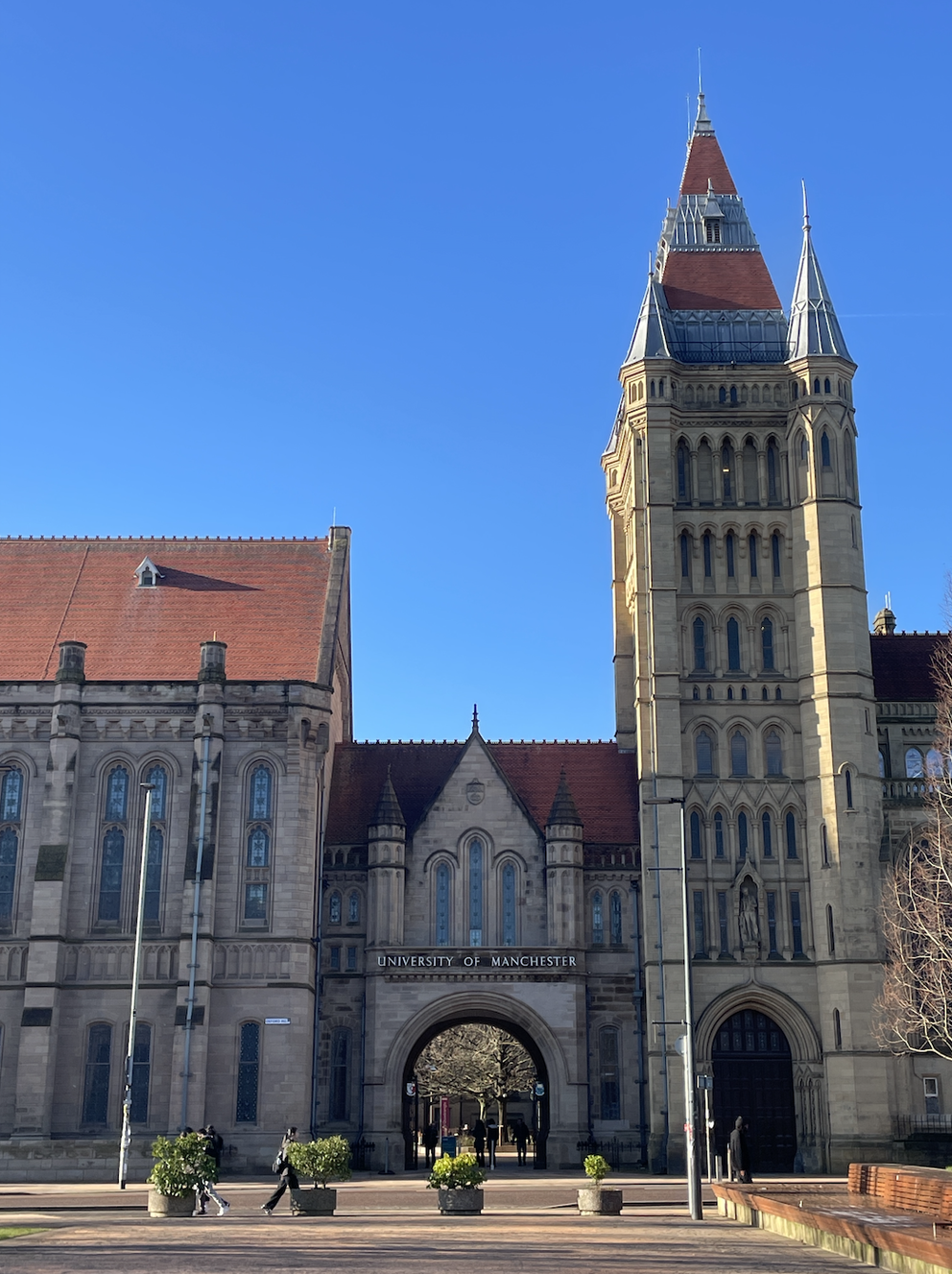
At university, I took some interesting courses. I had a linguistics course and a rhetoric course, which was my absolute favourite. I loved the lecturer, and the seminar sessions were so engaging and interactive. I also took “English for Academic Purposes,” which I really enjoyed. The courses were challenging at times, but also so fun that I looked forward to every class. The campus itself is nice, all the buildings are close together, which makes it feel like a little university district. The old main building is beautiful and reminded me of Harry Potter. There’s a café inside where you can sit surrounded by bookshelves and look through colourful windows onto the campus while enjoying a traditional English afternoon tea.
I lived in the catered hall Dalton-Ellis Hall, which I absolutely loved. The dining hall staff were so friendly and welcoming. I met my closest friends there, and our group was very diverse, with both British and Erasmus students from all over the world. The Res Life team at Dalton-Ellis was amazing, too. They invited us twice during the semester for one-on-one chats to see how we were settling in, and they organised lots of events like movie nights, craft evenings, quizzes, and day trips. They were always approachable, helpful, and very kind, which made settling in so much easier.
The University societies were another highlight. There’s truly something for everyone – sports, theatre, music, international societies, and many more. I joined a dance society, which had weekly training sessions and social activities. Being part of the group really helped me feel at home and gave me a strong sense of community.
At the end of my stay, I was so sad that the semester was over. Time flew by so quickly! I had such an amazing time with wonderful people. Erasmus can feel overwhelming at the beginning, the bureaucracy, organisation, and being away from home for so long can feel intimidating, but I am so grateful I got the chance to do it. It was truly a once-in-a-lifetime experience, and I would recommend it to anyone. Especially to do a semester abroad in Manchester!
Manchester
Anna Mayr, SS 2025
I arrived in Manchester on a grey, cold January day, feeling unsure and slightly overwhelmed. As it turned out, those five months flew by, and I am not exaggerating when I say that I had the best time possible and Manchester became my second home.
Going to university and living in Manchester
I thoroughly enjoyed going to university. The lecturers were very friendly and enthusiastic, the course content was engaging, and the small seminars made it easy to connect with other students. I had fewer classes, between 45 and 90 minutes a day, with more time for self-study than in Innsbruck. The summer term lasted for twelve weeks, with a three-week Easter break.
As a British and American Studies student, I took three courses worth a total of 30 ECTS credits:
Victorian Rights and Victorian Wrongs, which involved producing a podcast episode on the life of Elizabeth Gaskell and writing a 2,000-word final essay, History of English, which included a midterm and final open-book exam, and lastly, Gender, Sexuality and Bodies in Modern Japan, which required a creative project and another 2,000-word final essay. The workload was not too demanding, and I had plenty of time to explore Manchester. One of my highlights of student life was the wide range of free sports classes offered by the university every day. From yoga and pilates to women’s futsal, field hockey, “stretch and unwind” sessions, and even pickleball – the atmosphere was always welcoming, and I loved going there with my friends or by myself. The university also offers a wide range of societies; I joined the yoga society, which also made it really easy to connect with like-minded people.
Manchester itself is, in many ways, the complete opposite of Innsbruck. It is the UK’s third-largest city, and it has lots of skyscrapers and is bustling with cafés, restaurants, bars, and clubs. I particularly loved spending my time in the Northern Quarter, with its red-brick buildings, young people and good vibes. Manchester campus is also much bigger than the one in Innsbruck, with plenty of spaces to study, cosy cafés and beautiful historic buildings. Additionally, Manchester is quite flat, and the tallest peak is Kinder Scout with 636 metres in the nearby Peak District.
Catered Accommodation
My student accommodation, Dalton-Ellis, provided breakfast and dinner. Although I was initially wary of eating dining hall food twice a day for nearly five months, choosing catered accommodation turned out to be the best decision I could have made. The meals were decent and sometimes even delicious, there was always enough fruit and vegetables to get your vitamins, and you could drink as much tea as you liked.
More importantly, eating in the dining hall meant sharing meals with people from all over the world – Chile, Australia, the US, Denmark, Italy, Spain, Japan. One of my biggest fears before arriving was not making any good friends. Ironically, it turned out to be the easiest part of my stay, and the shared meals became my favourite part of the day.
Free time and exploring the UK
In my spare time, my friends and I often did day trips, for example to Sheffield, Birmingham, Liverpool, Newcastle, York, or we spent a few days in London. Hiking together in the Peak District was also much fun.
If I could change one thing, it’d be getting a bike: With unreliable buses costing £2 per ride, I ended up walking almost everywhere, reaching a for me unprecedented 20,000 steps a day. What surprised me was the weather: Before coming to Manchester, I invested in a high-quality raincoat, bracing myself for constant downpours – I had to wear it about fifteen times. By April, it was so warm and sunny that I could wear my skirts and dresses (although the locals I met kept stressing that this was not typical for their famously rainy city).
A life-changing experience
Most of all, I never expected to have such an amazing time. Saying goodbye to my life in Manchester after five months was very heartbreaking, but it again showed me how grateful I am to have made such beautiful memories and friendships. Going on exchange has been one of the best decisions of my life and completely changed the way I look at the world - as cliché as it may sound. Living in the UK for five months and speaking English every single day has also drastically improved my language skills and confidence to speak English, while also making me realise once again, how much I like the British culture I have already learned so much about in my studies. If you’re considering applying for Erasmus+ and doing an exchange, I wholeheartedly recommend it – and make sure to get a catered accommodation, as it changed everything for me!
As a side note: I was rejected the first time I applied for the exchange. Don’t let that stop you from trying again – I’ll be forever grateful that I did!
Image 1: A view that never gets old: The historic building of the University of Manchester
Image 2: Skyscrapers and the Bridgewater Canal in Castlefield
Manchester
Jonas Oberparleitner, WS 2024/25
When I looked at the Erasmus+ partner universities in our department, the University of Manchester immediately caught my eye. The initial appeal was largely due to relatives having studied there, but a closer look at the reputation and merits of their language programmes finalised my decision, and the semester proved me right in my choice.
Long established and well-attended, the University offers a large selection of courses in our field and related subjects – some of which are sure to interest you. I myself attended classes in literature, applied linguistics and rhetoric and enjoyed them immensely. A large amount of study spaces (most found within a specified building open 24/7) also ensure that one is seldom left in want of a table, socket, and chair to study in comfort – without having to leave the Uni Campus. And those students that are not satisfied with merely visiting their assigned courses and doing their coursework, can enjoy the offer of topical discussions, faculty or department organised lectures and readings, and more – depending on topic very recommended.
Besides the large pool of courses offered, Manchester also boasts a range of extracurriculars, clubs and societies – most organised through the student union. Not only are these a great way to meet local students and find a social base but they also represent an affordable way to try out new hobbies and sports and are easily accessible through the Student’s Union website. While many societies may come at a cost ranging from cheap to affordable, some are completely free of charge and with an offer of hundreds there is plenty to do. Most societies hold taster sessions at the beginning of the semester, which I recommend you use to try out anything you are interested in – in the end I tried my hand at fencing and joined some writing and dancing courses for the entirety of the semester. If all else fails and one finds themselves too bored, the university museum is free of charge and there are nice benches surrounding the dinosaur bones collection.
Living in the University dorms really does enhance the experienced. Having spent my time in Dalton-Ellis Hall, I benefited greatly from the events organised by the residence staff to make early contacts, find my feet in the city and simply learn my way around. The international nature of the university and the resulting diversity in the halls of residence also ensures that you fit in seamlessly and have no problem finding a wide range of characters, some of whom are sure to become good friends. The halls of residence provide a real space for socialising, and I count myself lucky to have made friendships that are sure to last longer than my semester.
Situated quite centrally on the Great British Isle (confusingly in the south of North-West England) and well connected to the train networks, Manchester and its main station are ideal for weekend excursions - either self-planned or organised by the Student Union. London, Edinburgh or smaller cities such as Leeds are within easy reach and allow you to use your semester abroad as a chance to get to know England. This more than makes up for Manchester's limited number of attractions.
All in all, I hope that my experience will help to make the decision easier for prospective exchange students, and I can only end my report by urging anyone who is thinking of applying for an exchange to do so. It is a truly rewarding experience. And if you do decide to go - why not Manchester? It is truly an unforgettable destination.