
Open source coffee ecosystem
Funding: Tyrolean innovation funding - cooperation projects
Funding period: 01/2026 - 12/2027
Project partner:
- Datum Coffee OG, Innsbruck: Development of coffee machine, grinder and digital platform
- University of Innsbruck, Department of Infrastructure, AB Environmental Engineering: Scientific evaluation and life cycle assessment
- Maschinenbau Grissemann GmbH: Support with prototyping and production
Project description:
The project pursues the goal of rethinking coffee preparation in the private and semi-professional sector and combining ecological sustainability, high coffee quality and ease of use. The starting point is the observation that today's coffee machines are energy-intensive to produce and at the same time have short lifetimes due to a lack of repairability. Longer-lasting coffee machines, on the other hand, are characterised by complex operation with high entry barriers.
At the same time, the volume of old electrical appliances is continuously increasing, while functioning components are often lost and are rarely returned to existing cycles.
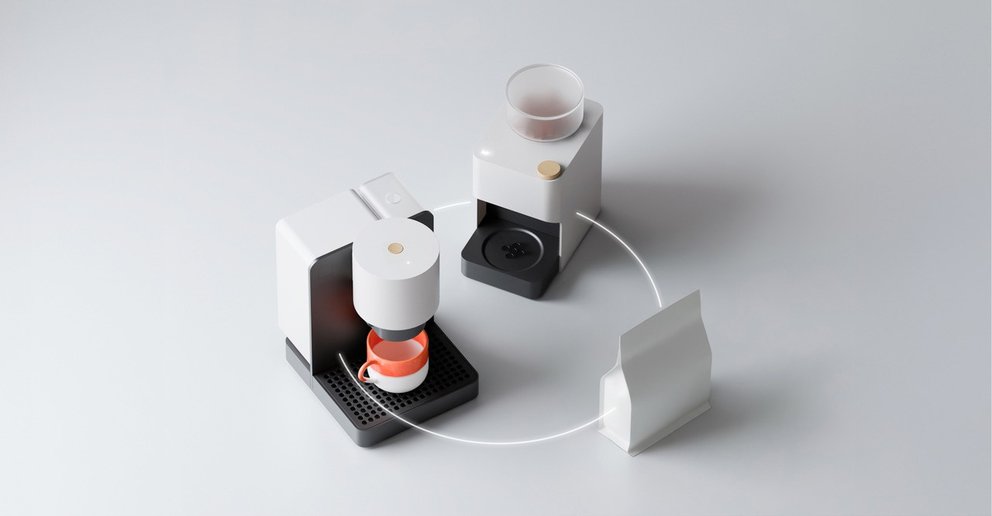
The project centres on the development of a modular coffee machine as part of an open, digital ecosystem. The aim is to link software and hardware to ensure consistent coffee quality while minimising coffee waste. The machine will be complemented by a matching coffee grinder and a digital platform that will be opened up to other manufacturers in the long term.
The technical development follows the principles of the circular economy. Modularity, dismantlability, reparability and a reduction in the variety of materials are already taken into account during the design process. A particularly energy-efficient brewing group with continuous flow heating significantly reduces power consumption compared to conventional systems and enables immediate readiness for use without long heat-up times. At the same time, the use of materials is reduced through compact design, simple assemblies and the elimination of unnecessary electronics.
In addition to product development, new business and service concepts are being investigated, including take-back systems, refurbishment strategies and deposit and rental models. The aim is to continue using appliances and high-quality components economically over several utilisation cycles and to significantly reduce the need for primary raw materials. This should increasingly decouple the economic success of the product from material consumption.
An interdisciplinary consortium from product development, manufacturing and research is working closely together on the project. The University of Innsbruck is responsible for the scientific evaluation of the ecological impact of the product system and the planned take-back concepts. For example, life cycle assessment analyses are carried out along the entire life cycle in order to support design, material and process decisions and to quantify the desired environmental impact.
Contact:
University of Innsbruck
Dipl.-Ing. Julika Knapp
Technikerstrasse 13
6020 Innsbruck
julika.knapp@uibk.ac.at