
Research
Conservation
Restoration and conservation measures are an integral part of every excavation project in order to protect the artefacts found from further deterioration. This includes all types and materials. Some of the extraordinary findings from Ascoli include wide Bronze belt, on which it was possible to observe and precisely document the remains of fabric and fur that were still adhering thanks to careful cleaning and treatment.


Geomagnetics
As part of the more recent investigations, the area around the already opened excavation area was also geomagnetically prospected over a large area in 2019. The image obtained with this non-invasive technique of other structures that could possibly be expected and are still hidden in the ground revealed further, widely scattered features that could include both buildings and burial structures.


Neutron Activation Analysis (NAA)
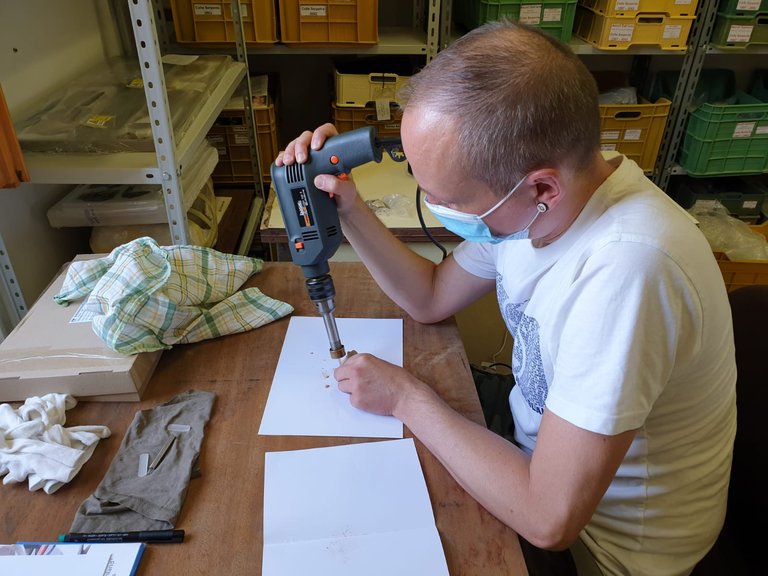
Sampling of ceramics as part of Neutron activation analysis (NAA). The NAA is considered one of the most reliable methods for determining the chemical origin and measures the concentrations of up to 30 elements, including many trace and minor elements. The elemental composition of pottery clay depends both on the composition of the raw clay used and on its preparation in the workshops. The elemental composition of the actually processed clay mass is decisive for determining its origin and allows supraregional comparisons. As the clay masses usually differ from place to place, it is assumed that vessels with the same elemental composition originate from the same production site. It is therefore possible to identify and localise the chemical fingerprint of a specific production site by taking suitable reference material. This part of the research in Ascoli is embedded in the larger project "Local pottery reactions" by E. Kistler (Innsbruck) and the sampling carried out by Kai Riehle (Innsbruck/Tübingen).
Project partner NAA: Dr Kai Riehle (Innsbruck/Tübingen)

Archaeobotany
Archaeobotanical samples are taken from selected features in order to reconstruct the ancient way of life, economy and diet. Archaeobotany is concerned with plant nutrition, insofar as ancient plant remains are found during excavations. Plant remains are only preserved under special conditions: no influence of oxygen, as in wet soil preservations, in dry soil preservations the preservation of the remains takes place through faeces, metals, salt, ice, dehydration etc. or through charring. In the latter case, the organic material is converted into charcoal while preserving the original structures, allowing the plant species to be identified. Dry soil preservation with charred remains and wet soil preservation occur most frequently. Most of the plant remains are seeds or fruits as well as wood, which are analysed by specialists. The identification is carried out by comparison with modern material, as the structures do not change over the millennia.
Project partner Archaeobotany: Dr Marlies Klee (Freiburg)


Anthropology and DNA
Through the systematic anthropological identification of the bones from the graves found, data can be obtained on the age, sex and state of health of the buried individuals. In conjunction with the associated grave goods, this in turn forms the basis for analysing social contexts. Genetic analyses can provide information about possible family connections of the dead, especially in the case of the frequently observed reburial of the same grave in Ascoli.
The anthropological investigations are carried out by the company AnthroArch, Gbr (Munich), the genetic analyses by Lundbeck Centre.
Stylistic and typological ceramic analysis
The pottery material recovered during the excavations forms the most frequent and informative group of finds. In order to determine the different vessel shapes and types of wares, these must be laid out, documented (photographed and drawn) and subjected to a stylistic and typological analysis. On this basis, insights can be gained into local food and cult practices as well as the extensive trade relations of the local population.

