
New research in Ascoli Satriano

The site and its cultural context
Ascoli Satriano is a municipality in Apulia, approx. 30 km south of the current provincial capital of Foggia, the successor to the ancient centre of Arpi. In ancient times, the site was known as Asculum or Ausculum. The settlement hill forms one of the last south-eastern foothills of the Apennines in this region; to the east, the land descends to the North Apulian plain, which extends to the Adriatic Sea in the west and south. In classical antiquity, the site is known from written sources primarily as one of the sites of Rome's conflicts with the Molossian king Pyrrhus of Epirus. Its exact location is not entirely clear, but it was probably in the area of the nearby meandering Carapelle river. These battles at the beginning of the 3rd century BC, which were victorious but costly for Pyrrhus, led to the popular expression "Pyrrhic victory".

However, the area of Ascoli Satriano was already a settlement site of regional and supra-regional importance well before these events. While few prehistoric findings are known to date, from the Iron Age onwards, especially from the 7th BC onwards, a not inconsiderable presence of ancient Italic populations can be documented archaeologically in the form of settlement traces, but especially in the form of graves. These inhabitants of what is now northern Apulia are referred to in Greek and Roman written sources as "Daunians", who, according to one of the (certainly late-constructed) traditions, were descended from the mythical King Daunos, who is said to have ruled here at the time of the Trojan War.
The archaeological finds from the settlement area of "Daunian" northern Apulia show some particularly characteristic types of finds: One is the so-called "daunian" stelae made in archaic times (7th - 5th century BC): highly rectangular stone slabs in abstract anthropomorphic form depicting human figures with rich costume and armour. They are a unique testimony to indigenous iconography and testify to the high cultural and artistic level of the inhabitants of this relatively unexplored region. The ceramic products of the area also bear witness to the high level of technical and craft skills as well as the special 'taste' of its inhabitants. They are characterised by typical regional vessels, such as olla (large, bulbous storage vessel), attingitoio (shallow bowl with a high, sometimes sculptured handle) and askos (bag-shaped pouring vessel with one or two spouts), which differ in their design from other surrounding ceramic traditions. The vessels, fired from light-coloured clay, are covered with fine dark brown, and from the 7th/6th century BC also two-coloured (red and dark brown) geometric patterns. Simple geometric bird (?) figures are also characteristic and frequent for this style of pottery. With a few stylistic modifications (in the 4th century BC, for example, horizontal floral bands became a popular decoration, largely replacing the geometric patterns), the production of regional pottery continued into the 3rd/2nd century BC - longer than in all other southern Italian regions, where Italic pottery products were replaced by Greek-style pottery much earlier.
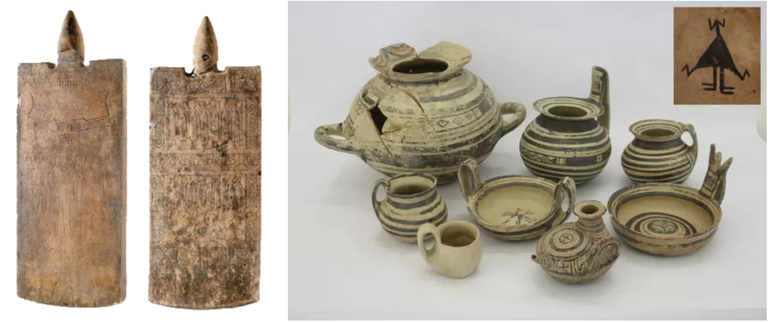
This traditionalism may be due to the fact that there were no Greek settlements (apoikia or so-called 'colonies') on the Adriatic coast of Apulia, as documented in other places in southern Italy and Sicily since the 8th century BC. It is precisely this regional independence that makes northern Apulia a particularly interesting area of research - a region that was only indirectly exposed to Greek influence from the 7th century onwards, but certainly had knowledge of and relations with the new arrivals of the city-states in the Ionian Gulf (e.g. Taranto, Metapont) and also selectively integrated their material goods (e.g. pottery) into its own living environment. From the late 4th and 3rd centuries BC, the region was then the scene of conflicts between the western Greek coastal cities, the northern Greek (Epirotic-Macedonian) kings allied with them and their armies, and the rising power of Rome, which extended its sphere of influence to the entire Italic peninsula.
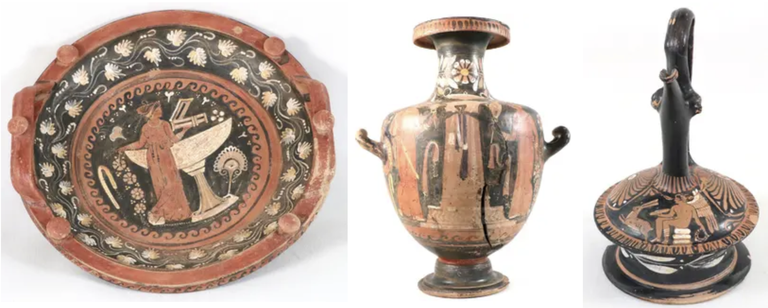
From the 4th century BC in particular, somewhat later than in the areas close to the Greek foundations, Greek-style pottery was also produced in northern Apulia and integrated into the indigenous way of life and, above all, funerary culture to a much greater extent than before. Workshops in places such as nearby Canosa and in Ascoli Satriano itself now produced vases richly decorated with figures in the red-figure style, which were deposited in the tombs of the local elite and demonstrated their penchant for luxurious funerary rituals.
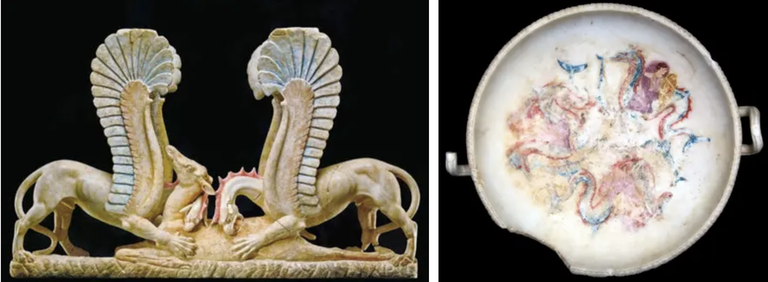
However, the most impressive testimony to local funerary luxury of the 4th/3rd century BC is an ensemble of monumental stone objects from a tomb in the Ascolis area that was looted by grave robbers and therefore cannot be located with certainty. On these marble objects (several vases, a basin and, above all, a table base in the shape of two griffins tearing a hind), numerous traces of painting are also well preserved, which attest to the colourfulness of these ancient objects, most of which have been lost today.
In the field of tension of scientific research into these different cultural influences, the element of the Italic population of the area long fell out of focus in favour of the protagonists (Greeks and Romans), who are also much better known from the ancient written sources. As a result, little is known about the ancient indigenous inhabitants of northern Apulia apart from the aforementioned material remains and handicraft products; their way of life and economy, their religious beliefs and their social organisation are still largely in the dark, which makes the scientific study of them all the more fruitful.
The older Innsbruck research
The Innsbruck research in Ascoli Satriano is focussing on the pre-Roman settlement traces of the site. It began in 1997 and was led by Dr Astrid Larcher until 2015. The investigations in the years up to 2002 concentrated on the so-called Colle Serpente - one of the hills on which the current village area is located and which has also been home to an archaeological park since 1995. Here, together with Italian colleagues, burial and settlement remains from the 6th to 4th century BC were uncovered (more detailed information at this link to the old homepage/Web presence of the older investigations up to 2015).
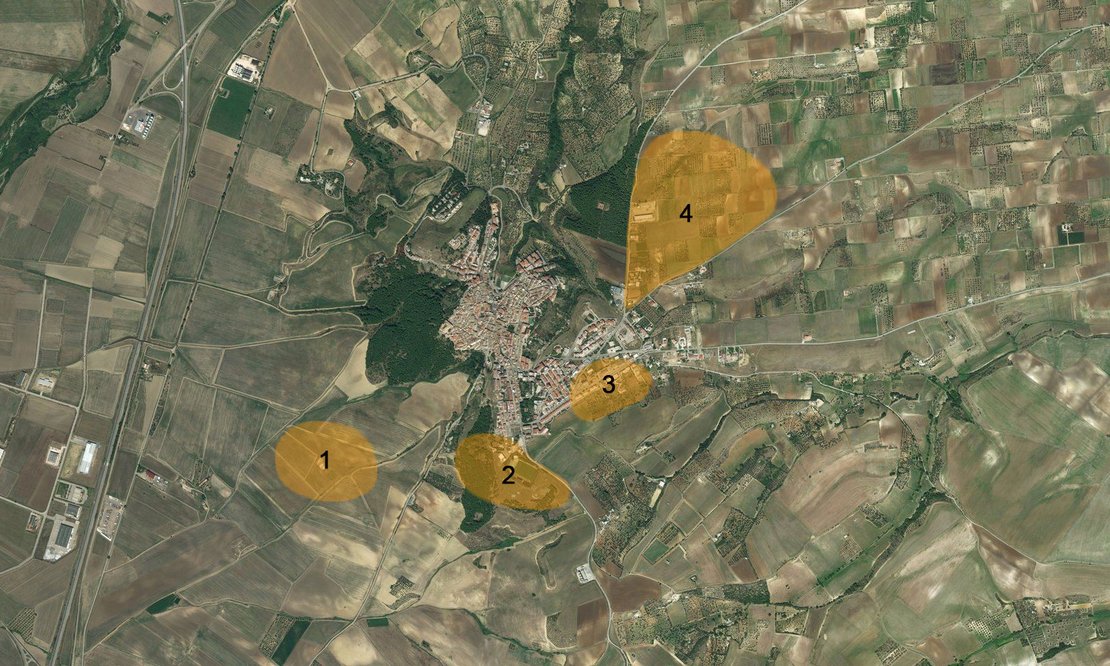
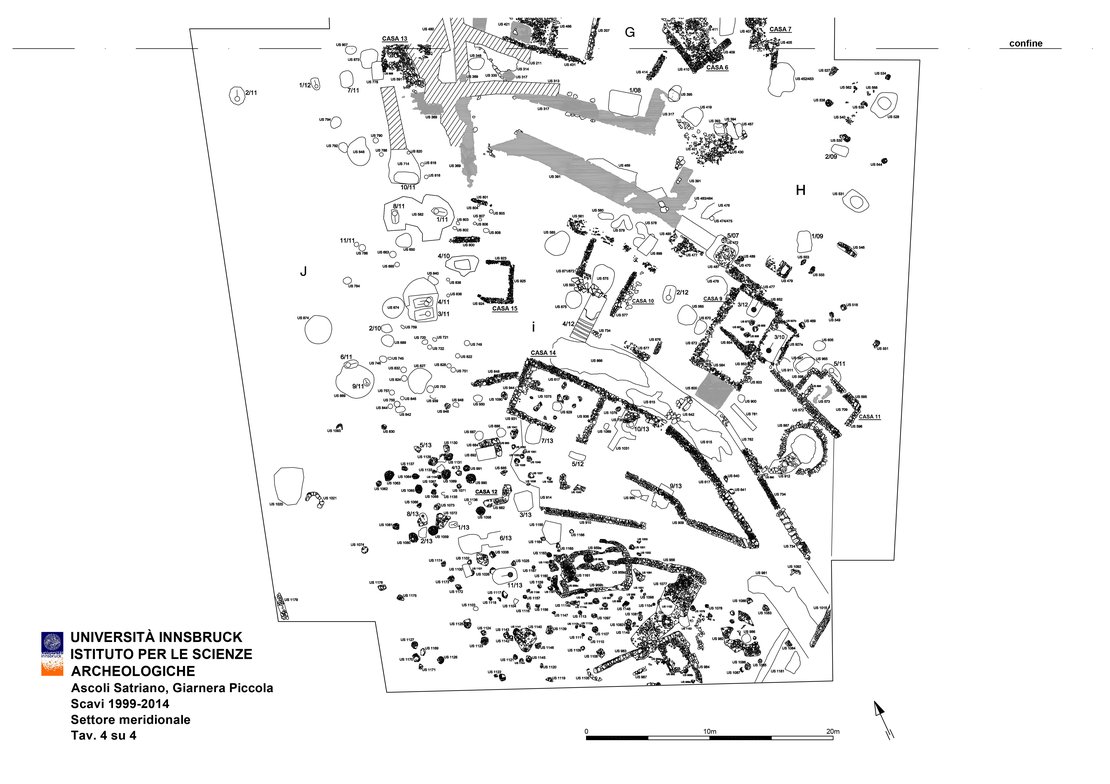
In 1999, investigations were also begun in the Giarnera Piccola. This area, which had become conspicuous due to its high number of finds and wide distribution of scattered finds, is located approx. 1 km west of Colle Serpente on a slope below the hilltops. In particular, the high proportion of early finds, which had come to light during agricultural work, prompted the archaeological investigation. Although preparatory geophysical investigations had already revealed numerous traces of what were in part systematic excavation activities in addition to the ancient features, the sections opened in this area still contained a large number and high density of undisturbed layers from the period between the 8th and 4th centuries B.C. Among the most spectacular features were large-scale pebble pavements. Such structures are also known from other North Apulian-Danubian settlements, but their significance has not yet been clearly recognised. In Giarnera Piccola, for example, they lead to chamber tombs from the 4th century BC (unfortunately often heavily disturbed by robbery), which are certainly associated with members of the local elite. One, for example, contained the mortal remains of four individuals, accompanied by rich grave goods, in particular banqueting crockery. The burial complexes also appear to have included smaller buildings above ground. However, the entire complex was already ritually abandoned towards the end of the 4th century BC, as evidenced, for example, by the careful removal of individual parts of the paving and the covering of other associated areas with bricks.

1 Giarnera Piccola - 2 Colle Serpente - 3 Valle Castagna - 4 Cimitero Vecchio

The new project
The aim of the new project, which has been continuing the investigations since 2016, is the detailed recording and evaluation of the architectural remains in the Giarnera Piccola area in particular and their relationship to the burial finds, which are often directly connected. This applies not only to the brick pavements of the 4th century BC, but also in particular to the earlier burials of the Archaic period (6th/5th century BC), which were laid out in and under smaller post huts and can possibly be regarded as a direct funerary-cultic precursor to the pebble pavements associated with larger tombs and stone buildings. In Ascoli Satriano, the large number of such features, their multiple documented occurrences in the immediate vicinity and the favourable preservation situation offer a unique opportunity to investigate this connection between grave and architecture in more detail. Detailed stratigraphic investigations will clarify the chronological relationship between tombs and building structures, while analyses of the find contexts and the grave goods will provide information about the specific construction of the post and stone structures (which has so far only been unsatisfactorily clarified in the southern Italian indigenous area) as well as about the social role of the buried themselves and their position in the burial community. The close connection between the grave and the (possibly only symbolic) "dwelling place" could also provide further information about the religious beliefs of this indigenous community.


The new project
Click here for more information on the project.
Results and publications
Click here for previous results and publications.
Contact us
PD Dr Christian Heitz, MPhil.
Principal investigator
E-mail: Christian.Heitz@uibk.ac.at
Phone: +43 512 507 40817