
Bachelor's Programme Sociology
Curriculum (2026W)
Bachelor of Arts
Duration/ECTS-Credits
6 semesters/180 ECTS-Credits
Mode of Study
Full-time
Language
German
Requirements
Secondary school completion certificate or equivalent and Language Certificates
Faculty
Faculty of Social and Political Sciences
Level of qualification
Bachelor (1st cycle)
ISCED-11: Level 6, EQF/NQF: Level 6
ISCED-F
0314 Sociology and Cultural Studies
Study code
UC 033 505
The curriculum is the basis of a degree programme. A look at the curriculum for the Bachelor of Sociology gives you a detailed overview of the structure, content, examination regulations and qualification profile of this Bachelor's degree.
The curriculum can clarify several important questions before you start your studies. For example, which criteria must be fulfilled for enrolment in the Bachelor of Sociology, how long the programme lasts, which modules must be completed and much more.
Information on the Curriculum (2026W)
The complete version of the curriculum reflects the currently valid version of the curriculum. It is for informational purposes only and is not legally binding. The legally binding version of the curriculum, including any amendments, may be found in the University of Innsbruck Bulletins.
In order to determine which version of the curriculum is applicable in your case, see the Catalogue of Studies,
- available at: https://lfuonline.uibk.ac.at/public/lfuonline_meinestudien.studienblatt
- Section: Current Curriculum version. https://www.uibk.ac.at/service/c101/mitteilungsblatt/2020-2021/48/mitteil.pdf
- English version of the curriculum (from October 1st, 2026)
- University of Innsbruck Bulletin, May 27th, 2026, Issue 74, No. 635 (modification of the curriculum)
Studies Induction and Orientation Stage (STEOP)
(1) Within the scope of the Studies Induction and Orientation Stage, which takes place in the first semester, the following course examinations are to be passed:
- VO Sociological Perspectives and Approaches 1: Introduction to Sociology (CM 1 lit. a, 2 hrs, 5 ECTS-Credits),
- VO Sociological Perspectives and Approaches 2: Contemporary Society (CM 1 lit. b, 2 hrs, 5 ECTS-Credits.
(2) Successful passing of all examinations of the Studies Induction and Orientation Stage entitles to passing all further courses and exams as well as to writing the Bachelor’s Thesis. The prerequisites specified in the respective curriculum are to be met.
(3) Before completion of the Studies Induction and Orientation Stage, courses covering a total of 20 ECTS-Credits may be passed.
Recommended Course Sequence
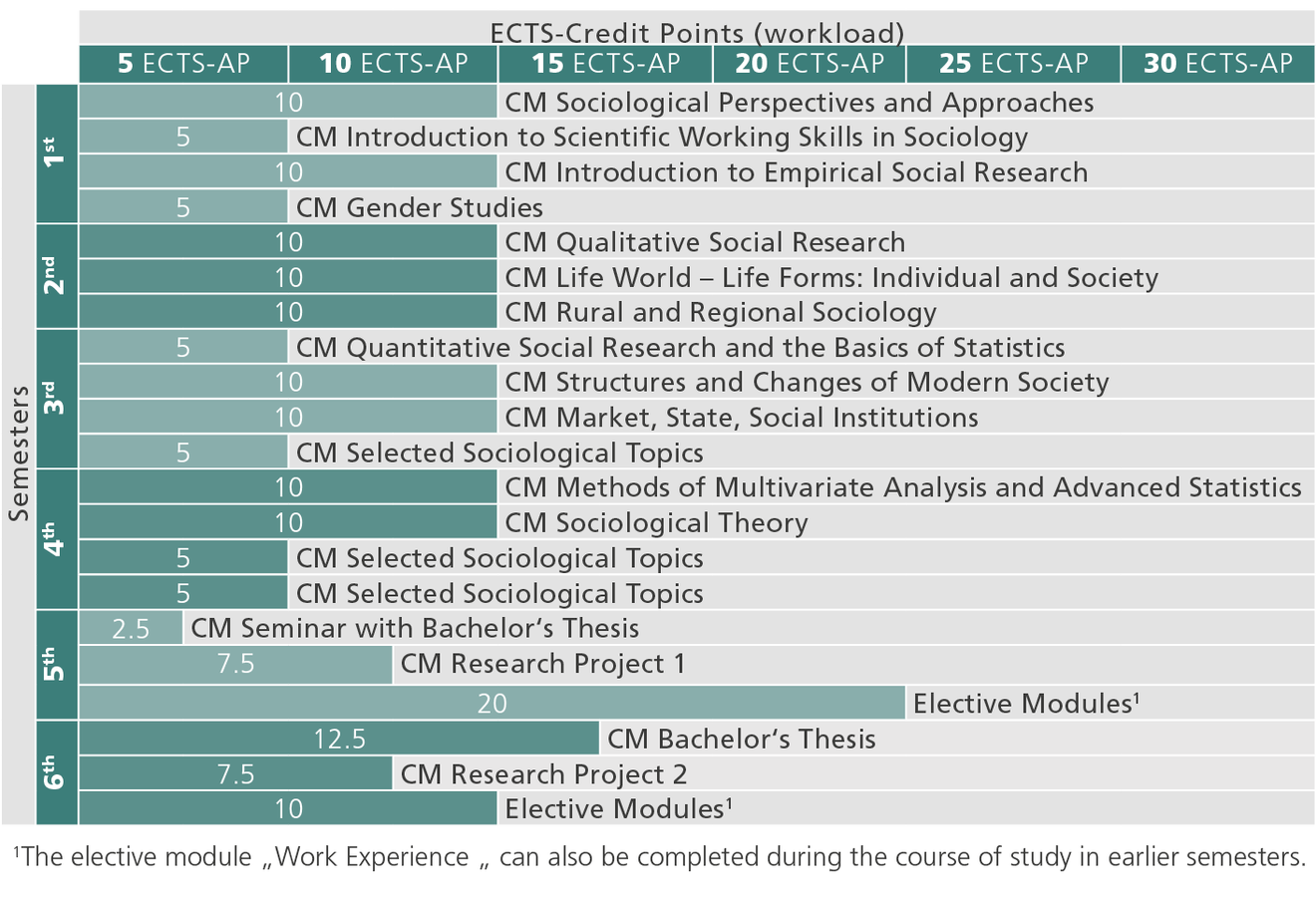
The exemplary course sequence given below is recommended for full-time students beginning their study programme in the winter semester. The table shows one possible course sequence for the bachelor's programme and is not compulsory. Delays resulting from repeated examinations are not taken into account.
The standard duration of the study programme is 6 semesters or 180 ECTS-Credits, whereby according to the Universities Act of 2002, a workload of 1,500 (real) hours per academic year must be fulfilled, corresponding to 60 ECTS-Credits (one ECTS-Credit is equivalent to a workload of 25 hours).
Entrance in Wintersemester
10.0 ECTS-Credits: CM Sociological Perspectives and Approaches
5.0 ECTS-Credits: CM Introduction to Scientific Working Skills in Sociology
10.0 ECTS-Credits: CM Introduction to Empirical Social Research
5.0 ECTS-Credits: CM Gender Research
10.0 ECTS-Credits: CM Qualitative Social Research
10.0 ECTS-Credits: CM Life World – Life Forms: Individual and Society
10.0 ECTS-Credits: CM Agricultural and Regional Sociology
5.0 ECTS-Credits: CM Quantitative Social Research and the Basics of Statistics
10.0 ECTS-Credits: CM Structures and Changes of Modern Society
10.0 ECTS-Credits: CM Market, State, Social Institutions
5.0 ECTS-Credits: CM Selected Sociological Topics
10.0 ECTS-Credits: CM Methods of Multivariate Analysis and Advanced Statistics
10.0 ECTS-Credits: CM Sociological Theory
5.0 ECTS-Credits: CM Selected Sociological Topics
5.0 ECTS-Credits: CM Selected Sociological Topics
2.5 ECTS-Credits: CM Seminar with Bachelor's Thesis
7.5 ECTS-Credits: CM Research Project 1
20.0 ECTS-Credits: Elective Modules1
1 The elective module "Work Experience " can also be completed during the course of study in earlier semesters.
12.5 ECTS-Credits: CM Bachelor's Thesis
7.5 ECTS-Credits: CM Research Project 2
10.0 ECTS-Credits: Elective Modules1
1 The elective module "Work Experience " can also be completed during the course of study in earlier semesters.
Entrance in Summersemester
10.0 ECTS-Credits: CM Sociological Perspectives and Approaches
5.0 ECTS-Credits: CM Introduction to Scientific Working Skills in Sociology
10.0 ECTS-Credits: CM Introduction to Empirical Social Research
5.0 ECTS-Credits: CM Selected Topics in Sociology
5.0 ECTS-Credits: PM Gender Research
10.0 ECTS-Credits: PM Structures and Changes in Modern Society
10.0 ECTS-Credits: PM Market, State, Social Institutions
5.0 ECTS-Credits: VU Selected Topics in Sociology
10.0 ECTS-Credits: CM Qualitative Social Research
10.0 ECTS-Credits: CM Life World – Life Forms: Individual and Society
10.0 ECTS-Credits: CM Agricultural and Regional Sociology
5.0 ECTS-Credits: CM Quantitative Social Research and the Basics of Statistics
5.0 ECTS-Credits: CM Selected Topics in Sociology
20.0 ECTS-Credits: Elective Modules1
1 The elective module "Work Experience " can also be completed during the course of study in earlier semesters.
2.5 ECTS-Credits: CM Seminar with Bachelor's Thesis
7.5 ECTS-Credits: CM Research Project 1
10.0 ECTS-Credits: CM Multivariate Analysis Methods and Statistics – Enhanced Level
10.0 ECTS-Credits: CM Sociological Theory
12.5 ECTS-Credits: CM Bachelor's Thesis
7.5 ECTS-Credits: CM Research Project 2
10.0 ECTS-Credits: Elective Modules1
1 The elective module "Work Experience " can also be completed during the course of study in earlier semesters.

| Semester | ECTS-AP | Titel |
|---|---|---|
Minor
As part of the Bachelor’s Programme, a Minor of 30 ECTS-Credits can be completed.
More information and a list of possible Minors can be found at:
https://www.uibk.ac.at/studium/angebot/wahlpakete/
Extension Programme
Within the scope of the Study Programme, an Extension Programme corresponding to 60 ECTS-Credits may be passed. Admission to the Extension Programme requires the admission to or the having passed of one of the selected Study Programmes. Detailed information: https://www.uibk.ac.at/studium/angebot/es-informatik/
Information about examination regulations, assessment and grading
Examination regulations
The examination regulation is an integral part of the curriculum, detailed information can be found under the paragraph examination regulations.
The grade distribution table is a statistical representation of the distribution of all successfully completed examinations in a given programme of study or subject (based on all registered students for the programme or subject). The grade distribution table is updated in regular intervals.
| Austrian grading scheme | Definition | %-age | ||
| 1 | EXCELLENT | 27.5 | = 100% | |
| 2 | GOOD | 33.5 | ||
| 3 | SATISFACTORY | 24.1 | ||
| 4 | SUFFICIENT | 14.9 | ||
| 5 | INSUFFICIENT |
March 2025
Overall classification of the qualification
Not applicable
Explanation: An overall classification (mit Auszeichnung bestanden/pass with distinction, bestanden/pass, nicht bestanden/fail) – is awarded only for examinations that conclude a programme of study and consist of more than one subject (an examination of this type is not specified in the curriculum of this programme of study).
Contact and Information
Examination Office
Standort Universitätsstraße 15
Associate Dean of Studies (from 02.07.2025)
Mag. Dr. Bernadette Müller Kmet
Dean of Studies (from 01.03.2024)
Univ.-Prof. Dr. Wilhelmus Johannes Gerardus Uunk