Phytomyxid-Host Interactions
Working group leacer: Sigrid Neuhauser
Team:
- Andrea Garvetto (Postdoc)
- Michaela Hittorf (PhD candidate)
- Anagha Santhosh (PhD candidate)
- Katharina Russ (PhD candidate)
- Lea Teifel (PhD candidate)
- Alina Rainer (PhD candidate)
- Alex Schwarz (PhD candidate)
- Bettina Schneidhofer (TA)
Bachelor's and Master's students:
- Lisa Hagmann, BSc
- Sara Hnaien, BSc
- Sümeyra Akgün, BSc
- Eda Oezaltin, BSc

Research area
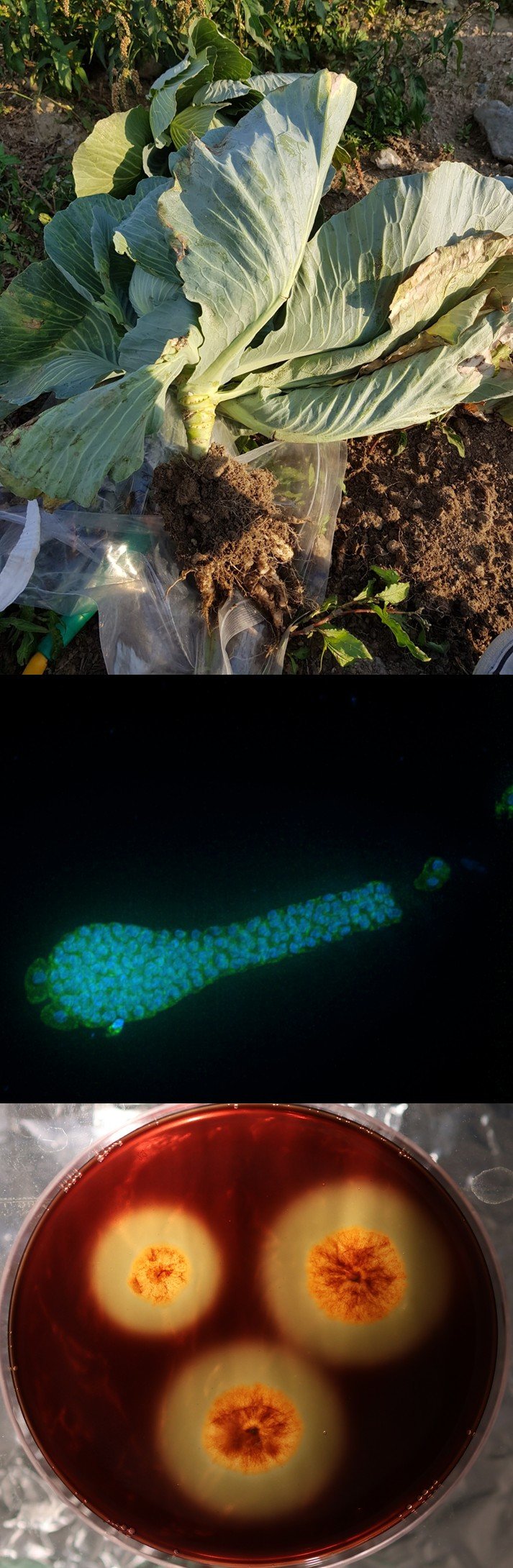
The group's research focuses on the biology, taxonomy and biodiversity of Phytomyxea and other eukaryotic microorganisms. We investigate fundamental aspects of the interaction between Phytomyxea and their hosts using dual cultures in laboratory experiments and field studies. Additionally, we study the biological interactions between eukaryotic microorganisms and other organisms in their environment.
The main focus of our research is the biology of Phytomyxea, their ecology and biodiversity, and their interactions with protists, fungi and host organisms. To better understand these interactions, we conduct comparative analyses of marine and terrestrial phytomyxea that infect plants and brown algae.
The biology of phytomyxea
We are studying cellular interactions between pathogens and hosts to understand how Phytomyxea interact with and communicate with their hosts. For instance, we are investigating effectors and their impact on the host cell wall and other proteins that could influence infection. This interaction fundamentally involves energy transfer from the host to the pathogen, with the host's autotrophic energy production being influenced by the biological rhythms of the Phytomyxea-host interaction. We analyse how parasites and their hosts are influenced by the daily cycle, comparing host responses with and without infection. Changes in the life cycle of Phytomyxea provide an alternative approach to investigating these processes.
The ecology and biodiversity of Phytomyxea, protists and fungi
A central aspect of our research is the classification and diversity of Phytomyxea, including cataloguing their unique characteristics and habitats. We analyse how environmental factors influence the establishment of specific pathogen genotypes and conduct controlled experiments to determine the roles of host genotype and specific environmental parameters in these interactions. We focus particularly on how climate change affects pathogens, i.e. whether it favours or weakens them.
Fungi, protists and their interactions with the environment
Based on the pathosystems described above, we are investigating the relationships between these organisms and bacterial and fungal microbiota to determine how these other organisms affect the symbiotic relationships between phytomyxae and their hosts.
We have expanded our research to include azole-resistant fungi from the environment, moving beyond species that are usually clinically or phytopathologically relevant. The aim of this study is to identify risk factors for the emergence of new pathogens and to develop a risk assessment model using environmental sequencing.
Additionally, we are investigating the interactions between fungi and bacteria, as well as their potential impact on wood degradation by the dry rot fungus Serpula lacrymans.