

GOAL 4 Quality Education
Education and promote lifelong learning opportunities for all
SDG 4 seeks to ensure access to equitable and quality education through all stages of life. Apart from formal qualifications, SDG 4 also aims to increase the number of youth and adults having relevant skills for employment, decent jobs and entrepreneurship.
Furthermore, SDG 4 envisions the elimination of gender and income disparities in access to education. The achievement of universal literacy and numeracy and the acquisition of knowledge and skills to promote sustainable development are also considered crucial for empowering people to live independent, healthy and sustainable lives.
To accelerate progress, SDG 4 calls for building and upgrading educational facilities, expanding the number of higher education scholarships available to developing countries and increasing the supply of qualified teachers.
Monitoring SDG 4 in an EU context focuses on progress made in promoting and increasing basic education, tertiary education and adult education.
Education for Sustainable Development Goals
Suggestions for the development of specific sustainability competencies from the action-oriented, transformative educational and learning outcome-oriented guide Education for Sustainable Development Goals, UNESCO (2017)
Suggested learning outcomes
Cognitive learning outcomes
- The learner understands the important role of education and lifelong learning opportunities for all (formal, non-formal and informal learning) as main drivers of sustainable development, for improving people’s lives and in achieving the SDGs.
- The learner understands education as a public good, a global common good, a fundamental human right and a basis for guaranteeing the realization of other rights.
- The learner knows about inequality in access to and attainment of education, particularly between girls and boys and in rural areas, and about reasons for a lack of equitable access to quality education and lifelong learning opportunities.
- The learner understands the important role of culture in achieving sustainability.
- The learner understands that education can help create a more sustainable, equitable and peaceful world.
Socio-emotional learning outcomes
- The learner is able to raise awareness of the importance of quality education for all, a humanistic and holistic approach to education, ESD and related approaches.
- The learner is able through participatory methods to motivate and empower others to demand and use educational opportunities.
- The learner is able to recognize the intrinsic value of education and to analyse and identify their own learning needs in their personal development.
- The learner is able to recognize the importance of their own skills for improving their life, in particular for employment and entrepreneurship.
- The learner is able to engage personally with ESD.
Behavioral learning outcomes
- The learner is able to contribute to facilitating and implementing quality education for all, ESD and related approaches at different levels.
- The learner is able to promote gender equality in education.
- The learner is able to publicly demand and support the development of policies promoting free, equitable and quality education for all, ESD and related approaches as well as aiming at safe, accessible and inclusive educational facilities.
- The learner is able to promote the empowerment of young people.
- The learner is able to use all opportunities for their own education throughout their life, and to apply the acquired knowledge in everyday situations to promote sustainable development.
Suggested topics
Education as a public good, a global common good, a fundamental human right and a basis for guaranteeing the realization of other rights.
The Education 2030 agenda, and innovative and successful case studies from across the globe.
The relevance of inclusive and equitable quality education and lifelong learning opportunities for all (formal, non-formal and informal learning, including the use of ICT) and at all levels for improving people’s lives and sustainable development.
Reasons for a lack of access to education (e.g. poverty, conflicts, disasters, gender inequality, lack of public financing of education, growing privatization).
Global attainment of literacy, numeracy and basic skills.
Diversity and inclusive education Basic skills and competencies needed in the 21st century.
Knowledge, values, skills and behaviours needed to promote sustainable development.
The concept of education for sustainable development (ESD), whole-institution approach as a key strategy to scale up education for sustainable development, and pedagogy for developing sustainability competencies.
Youth empowerment and empowerment of marginalized groups.
Examples of learning approaches and methods
Develop partnerships between schools, universities and other institutions offering education in different regions of the world (South and North, South and South).
Plan and run a quality education awareness campaign.
Conduct a case study on the education system and access to education (e.g. enrolment in primary education) in selected communities or countries.
Plan and run an ESD project at a school or university, or for the local community.
Celebrate UN World Youth Skills Day (15 July), International Literacy Day (8 September) or World Teachers’ Day (5 October); or take part in Global Action Week for Education.
Organize ESD days at local, regional and national level.
Develop an enquiry-based project: “What is a sustainable school?”
Examples
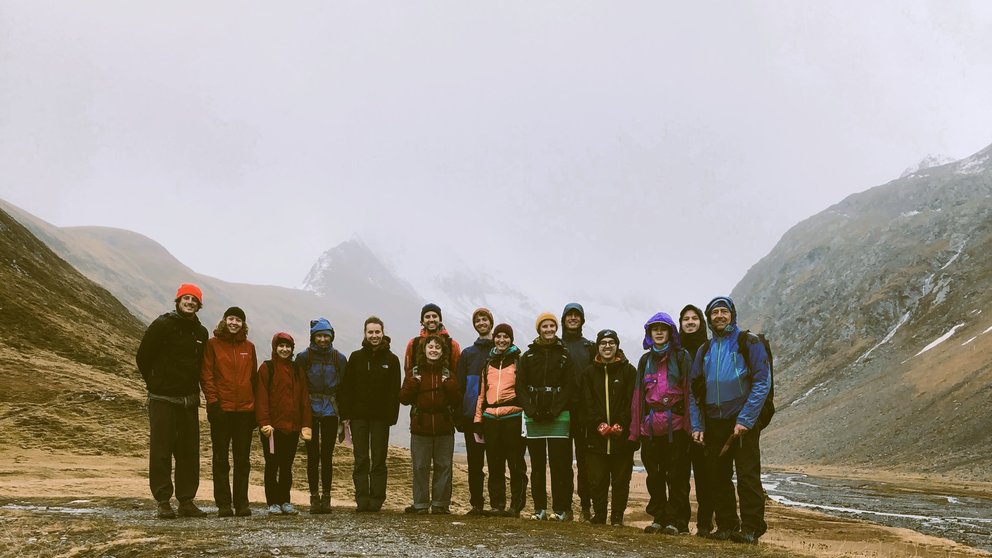
800871 EX Bildung für Nachhaltige Entwicklung im Geiste der Humboldt Brüder. Eine (selbst-)reflektierende Expedition in den Alpenraum: As part of the “Education for Sustainable Development” initiative, Sabrina Bacher (Institute for Teacher Education and School Research) and David Segat (Institute of Geography) at the University of Innsbruck designed an interdisciplinary course in the form of an excursion. Entitled "Education for Sustainable Development in the Spirit of the Humboldt Brothers. A (self-)reflective expedition in the Alpine region," the course combined geographical and educational perspectives to bring sustainable development to life. The aim of the course was to promote a holistic, interdisciplinary understanding of nature in the spirit of Alexander von Humboldt. This was intended to sensitize students to issues of sustainability and strengthen their critical thinking and reflective abilities with regard to human-environment relations. The excursion made it possible to experience theoretical concepts in real contexts and to link interdisciplinary perspectives. A three-pillar didactic approach was developed specifically for the course: (1) Wilhelm von Humboldt's educational ideal and ideas on tertiary education and its didactic further development by Wolfgang Klafki (2) findings from nature, experiential, and adventure education, and (3) the university didactic competency framework LOUIS (Learning Outcomes in University for Impact on Society). A phenomenologically influenced concept of learning formed the basis, according to which learning is understood as a holistic process of experience and meaning-making, focusing on perception, physicality, and subjective experience. Through interactive, experience-based learning, students were encouraged to reflect on their responsibility for sustainable development and to see themselves as multipliers of sustainable practices. The teaching concept combines science, practice, and personal development and makes a valuable contribution to university education for sustainability. Awarded the Ars Docendi State Prize for Excellence in Teaching (main prize 2025).
The Atlas of Good Teaching (available in German only) showcases, among other things, examples from all higher education sectors with a focus on Education for Sustainable Development (SDGs).
External Links
Department of Economic and Social Affairs, United Nations
Targets and Indicators of Goal 4