
News
[2025-02-03] Günter Mühlberger receives the Science Prize of the University of Innsbruck for his life's work.
[2024-08-30] In the KATI-digital project - Kataster Tirol Digital - a team of volunteers has actually entered the data for all of Tyrol's approx. 750,000 building and land parcel records into our database. Around 15-20 individual items of information are available for each plot, meaning that the database contains more than 10 million data points. All data is freely available to researchers and the public.
Projects - ongoing
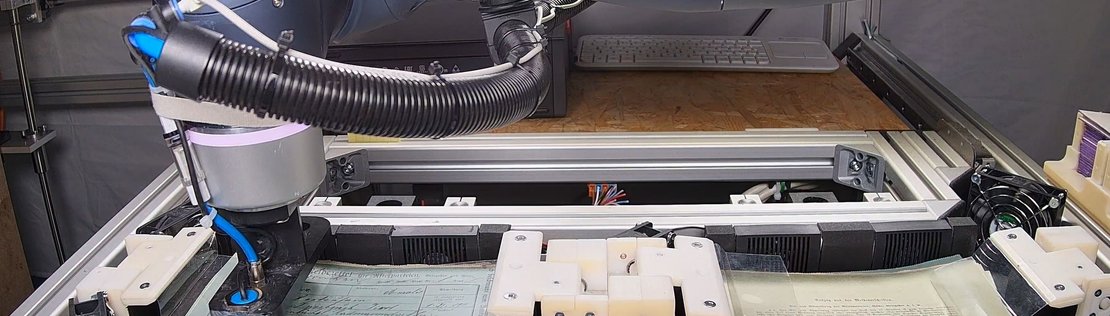
Robotic scanning - new approaches to digitalisation (2021-2026)
The aim of this project, which is being funded as part of the DH-Infra project, is to develop a digitalisation platform based on modern robotics. [more]

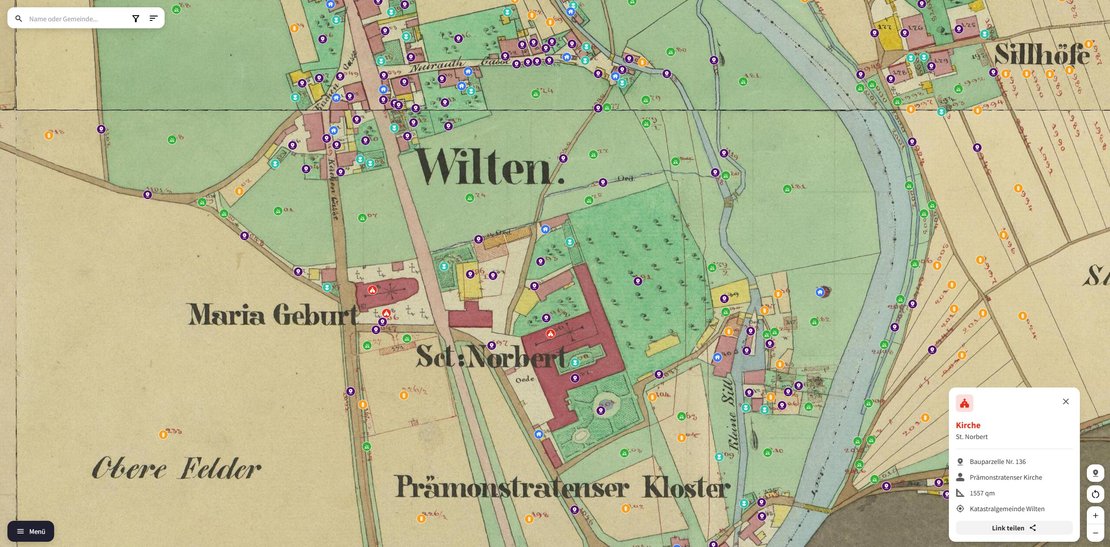
FRANZI - Franziszeischer Kataster Online (2019-2025)
The project has set itself the goal of digitising, automatically indexing and making available online all land and building plot records relating to the Franziszeische Kataster (1817 - 1861) in Austria. It thus represents a direct continuation of the lighthouse project for Tyrol. The project is managed by READCOOP SCE, DEA is responsible for the content. The first results of the project can already be accessed at FRANZI online.

NEMO - European Defence Funds (2024-2029)
NEMO is a project dedicated to the use of AI for text and speech recognition in the military sector. DEA was invited to join the consortium due to its expertise in the field of text recognition.
Projects (completed)
NewsEye: A Digital Investigator for Historical Newspapers (2018-2022)
Funded by the European Union's Horizon 2020 research and innovation programme, is a research project that advances the state of the art and introduces new concepts, methods and tools for the digital humanities by providing improved access to historical newspapers for a wide range of users. Transkribus plays a central role in the project and, based on training data from the national libraries of Finland, France and Austria, the quality of text recognition has been significantly improved, even for difficult newspaper pages.
READ - Recognition and Enrichment of Archival Documents (2016-2019)
READ is a direct continuation of the work begun in the tranScriptorium project. In addition to a range of interesting tools for archives and humanities scholars, the service platform in particular is to be expanded into a comprehensive research infrastructure for historical documents. The H2020 project is led by the DEA and is one of the largest research projects at the University of Innsbruck with EUR 8.2 million in funding. The video gives an insight into the results of the project and the Transkribus platform.
Transkribus
Plattform zur Erkennung historischer Handschriften
tranScriptorium (EU research programme: 2013-2016)
We have been working on text recognition of historical scripts for more than 10 years. Now it's time for the next step: HTR (Handwritten Text Recognition)! We are particularly proud to be working with one of the leading teams in this field until 2016 on a first prototype of comprehensive software for the automated recognition of historical handwriting. Also involved is the University College London Centre for Digital Humanities, which was honoured with the Prix Ars Electronica for its transcribe Bentham project.
Europeana Newspapers (ICT-PSP project: 2012-2015)
Under the leadership of the Berlin State Library, 15 libraries from all over Europe are making their digitised newspaper collections available for the European Library Europeana. Around 8 million of these newspaper pages are refined at the DEA using OCR (Optical Character Recognition) and prepared for a full-text search. The OCR cluster used for this is one of the largest in Europe. Production started as planned at the beginning of 2013.
Services
Digitised catalogues
Old but good: The "" catalogues are growing. Five catalogues with more than 700,000 cards from the Belgrade University Library are now online. Text recognition was carried out for more than 20 languages as well as Cyrillic. This application has been online since 2004 and now offers more than 40 catalogues from almost 20 different institutions.
austrian literature online
Planned in 1998, with a first prototype online in 1999: alo was the first digital library in Austria. For more than 10 years, it was fed by various national and international projects. The website represents the status of 2010 and is still being used diligently. No new documents have been added since 2012.
Counselling
In addition to our involvement in the conception and implementation of research projects in the field of digitisation and digital humanities, we are also happy to provide advice on the application process for digitisation projects.
Contact us
Dr Günter Mühlberger (DEA)
guenter.muehlberger@uibk.ac.at
Phone: +43 (0)512 507 8454
3rd floor of Building IV of the University of Innsbruck
Campus Innrain, in the GeiWi tower, room 40305 (north-east corner)
Postal address
University of Innsbruck
Digitisation & Electronic Archiving (DEA)
Innrain 52d
6020 Innsbruck
AUSTRIA
Bank details:
Hypo Tirol Bank AG
SORT CODE 57000
Account no. 210 111 306 40
BIC: HYPTAT22
IBAN: AT165700021011130640
Reference number (for invoices): KE608002 DEA
Value added tax identification number (UID) of the University of Innsbruck: ATU57495437
The University is exempt from VAT according to the Universities Act 2002.
"Digitisation is now regarded as a central instrument for research in the humanities and cultural studies and the developing digital humanities." (DFG Code of Practice, 2013)