
Activities and news
-

-
-
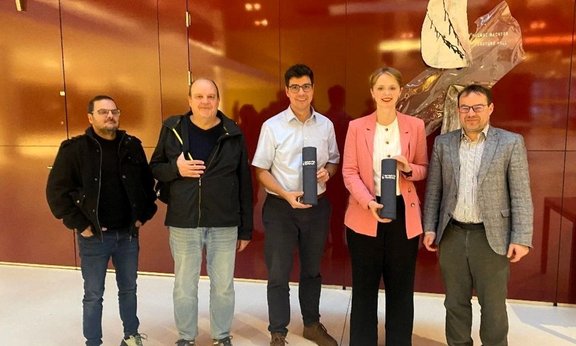
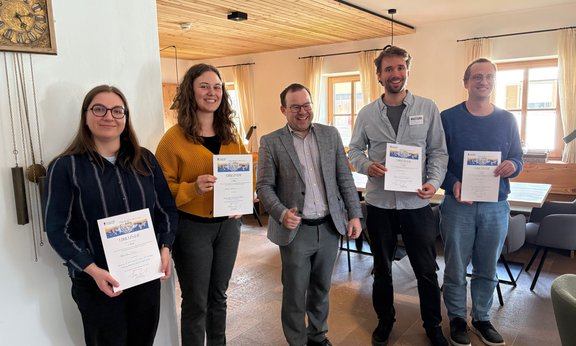
 FunMat Paper Award 2025
The call for entries for the FunMat Paper Award 2025 is now open. The deadline for submissions is 3 October 2025.
11.08.2025 -
-
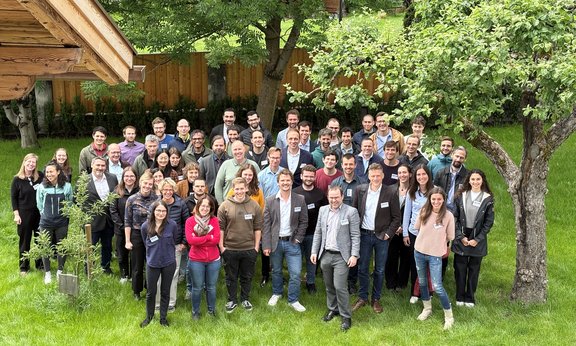 FunMat Retreat
The first retreat of the new research focus Functional Materials Science (FSP FunMat) was held on Friday, 23 May 2025.
23.05.2025


From the newsroom
Some articles in German only.

Acid-base reaction in reverse
Proton transfers occur on the surfaces of sea salt aerosols, releasing acids. Surprisingly, weak organic acids can protonate chloride ions and form hydrogen chloride – contrary to prevailing doctrine. A study by Innsbruck researchers led by Martin Beyer in collaboration with City University Hong Kong shows that a completely dry salt environment can reverse the direction of the reaction.
19.02.2026

Optical temperature sensing from cold to very hot
An international collaboration involving researchers from the University of Innsbruck has developed a novel luminescent material that enables particularly robust and precise optical temperature sensing across an exceptionally broad temperature range.
04.02.2026

Smart degradation of the greenhouse gas sulphur hexafluoride
Sulphur hexafluoride is an extremely potent and long-lived greenhouse gas. A team led by Fabian Dielmann from the University of Innsbruck has now presented a simple method for degradation of this industrially used gas. The method, which has been published in the journal Nature Communications, could fundamentally simplify the disposal of sulphur hexafluoride.
28.01.2026

Ion trap enables a minute in the nanocosmos
At the department for Ion Physics and Applied Physics at the University of Innsbruck, a research team has succeeded for the first time in storing electrically charged helium nanodroplets in an ion trap for up to one minute. This extends the time window for experiments with these extremely cold “mini-laboratories” by a factor of 10,000 compared to previous methods – and opens up new possibilities for basic research in physics and chemistry.
12.01.2026

Neue Einblicke in die Dynamik von Nickelaten
Ein Forschungsteam um Simon Penner und Bernhard Klötzer am Institut für Physikalische Chemie der Uni Innsbruck hat gemeinsam mit internationalen Partnern erstmals im Detail gezeigt, wie sich die Strukturdynamik des Nickelats LaNiO₃ während einer Reduktion auf die Leitfähigkeit auswirkt.

FWF Funding for surface chemistry research
Laerte Patera from the Institute of Physical Chemistry recently received funding from the Austrian Science Fund (FWF). As part of the consortium ‘Pushing Oxide Catalysis: Atomic-Scale View at Photocharges’, Patera's group aims to investigate photocatalytic processes using state-of-the-art atomic force microscopy methods.
12.12.2025

Green light from new sources
Findings from Innsbruck, Schwabmünchen and Düsseldorf show how the green phosphors currently most commonly used commercially in LEDs can be replaced by representatives of a new class of substances.
12.11.2025

First synthesis of 2D boron oxide crystal
An Italian-Austrian team, including Laerte Patera from the Institute of Physical Chemistry, has succeeded in synthesising a novel two-dimensional crystalline form of diboron trioxide. The study, published in the renowned journal Science, confirms the existence of a structure that had previously only been predicted theoretically.
03.10.2025

New doctoral program on flow batteries
The SPACER project, funded by the EU under the Marie Skłodowska-Curie program, is a new training network for doctoral students focused on the improvement of redox flow battery technology. As part of the initiative, 17 doctoral students from ten countries are being trained, including at the Research Institute for Textile Chemistry and Textile Physics at the University of Innsbruck. Coordinated by the Fraunhofer Institute for Chemical Technology (ICT), the project brings together 13 institutions and eight associated partners to drive innovation in the field of sustainable energy storage.
22.9.2025

Dedicated teachers honored
Two of the five main awards and one recognition award from the Ars Docendi 2025: National award for Excellence in Teaching went to lecturers at the University of Innsbruck this year. Archaeologist Aydin Abar and chemist Fabian Dielmann won in the category “Social and Sustainability-Oriented Teaching,” while education researcher Sabrina Viktoria Bacher and geographer David Segat received the award in the category “Cooperative Teaching and Working Methods.”
17.09.2025

Highly coveted mineral resources
The energy transition requires large quantities of metals such as copper, lithium, and cobalt. New deposits are hard to find. Geologist Clifford Patten is tracking these raw materials deep into the Earth's interior: where volcanoes form, the metals of the future could also be transported and enriched.

Deciphering ice structures in space
A research team from the University of Innsbruck has developed a new method for analysing the structure of ice on distant celestial bodies. The current study shows that ice phases with ordered and disordered hydrogen atoms can be distinguished using near-infrared spectroscopy - a technique that is suitable for space observations.
3.7.2025

"Mozartkugeln" made from helium
In a recent study, researchers from the University of Innsbruck, in collaboration with colleagues from Madrid, have shown how atoms arrange themselves into highly symmetrical structures under extreme conditions. The work was recently published in the journal Small Structures and provides fascinating insights into the self-organisation of matter at the atomic level.
30.6.2025

Three ASTRA prizes for the University of Innsbruck
The historian Eric Burton, the mathematician Alexander Glazman and the physicist Elisabeth Gruber are delighted to receive one of the ASTRA Prizes of the Austrian Science Fund (FWF), which were awarded in Vienna on Wednesday, 25 June. With a funding amount of around one million euros each, the ASTRA Prizes are the highest honour for young scientists in Austria.
26.6.2025

Sustainable manganese-based phosphors
Almost all light-emitting diodes used today require phosphors based on so-called rare earths, which are expensive and difficult to extract. In a joint research project between Heinrich Heine University Düsseldorf (HHU) and the University of Innsbruck, chemists have now shown that in principle the element manganese is also suitable for such applications.

New catalyst enables efficient hydrogenation
An innovative copper catalyst now enables the hydrogenation of molecular groups that were previously considered difficult to convert—and under significantly milder conditions. This development could greatly simplify the production of active ingredients and isotope labeling. The breakthrough is the result of international collaboration, involving Fabian Dielmann's research group, among others.
26.05.2025

Game changer for applied electrocatalysis
Transition metal carbides are considered promising alternatives to expensive precious metals such as platinum – especially with regard to a CO₂-neutral energy future. An international research team led by Julia Kunze-Liebhäuser from the Institute of Physical Chemistry is now investigating why tungsten carbide catalysts remain highly active under reaction conditions despite their sensitivity to oxidation.
29.04.2025

A compound that should not exist
According to conventional wisdom, caesium chloride hydrates should not exist. Scientists at the Czech Academy of Sciences, in collaboration with Thomas Lörting's team at the University of Innsbruck, have now proven their existence. The key to their production is a special process that reveals new ways of synthesising unstable molecules.
03.04.2025

CD laboratory for the optimisation of dosage forms opened
The Christian Doppler Laboratory for Innovative Crystal Engineering Strategies in Drug Development was inaugurated at the University of Innsbruck. Together with the pharmaceutical company Sandoz, the team at the new CD laboratory is researching the interactions of molecules and their influence on the chemical stability, processability and efficacy of drugs. The project is funded by the Federal Ministry of Economics.
27.03.2025