
Guidelines for Science Flash contributions
Submissions to the Science Flash must include:
- Title (short and attractive for a wider audience)
- Short abstract of your publication as the main body of your contribution, which summarizes the main findings of your study in a way that is also accessible to scientists from other fields and non-scientists.
- 1 figure that will be included in the Science Flash contribution (any size; can also be a composite of more figures). Please include a short figure caption.
- 1 catching figure that will be displayed at the main page (can be your main figure or a part of it; without captions). Please consider that this figure will be displayed as a small image at the main page (above the link to the Science Flash section) and details/text will not be legible due to the small size. This figure must have a size of 1800 x 1080 px (or equivalent ratio), to ensure that the image will be displayed correctly.
- Information about the publication (Authors, year, title, journal, DOI/weblink)
Please submit your contribution as a Word file (Title, body, figure caption) and image files (jpg, png,…) to Michael.Bahn@uibk.ac.at and Gilbert.Neuner@uibk.ac.at
The IDC student paper awards 2025 have been awarded to Friederike Barkmann, Valentin Johannes Heimer, Benedikt Hiebl, Carlotta Musso, Fabrizzio Protti Sánchez, Maria Chiara Vulcano, Sebastiano Zaniniand Anna de Vries.
Congratulations!
Below you find a description of the awarded papers.
Mapping Butterfly Species Richness and Abundance in Mountain Grasslands —Spatial Application of a Biodiversity Indicator
Friederike Barkmann, Erich Tasser, Ulrike Tappeiner, Peter Huemer, Benjamin Schattanek-Wiesmair, Kurt Lechner, Alois Ortner and Johannes Rüdisser
Butterflies are not only charismatic insects but also important biodiversity indicators that react sensitively to changes in environmental conditions. Information on their species richness and abundance in grassland habitats can be used to inform policy makers, raise awareness in the public and plan and evaluate nature protection measures. We used data from over 175 butterfly survey sites from the Viel-Falter monitoring and environmental variables to predict butterfly species richness and abundance for all grassland habitats in Vorarlberg and Tyrol. The resulting maps of predicted species richness and abundance provide assessments beyond the limited number of survey sites at a high spatial resolution which is especially relevant for local
and regional management actions. We also assessed how factors at local and landscape level affect butterfly populations. In the mountainous study region elevation was an important predictor with highest species richness and abundance at mid-elevations. In addition, there was a positive effect of south facing slopes, medium levels of productivity and forest edges in the surrounding landscape. The study shows how the integration of field surveys with high resolution remote sensing data can improve our understanding of spatial biodiversity patterns and the drivers that influence them.
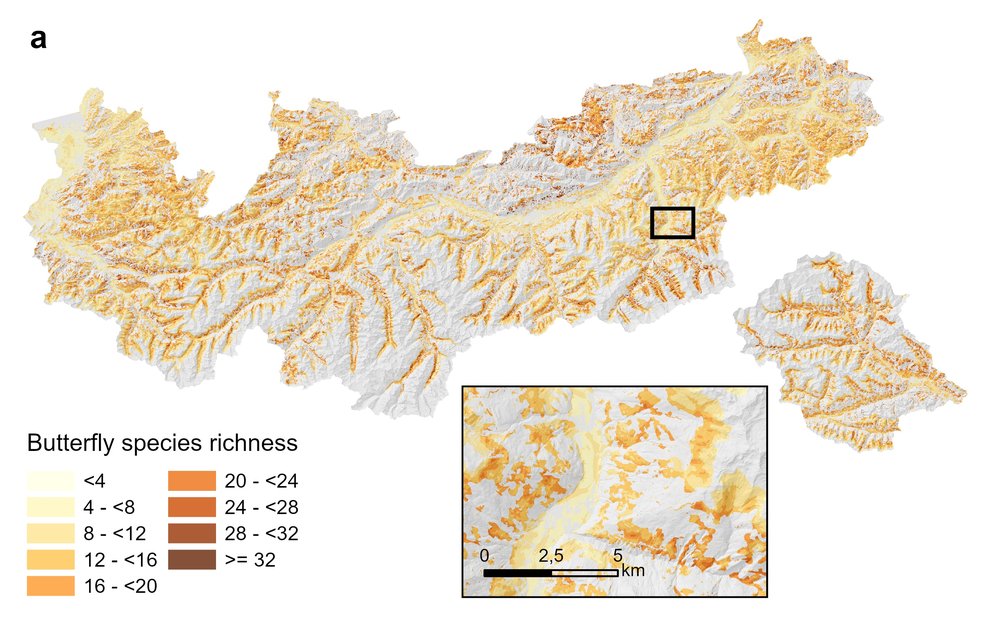
Barkmann, F., Tasser, E., Tappeiner, U., Huemer, P., Schattanek-Wiesmair, B., Lechner, K., Ortner, A. and Rüdisser, J. (2025), Mapping Butterfly Species Richness and Abundance in Mountain Grasslands—Spatial Application of a Biodiversity Indicator. Divers Distrib, 31: e70000. https://doi.org/10.1111/ddi.70000
Machine learning training data: over 500,000 images of butterflies and moths (Lepidoptera) with species labels
Friederike Barkmann, Andreas Lindner, Ronald Würflinger, Helmut Höttinger, Johannes Rüdisser
Apps to share sightings of species by taking and uploading pictures have considerably gained popularity in the last years resulting in large datasets of species records. The collected information on the occurrences of different species can contribute to a better understanding of species distributions and ecosystem dynamics but the processing of the datasets can be time-consuming and expensive. Deep learning models (artificial neural networks) can support quality control by automatically identifying species on the images but they require large training datasets for reliable classification. We published a dataset with over 500,000 images of butterflies and moths that were taken by users of the App “Schmetterlinge Österreichs” of the foundation “Blühendes Österreich”. The correct identification of the 185 species in the dataset was validated by an expert. A model that was trained on the dataset could correctly predict nearly 98 % of the images. The model did not work equally well for all species though, with lower performance for some species that were represented by fewer images. The published dataset is a valuable resource to train and test other models on a species identification task and compare different methods for automated species identification. In addition, it provides the necessary foundation to establish automated species identification models for most Austrian butterfly species which can be used for scientific and educational purposes.
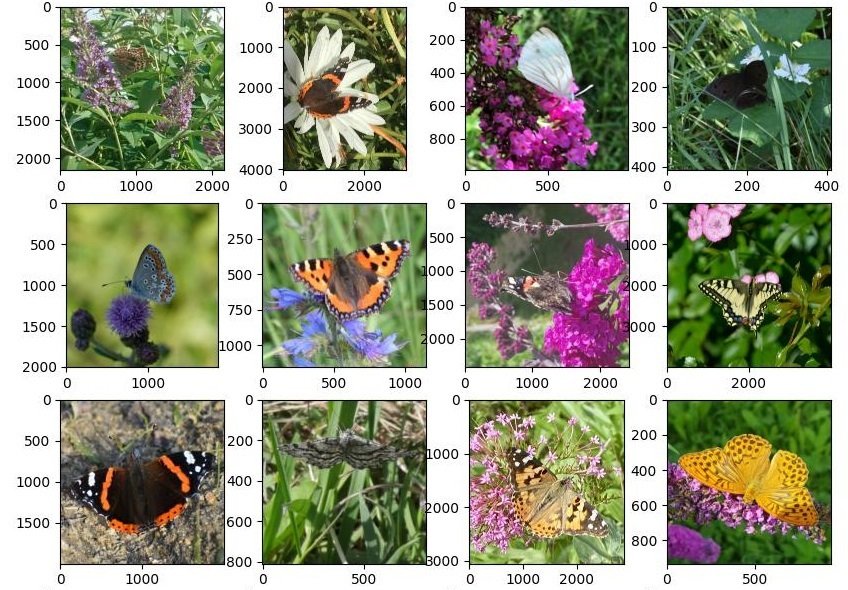
Barkmann, F., Lindner, A., Würflinger, R. et al. Machine learning training data: over 500,000 images of butterflies and moths (Lepidoptera) with species labels. Sci Data 12, 1369 (2025). https://doi.org/10.1038/s41597-025-05708-z
Disentangling the cryptic evolution of European woodrushes
Heimer V., Carnicero P., Carrizo García C., Hilpold, A., Dolenc Koce J., Leal J. L., Li M., Varotto C., Schönswetter P. & Frajman B.
Polyploidization – the duplication of entire genomes – is a major driver of plant evolution, but it also complicates the reconstruction of evolutionary relationships, especially in groups shaped by repeated hybridization. European woodrushes (Luzula sect. Luzula) exemplify this challenge: they form a taxonomically complex group with widespread polyploidy, extensive hybridization, and strikingly uniform morphology. As a result, their evolutionary history has remained poorly understood, even in well-studied regions such as the Alps.
Focusing on the Eastern Alps, a center of diversity for this group, we investigated the evolutionary relationships among nine Luzula species using an exceptionally extensive sampling of more than 1000 individuals. We combined genome-wide sequencing data (ddRADseq) with plastid DNA sequences, relative genome size measurements, and chromosome counts in an integrative analytical framework. This approach allowed us to resolve complex, reticulate relationships that could not be disentangled using any single method alone.
Our analyses reveal weak genetic differentiation and signatures of hybridization among several diploid lineages. Building on this foundation, we reconstructed the origins of polyploid species and identified key hybridization events associated with chromosome duplication (allopolyploidy). Notably, we provide the first empirical evidence of natural hybridization between a diploid and an allotetraploid species resulting in a stable tetraploid species.
Our results demonstrate that repeated whole-genome duplications and pervasive hybridization – both within and across ploidy levels – have been central to the diversification of this cryptic species complex and showcase the power of integrative approaches for resolving complex evolutionary histories.
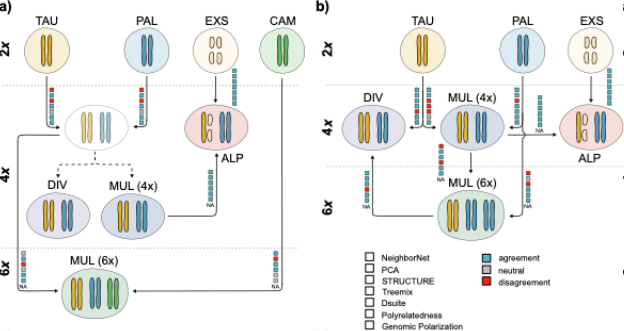
Schematic representation of the most likely evolutionary scenario (a) and a plausible alternative (b) for the polyploid complex of European Luzula sect. Luzula. Ploidy levels are indicated on the left and separated by dotted horizontal lines. Karyotypes are depicted schematically with colors representing ancestral diploid subgenomes. Black arrows show proposed hybridization events, and dashed arrows represent evolutionary divergence without hybridization. Analyses supporting or objecting the involvement of each species in a given hybridization event are indicated as colored squares.
Schönswetter, P., Carnicero, P., Dolenc Koce, J., Heimer, V., Frajman, B., Leal, J. L., Varotto, C., Li, M., Hilpold, A., & Carrizo García, C. (2025). Hybridization and Polyploidy Shaped the Evolutionary History of a Complex of Cryptic Species in European Woodrushes ( Luzula sect. Luzula ). Systematic Biology, 75(3), 493–516. https://doi.org/10.1093/sysbio/syaf065
Advancing forest mapping: Pretraining strategies and deep-ensemble based uncertainty for predicting evergreen broad-leaved cover from Sentinel-2 time series
Benedikt Hiebl, Nicola Alessi, Giacomo Calvia, Alessandro Bricca, Gianmaria Bonari, Giulio Zangari, Wouter Dorigo, Stefan Zerbe, Martin Rutzinger
Mediterranean and temperate forests are currently undergoing changes due to climate change and land-use dynamics. In particular, evergreen broad-leaved tree species are expanding into regions previously dominated by deciduous forests. Yet, mapping these shifts at a functional level over large areas remains challenging due to limited availability of accurate field observations, which constrains data-driven Machine Learning approaches.
In this study, we investigated deep learning strategies to map the fractional cover of evergreen broad-leaved trees using annual dense Sentinel-2 satellite time series. We show that pretraining a Convolutional Neural Network on large, contextually similar datasets—using existing forest vegetation databases—substantially improves prediction accuracy when only limited field data for a specific mapping target are available.
Beyond improved accuracy, we explicitly quantify prediction uncertainty using deep ensembles. This allows us to identify regions where the model is less confident, such as areas with forest types not well represented in the training data. The resulting maps therefore not only provide estimates of evergreen broad-leaved forest cover, but also indicate where predictions should be interpreted with caution.
Overall, the study demonstrates that combining transfer learning with uncertainty-aware deep learning enables more reliable and transparent forest mapping from satellite time series under data scarce conditions, supporting biodiversity assessments and climate adaptation strategies.
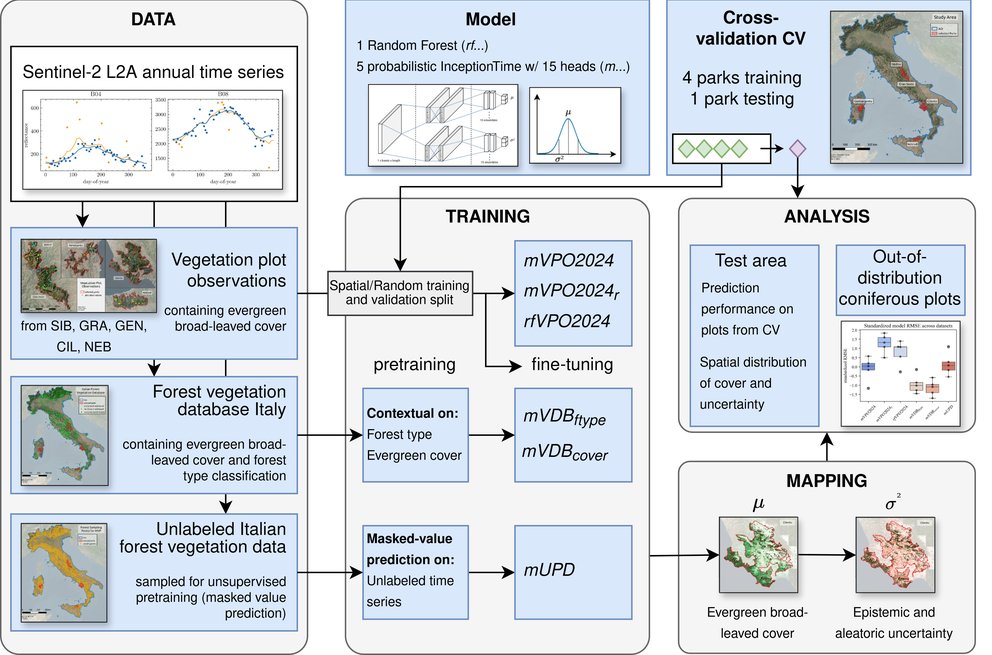
Benedikt Hiebl, Nicola Alessi, Giacomo Calvia, Alessandro Bricca, Gianmaria Bonari, Giulio Zangari, Wouter Dorigo, Stefan Zerbe, Martin Rutzinger,
Advancing forest mapping: Pretraining strategies and deep-ensemble based uncertainty for predicting evergreen broad-leaved cover from Sentinel-2 time series,
International Journal of Applied Earth Observation and Geoinformation, https://doi.org/10.1016/j.jag.2025.104734.
Global variability in hydraulic traits and water use strategies of mountain shrubs and dwarf shrubs
Musso C., Ganthaler A., Mayr S.
Shrubs are woody plants that grow more in width than in height and can survive even in harsh high‑mountain environments. Although they are an important growth form in these areas, their hydraulic properties (water uptake, transport, and release) remain poorly understood. In this study, we reviewed the water‑use strategies of mountain shrubs across different climates and regions. Our analysis shows that shrubs rely on diverse hydraulic strategies to maintain a favourable water status. However, important knowledge gaps remain, particularly regarding root traits, embolism recovery, and water storage. This review provides new insights into how shrubs adapt to the environmental stresses of mountain regions.
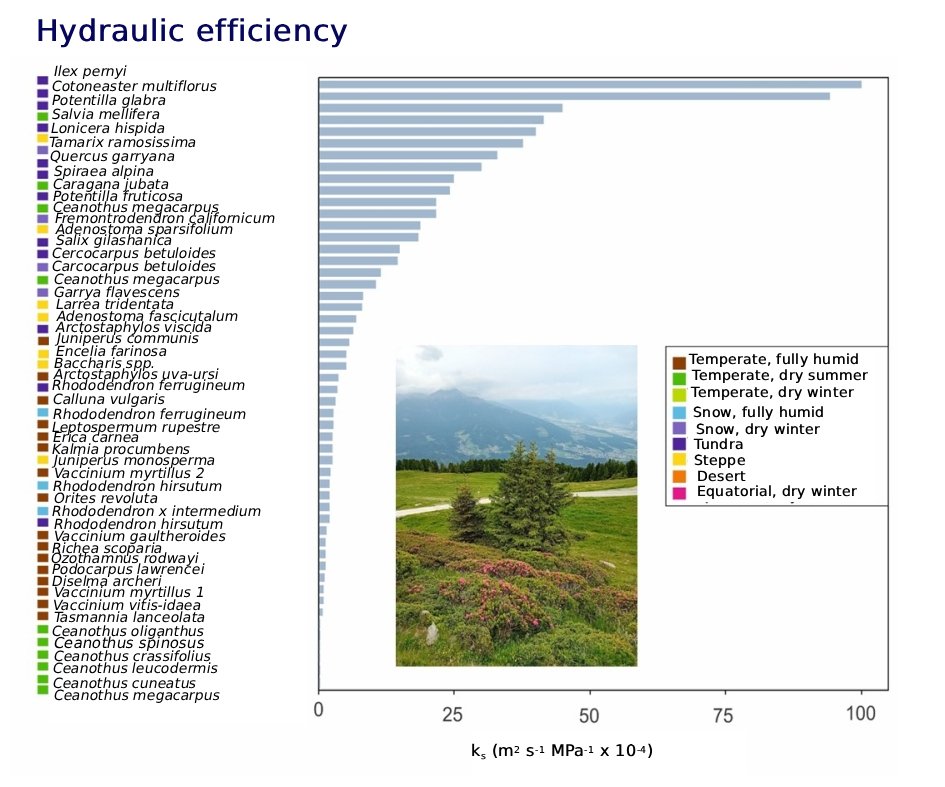
Musso, C., Ganthaler, A. and Mayr, S. (2025), Global variability in hydraulic traits and water use strategies of mountain shrubs and dwarf shrubs. Plant Biol J, 27: 1253-1270. https://doi.org/10.1111/plb.70088
Soil respiration responses to prolonged warming vary seasonally in a subarctic grassland
Fabrizzio Protti-Sánchez, Linsey M. Avila, Kathiravan Meeran, Johannes Ingrisch, Páll Sigurðsson, Klaus S. Larsen, Bjarni D. Sigurdsson, Ivan Janssens, Michael Bahn
Northern ecosystems are warming faster than most other regions, yet how this affects the large amounts of carbon stored in their soils remains uncertain. A key process by which soil carbon is released to the atmosphere is soil respiration – the CO2 produced by soil microbes and roots. This process is highly temperature-sensitive and is expected to increase under climate warming. However, whether this effect persists over long timescales and across seasons remains unclear.
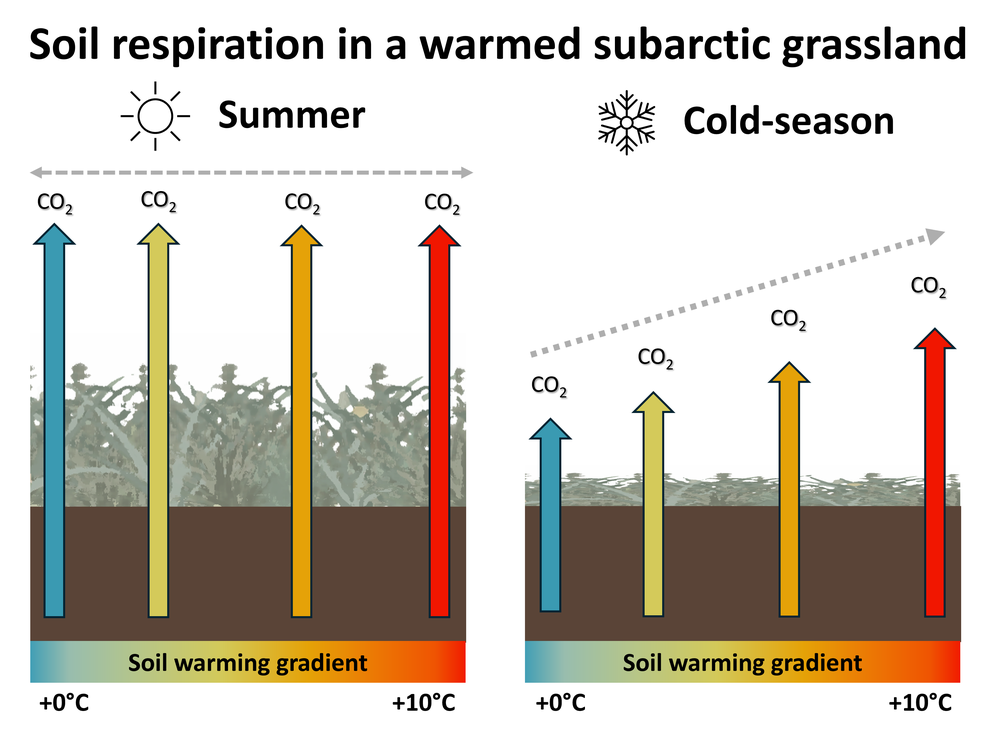
In this study, we used a natural geothermal warming gradient in a subarctic grassland in Iceland, where soil temperatures range from ambient to more than 10 °C above ambient, to investigate how more than a decade of warming influences soil respiration throughout the year. We found that warming significantly increased soil carbon release during the cold season, while having no detectable effect in summer, leading to higher total annual soil carbon emissions. As soils became warmer, they also became less sensitive to further temperature increases, and seasonal contrasts in soil respiration gradually weakened.
Overall, our results highlight the importance of considering seasonal variations when predicting warming impacts on soil carbon dynamics. By providing new insights into how long-term warming influences carbon release in northern ecosystems, this study improves our understanding of their potential to amplify global warming as temperatures continue to rise.
Protti-Sánchez, F., L. M. Avila, K. Meeran, et al. 2025. “Soil Respiration Responses to Prolonged Warming Vary Seasonally in a Subarctic Grassland.” Global Change Biology31, no. 8: e70388. https://doi.org/10.1111/gcb.70388.
How well do we understand the role of periphyton as a source of dietary energy and nutrients in mountain stream food webs?
Maria Chiara Vulcano, Martin J. Kainz, Georg H. Niedrist, Leopold Füreder
Periphyton is a key basal resource in stream food webs, supplying dietary energy and essential nutrients to aquatic consumers. These nutrients include omega-3 and omega-6 polyunsaturated fatty acids (PUFA), which are essential for the growth, reproduction, and development of aquatic consumers.
While other aspects of mountain stream ecology and hydrology are better studied, the nutritional features of periphyton (both its quantity and nutritional quality) have received little attention. Our literature review revealed that only a few studies have examined the patterns of periphyton biomass in alpine and subalpine streams, and that only six recent studies have assessed its lipid and PUFA content.
Assessing both the quantity and quality of periphyton is crucial because, for example, large amounts of periphyton lacking essential nutrients cannot be efficiently used by consumers, whereas smaller amounts of nutrient-rich periphyton may provide a greater nutritional support. Quantity alone is therefore insufficient to understand trophic dynamics.
Periphyton quantity and quality can vary seasonally and spatially across alpine and subalpine catchments. For example, available data show that regional climate and environmental conditions drive seasonal patterns of periphyton biomass in high-elevation catchments, and suggests that streams with contrasting nutrient and disturbance regimes can exhibit markedly different biomass levels (see figure).
A deeper understanding of patterns in periphyton quantity and quality is important to explain current trophic dynamics in mountain streams, and for predicting their future development under ongoing climate change.
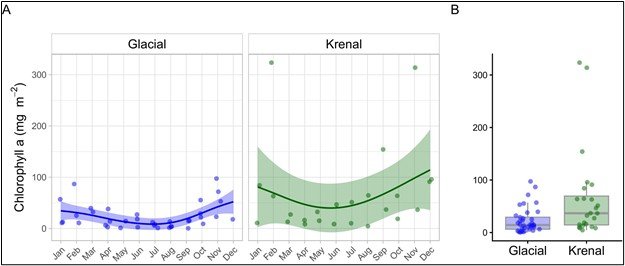
Periphyton Chlorophyll-a content in alpine glacial and krenal streams of the European Alps. (A) Variations of periphyton Chl-a (used as a measure of periphyton biomass) in glacial and krenal streams over the course of a year. (B) Monthly Chl-a content of periphyton in glacial and krenal streams. Data have been extracted from Uehlinger et al. (2010) using WebPlotDigitizer. We included data from streams surveyed for at least 1 year, with no more than four monthly measurements missing and gaps no longer than two consecutive months.
Vulcano, M. C., M. J. Kainz, G. H. Niedrist, and L. Füreder. 2025. “The Fundamental Role of Periphyton in Supplying Dietary Energy to Alpine Stream Food Webs: Current Knowledge, Limitations and Future Perspectives.” Freshwater Biology70, no. 11: e70133. https://doi.org/10.1111/fwb.70133.
Disentangling biodiversity and temperature effects on bees and pollination services in mountain agroecosystems
Sebastiano Zanini, Matteo Dainese, Lisa Obwegs, Elia Guariento, Timo Kopf, Matteo Anderle, Georg Leitinger, Ulrike Tappeiner
In agricultural landscapes, wild bees are essential partners for both natural ecosystems and food production. Yet their populations are under pressure from intensive farming practices and climate change. This study explored how local biodiversity (used as an indicator of land-use intensity) and temperature influence wild bees and the pollination they provide in mountain farmland systems in South Tyrol, Italy.
To do this, we selected study sites along two independent gradients and examined how local biodiversity (measured as the diversity of multiple animal and plant groups; also called multidiversity for this reason) and temperature shape wild bees and pollination services. We assessed wild bee diversity using white, blue, and yellow pan traps, recorded honeybee and wild bee flower visits on potted strawberry and radish plants, and measured fruit and seed production. These variables were collected across apple orchards, vineyards, hay meadows, orchard meadows, and pastures.
We found that higher local biodiversity strongly supports wild bee abundance and species richness. In contrast, temperature alone had relatively limited direct effects on wild bee diversity. Wild bee visitation was also higher in biodiverse landscapes, while honeybees tended to dominate flower visits in simplified, low-diversity areas.
Experiments with strawberries and radishes revealed that insect pollination can help buffer the negative effects of warmer conditions on crop production. When pollinators could not pollinate flowers through nets around the plants, higher temperatures led to lower strawberry fruit weight. Instead, pollinated plants were less affected by warming.
Overall, the study highlights the close links between biodiversity, land use, and climate (simulated through elevation along a temperature gradient). It suggests that conserving and restoring biodiversity in agricultural landscapes can strengthen resilience to climate change with an “insurance effect”. Protecting a rich variety of species and habitats not only supports bee diversity, but also help maintain essential ecosystem functions such as pollination, which underpin both wild plant reproduction and food production.
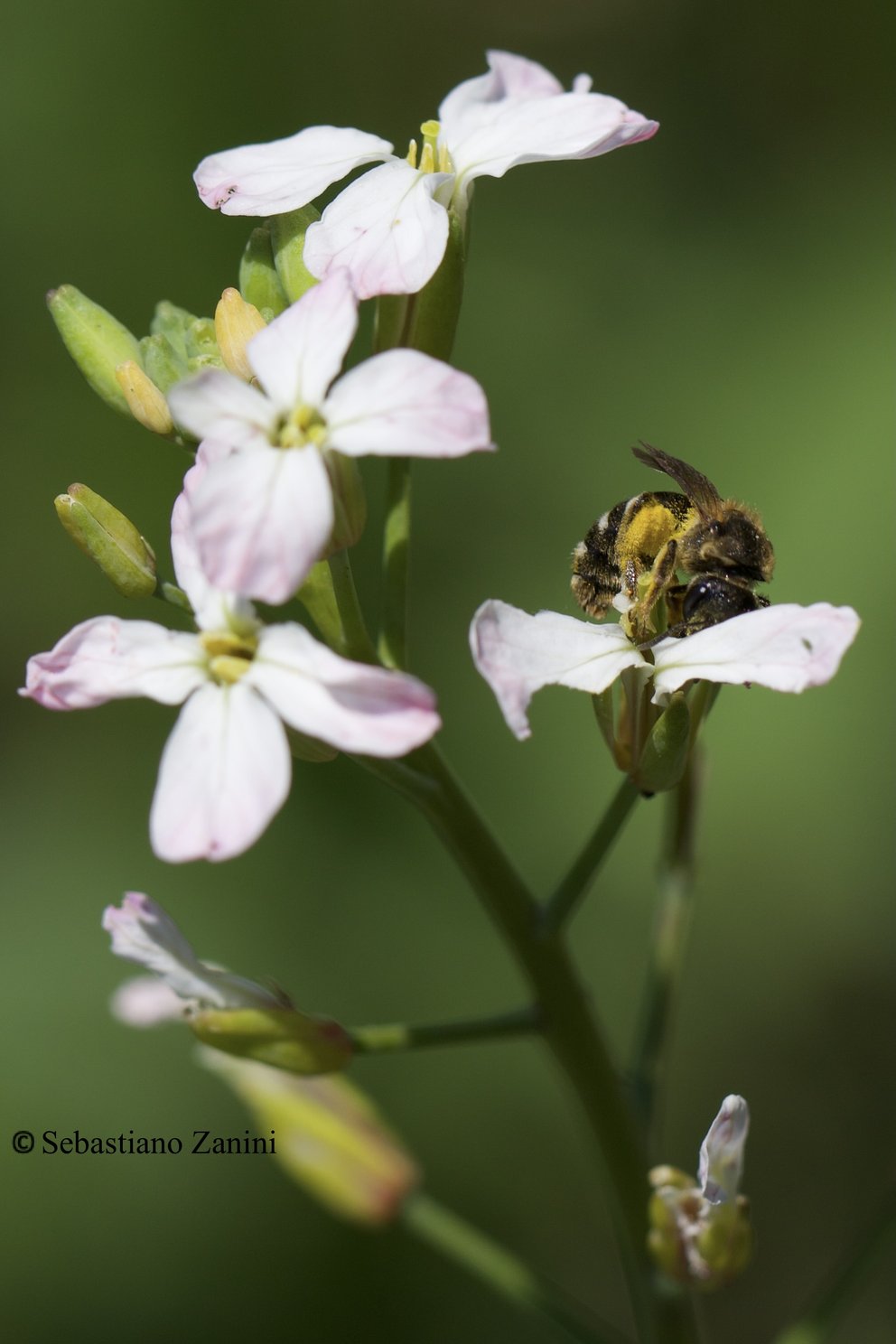
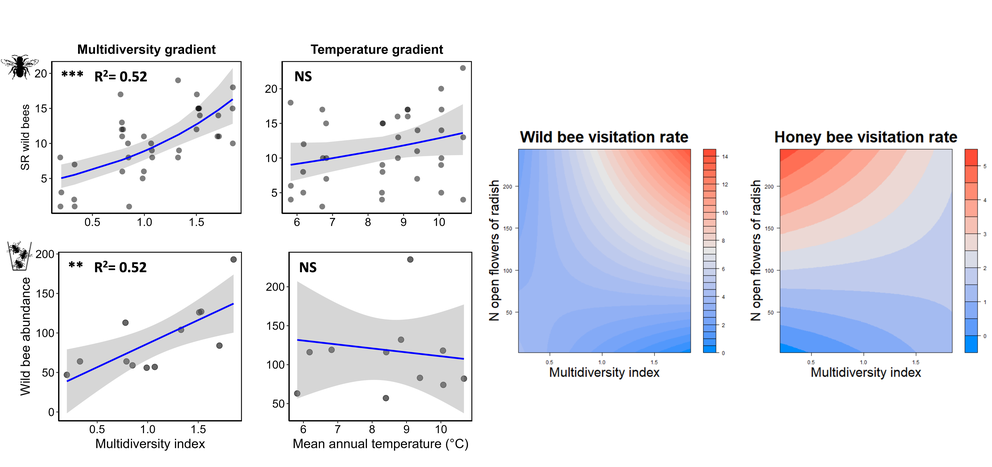
The left side of the figure shows four panels illustrating the relationships between wild bee species richness (SR wild bees) and abundance along two independent environmental gradients: the multidiversity index (left panels) and mean annual temperature (MAT; right panels). The coloured plots on the right side of the figure display how wild bee and honeybee visitation rates vary with the multidiversity index and the number of open radish flowers. Colour bars next to each plot represent visitation intensity. All plots are based on estimates from linear mixed-effects models (LMMs).
Sebastiano Zanini, Matteo Dainese, Lisa Obwegs, Elia Guariento, Timo Kopf, Matteo Anderle, Georg Leitinger, Ulrike Tappeiner, Disentangling biodiversity and temperature effects on bees and pollination services in mountain agroecosystems, Agriculture, Ecosystems & Environment. https://doi.org/10.1016/j.agee.2025.109945
Wetlands -the overlooked COS flux-
Anna de Vries, Georg Wohlfahrt, Kukka‐Maaria Kohonen, Camille Abadie, Marine Remaud, Jürgen Kesselmeier, Asta Laasonen, Mary Whelan, Ivan Mammarella and Timo Vesala
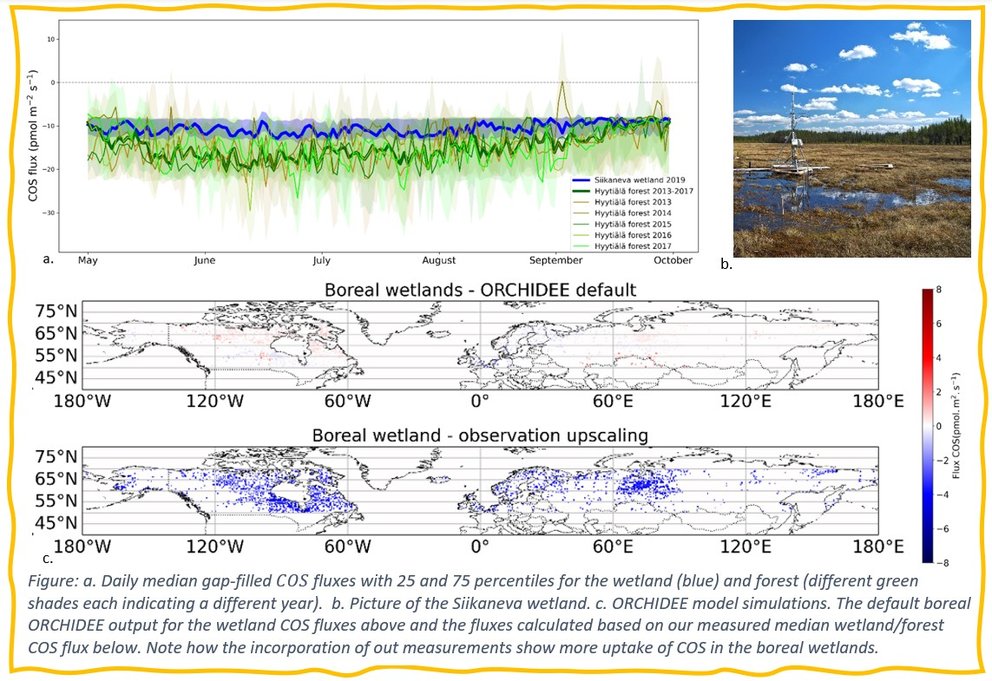
Carbonyl sulfide (COS) is a gas used to study the carbon cycle. This because plants absorb COS in a similar way as they absorb CO2. However, to use COS effectively, all sources and sinks must be understood and nowadays there still is an unexplained missing sink in high northern latitudes. Boreal COS budget calculations typically account for the contribution by forests, but ignore any uptake that wetland ecosystems, widespread in Northern latitudes, may contribute. The first direct measurements of the ecosystem-atmosphere COS exchange of a boreal wetland, presented in this article, demonstrate their likely importance for Northern latitude COS budgets. The investigated wetland (Siikaneva, Finland) took up on average 11 pmol m−2s−1 COS, which was c. 72 % of the nearby boreal forest COS uptake. During nighttime, the COS uptake rates were similar at both sites. Upscaling our measurements to the boreal region using the ORCHIDEE model revealed a Northern wetland sink of c. 13 Gg S/y, changing the simulated budget from a small source to a COS sink impacting Northern latitudes carbon uptake estimates based on COS. With these measurements we show the importance of including boreal wetland COS fluxes in budget calculation.
Highlights
- This study presents the first direct measurements of COS exchange in a boreal wetland (Siikaneva, Finland).
- The wetland showed an average COS uptake of 11 pmol m⁻²s⁻¹, about 72% of the uptake by nearby boreal forests.
- At night, both the wetland and forest showed similar COS uptake.
- When upscaled to the entire boreal region using the ORCHIDEE model, wetlands were estimated to be a COS sink of ~13 Gg S/year. This inclusion shifts the COS budget from a small source to a net sink, impacting carbon uptake estimates
de Vries, A., Wohlfahrt, G., Kohonen, K.-M., Abadie, C., Remaud, M., Kesselmeier, J., et al. (2025). The contribution of boreal wetlands to the Northern Hemisphere carbonyl sulfide sink. Geophysical Research Letters, 52, e2024GL112858. https://doi.org/10.1029/2024GL112858
Congratulations!
Below you find a description of the awarded papers.
How Future Global Changes Will Impact Grasslands’ Greenness?
Grasslands are under pressure from climate change, including warming, elevated CO2, and
drought. In this study, we explored how these changes individually and together affect grassland
growth and phenology characterised by greenness indices. Using three years of data from an
Alpine grassland experiment, we found:
• Warming sped up spring growth and greenness.
• Elevated CO2 boosted growth rates.
• Drought had no immediate impact but caused faster growth in the next spring due to a
"memory effect."
• Combined effects amplified shifts, causing earlier summer greenness decline and faster
spring growth in the following year.
These findings reveal that grasslands will respond more dramatically to combined global
change factors than to individual ones, posing challenges for future management and
conservation.

Graphical summary of statistically significant treatment effects on grassland phenology, as
based on the greenness index derived from the phenocam images across the six treatments
(A=ambient control, C=elevated CO2 (+300 ppm), T=warming (+3° C), D=summer drought,
CT=elevated CO2 combined with warming, CTD=elevated CO2, warming and summer
drought.) Grassland management involves three cuts at the end of May, July and September.
The four important phenological stages 1) Start of growth (Upturn date), 2) Peak growth
(Maximum greenness), 3) Start of senescence (Downturn date), and 4) End of senescence are
represented using the respective icons provided in the lower legend. Open symbols on the
right-hand side legend for the treatments indicate that these treatments did not cause
statistically significant effects and are therefore not included in the graphical summary.
Joseph, L.; Cremonese, E.; Migliavacca, M.; Schaumberger, A.; Bahn, M. (2025): Warming, elevated CO2 and drought in combination amplify shifts in canopy greenness dynamics in managed grassland.
In: Agriculture, Ecosystems & Environment 378, No. 109304. (DOI)
When water turns to ice: Control of ice volume and freezing dynamics as important aspects of cold acclimation
In the cold acclimated (CA) state, a reduced tissue water content is considered important to survive subzero temperatures. However, the causal relationship between the reduced water content and increased frost hardiness is unclear. Our aim was to assess whether the seasonally reduced water content affects the freezing dynamics and the amount of ice formed in evergreen leaves: Xeromorph leaves of the woody species Buxus sempervirens and Hedera helix were compared with the herbaceous, soft-leaved Bellis perennis in the non-acclimated (NA) state in summer, during cold acclimation and in the fully CA state in winter. Freezing dynamics were studied using differential scanning calorimetry in addition to the volume fraction of ice and related to water content, osmotic potential and frost hardiness.
In the CA state, freezing dynamics were slower than in NA state. In xeromorph leaves, displacement from ideal equilibrium freezing was higher than in B. perennis. Freeze dehydration was lower in CA state. In the CA state, water content and osmotic potential were reduced, except for B. sempervirens, where the water content remained unchanged. Active osmoregulation and controlled dehydration (only found in two species), are supporting cellular water retention against the dehydrative force of extracellular ice. B. perennis had the highest water content and the least negative osmotic potential, and was the most frost susceptible species (LT10: ‒8.4 °C CA). The leaves froze at ideal equilibrium. 83% of the total water froze, occupying more than 60 vol%. H. helix (LT10: ‒18.4 °C CA) was frost hardier and B. sempervirens (LT10: ‒28.8 °C CA) the frost hardiest species, but in contrast to the other species tested got frost killed by intracellular freezing. The xeromorph leaves froze at non-ideal equilibrium and had lesser ice masses. Despite an increase in frost hardiness with CA, the volume fraction of ice at LT10 was the same (30-40 vol%). In the CA state, slower freeze dehydration and at the same subzero temperature lesser ice masses appeared to be important for higher frost hardiness.
Overall, an important component of cold acclimation in evergreen leaves was the slowing of freezing dynamics, which, depending on the species, involved a specific cell architecture, osmoregulation and a reduction in water content.
Highlights
* In evergreen leaves, cold acclimation leads to slower freezing
* Cold acclimation reduces the extent of cellular freeze dehydration
* The total amount of ice masses becomes reduced during cold acclimation
* Xeromorph leaves freeze at non-ideal equilibrium, soft leaves at ideal equilibrium
* Osmoregulation, cell architecture and partly dehydration affect freezing dynamics

Ralser, Maria; Stegner, Matthias; Neuner, Gilbert (2024): When water turns to ice: Control of ice volume and freezing dynamics as important aspects of cold acclimation.
In: Environmental and Experimental Botany 227, Nr. 105957. (DOI)
Meadow orchards as a good practice example for improving biodiversity in intensive apple orchards
Agricultural land use and intensification of management practices are key drivers of the current global biodiversity crisis. To conserve life in and around agricultural areas and ensure the delivery of essential ecosystem services, changes in management practices are needed. A promising approach is to consider traditional, extensive agricultural management practices, that have been developed and implemented over a long time. Comparing intensive land-use forms with their extensive and traditional counterparts can help define a good practice example for integrated conservation.
In this study, we compared the biodiversity of traditional meadow orchards with intensively managed apple orchards in a mountain region. We adopted a multi-taxon approach, examining seven taxa (vascular plants, wild bees, diurnal butterflies, orthopterans, spiders, birds, and bats) considered important bioindicators of biodiversity and different ecosystem functions. Additionally, we assessed macro-invertebrates across four orchard habitat strata (soil, ground-dwelling, herb, and tree layer), identifying them to higher taxonomic levels. Each group and stratum was sampled using a target sampling method.
Our findings showed consistently higher abundance, diversity, and presence of threatened species in meadow orchards compared to apple orchards. Specifically, wild bees, butterflies, orthopterans, and birds exhibited significantly lower diversity in intensive apple orchards across different diversity indices. Despite differences in species’ habitat and landscape requirements, the results consistently point to the overall impact of management practices. Furthermore, multi-taxonomic indices of all taxa and most habitat strata reinforced this trend, supporting the conclusion that these findings are applicable to the whole orchard ecosystem.
We conclude that traditional agroforestry systems, such as meadow orchards, could represent a well-suited good-practice example for integrated biodiversity conservation in the agricultural landscape. Finally, we emphasize the importance of maintaining traditional management practices through effective conservation measures such as subsidies as part of agri-environmental schemes.

Guariento, E.; Obwegs, L.; Anderle, M.; Bellè, A.; Fontana, P.; Paniccia, C.; Plunger, J.; Rüdisser, J.; Stifter, S.; Giombini, V.; Egarter Vigl, L.; Tappeiner, U.; Hilpold, A. (2024): Meadow orchards as a good practice example for improving biodiversity in intensive apple orchards.
In: Biological Conservation 299, Nr. 110815. (DOI)
Individual versus combined effects of warming, elevated CO2 and drought on grassland water uptake and fine root traits
Projected future conditions, involving increased temperatures, atmospheric CO2 levels, and drought, are expected to modify the water dynamics of terrestrial ecosystems. Grasslands, which are highly sensitive to water shortage, are likely to be particularly affected by these global change factors. Despite the relatively well-understood individual effects of these factors, limited understanding exists about their interactive effects on grassland water uptake and whether adaptations in fine root production and traits can alter the capacity of grassland to take up water. This knowledge gap has limited our ability to predict the ecohydrological responses of grassland systems tto projected future conditions.

In this study, we addressed this knowledge gap by testing the individual and combined impacts of warming, elevated CO2, and drought on root water uptake and the production and traits of fine roots across the soil profile in a managed C3 grassland, as well as ratios of fine-root-to-shoot production. We also examined the relationships between these fine root properties and the capacity of the grassland to take up water. We found that high temperatures, amplified by warming, exacerbate reductions of root water uptake under drought, with negligible water‐sparing effects from elevated CO2. Our findings additionally provide clear evidence that drought, both under current and future (warming and elevated CO2) conditions, shifts root water sourcing towards deeper soil layers. Finally, the overall relationships of grassland water uptake capacity to specific root length and root diameter highlight a so‐far underappreciated role of root traits for grassland water uptake capacity. This study concludes that under warmer future conditions, irrespective of shifts in water sourcing, hot droughts will lead to increasingly severe restrictions of grassland water dynamics.
Radolinski, J.; Vremec, M.; Wachter, H.; Birk, S.; Brüggemann, N.; Herndl, M.; Kahmen, A.; Nelson, D.B.; Kübert, A.; Schaumberger, A.; Stumpp, C.; Tissink, M.; Werner, C.; Bahn, M. (2025): Drought in a warmer, CO2-rich climate restricts grassland water use and soil water mixing.
In: Science 387/6731, S. 290 - 296. (DOI)
Student Paper Awards 2023
The Student Paper Awards 2023 have been awarded to Hanna Pritsch and Elena Tello García. Congratulations to both!
Below a description of the awarded papers.
Plankton community composition in mountain lakes and consequences for ecosystem services
Mountain lakes play a crucial role in providing a variety of ecosystem services (ES), including water provision, habitat maintenance, outdoor recreation, aesthetics, education and research, and more. However, these pristine ecosystems are vulnerable to the impacts of global change, including factors like global warming, intensified land use, and increased human activities such as fish stocking, tourism, and livestock farming. Ensuring the continued provision of these ES relies on maintaining the integrity of these ecosystems. To develop targeted conservation measures, it is imperative to monitor changes in the ES of mountain lakes, necessitating the use of suitable indicators.
While previous assessments have mainly focused on aesthetic and recreational values using transparency as an indicator, this study takes a more comprehensive approach, by investigating the link between limnological parameters and potential ES provision employing widely used standard parameters and metabarcoding based on 16S/18S rDNA high-throughput sequencing to obtain information on plankton communities.
In this study we sampled 26 mountain lakes in the European Alps and related ten limnological parameters to six ES identified as most relevant by local stakeholders. Results indicated generally low to moderate concentrations of total phosphorus and chlorophyll a, along with high transparencies, classifying most lakes as ultra- (n=6) or oligotrophic (n=18). Phytoplankton functional groups aligned with the trophic state, revealing insights such as a decrease in the relative abundance of mixotrophic versus phototrophic phytoplankton with increasing trophic state. While most lakes showed high potential for providing multiple ES, only six lakes supported larger cladocerans, suggesting an overall reduced food availability for amphibians. The high transparency of most lakes indicated a high potential for aesthetic and recreational values, while some lakes with a greater proportion (>30%) of phototrophic phytoplankton manifested reduced water clarity, probably due to eutrophication.
Our findings highlighted that ecological deterioration in these lakes could negatively impact the future provision of ES, underscoring the urgency of conservation measures in the face of global change. The study emphasized the importance of protecting pristine mountain lakes. Notably, data on plankton community composition could serve as valuable guidance for prioritizing lakes for protection efforts.
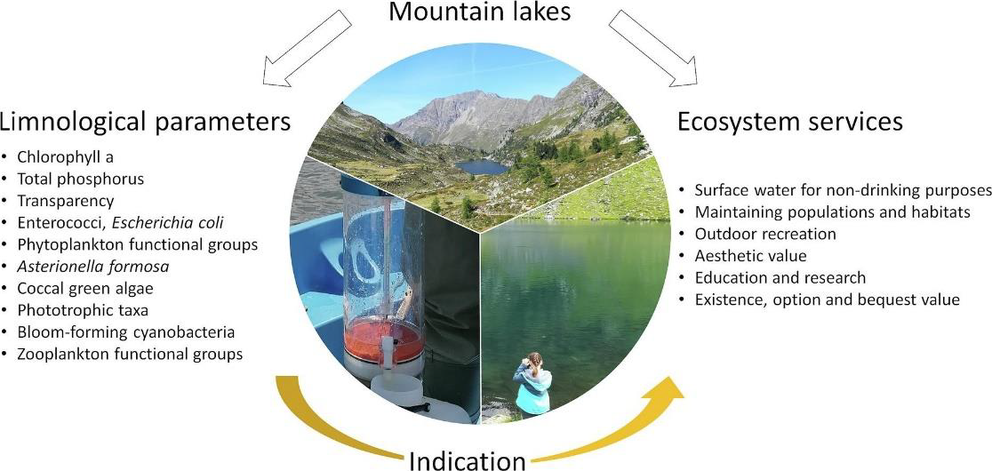
Graphical abstract showing the link between mountain lake ecosystems, assessed by limnological parameters, and provided ecosystem services.
Pritsch, H., Schirpke, U., Jersabek, C. D., & Kurmayer, R. (2023). Plankton community composition in mountain lakes and consequences for ecosystem services. Ecological Indicators, 154, 110532. https://doi.org/10.1016/j.ecolind.2023.110532
Red clover productivity under drought: Are soil microbes a burden or a treasure?
Plants face water scarcity by changing their traits to avoid water loss by reducing leaf size, increasing leaf thickness and reducing stomatal density, and to increase root uptake by increasing root biomass. While these responses to drought are well documented, the role of plant-soil interactions in influencing these changes remains unclear. This study focuses on mutualistic soil microbes, specifically arbuscular mycorrhizal fungi (AMF) and Rhizobium, which are known to enhance plant productivity, water and nutrient uptake, and stress tolerance. We hypothesise that fluctuations in soil microbial populations not only influence plant productivity, but also modulate plant responses to drought by shaping plant traits. To test this hypothesis, a pot experiment was conducted with red clover (Trifolium pratense L.). The experiment included two treatments: a water treatment (wet versus drought) and microbial reduction by soil steam sterilization (native versus sterilized soil).
The results showed that plants in the native soil had low productivity and exhibited traits associated with slow-growing strategies, including smaller and coarser leaves, lower stomatal density, and increased root mass. Mutualism with beneficial microbes, such as AMF, and the fight against pathogens required resources from the plant, hindering productivity. Conversely, reducing soil microbial loads through sterilization increased plant productivity under well-watered conditions, promoting traits associated with fast-growing strategies. However, under drought conditions in sterilized soil, productivity decreased, early wilting occurred, and traits associated with a slow-growing strategy emerged. Notably, roots became longer and thinner and rhizobial nodulation decreased, signalling a reduction in mutualistic interactions.
These findings highlight the key role of soil microbes in triggering changes in plant traits, and thus their importance in plant responses to drought. Additionally, they highlight the microbial contribution to maintaining plant productivity and vitality of red clover under challenging environmental conditions.
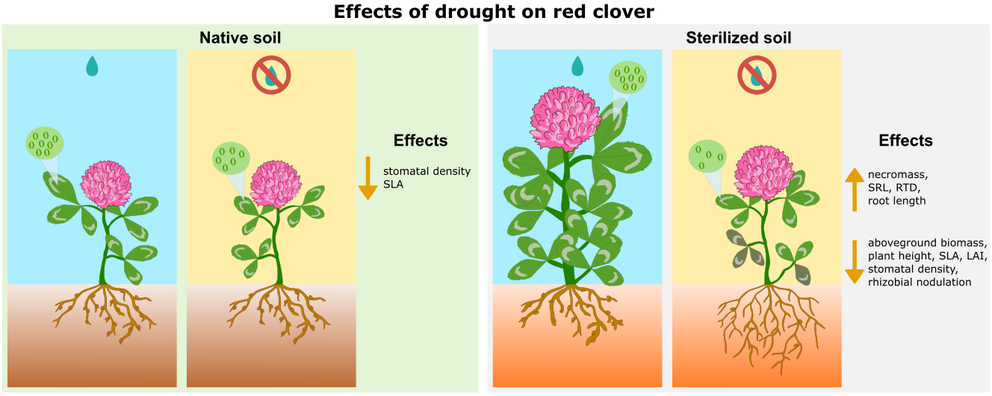
Graphical abstract of the paper showing the effects of drought on red clover growing in native soil and sterilized soil.
Tello-García, E., Mandolini, E., Tasser, E., Probst, M., Peintner, U., Tappeiner, U., Leitinger, G. (2023) Red clover productivity under drought: Are soil microbes a burden or a treasure?
Environmental and Experimental Botany 214: 105486 DOI: https://doi.org/10.1016/j.envexpbot.2023.105486
Student paper awards 2022
Science Flash contributions:
Comparison of commonly used software pipelines for analyzing fungal metabarcoding data
Red clover productivity under drought: Are soil microbes a burden or a treasure?
DP ABGC Student Paper Award 2021
DP ABGC Student Paper Award 2020
The multifunctionality of mountain landscapes
Pros and cons of using a standard protocol to test germination of Alpine species
Agent-Based Modelling of a Coupled Water Demand and Supply System
Wolbachia megadiversity: 99% of these microorganismic manipulators unknown
DP ABGC Student Paper Awards 2019
The microbiome of plants: R. glacialis and its rhizobiome along a high-alpine altitudinal gradient
Lots of ‘junk’ in the genome of a small aquatic invertebrate
A dataset for future monitoring of climate change effects in Alpine streams
Forest fires: How surviving trees can suffer from heat injuries