

GOAL 13 Climate Action
Take urgent action to combat climate change and its impacts
SDG 13 seeks to implement the commitment to the United Nations Framework Convention on Climate Change and operationalise the Green Climate Fund. It aims to strengthen countries’ resilience and adaptive capacity to climate-related hazards and natural disasters by integrating climate change mitigation and adaptation measures into national strategies, policies and planning.
This also requires improved education, awareness-raising and capacity on climate change mitigation and adaptation, as envisioned by SDG 13.
As the poorest and most vulnerable people are affected the most by climate change impacts, SDG 13 calls specifically for raising capacity for climate-change related planning and management in least developed countries.
Monitoring SDG 13 in an EU context focuses on progress made in climate mitigation efforts, in reducing climate impacts and in supporting climate action.
Education for Sustainable Development Goals
Suggestions for the development of specific sustainability competencies from the action-oriented, transformative educational and learning outcome-oriented guide Education for Sustainable Development Goals, UNESCO (2017)
Suggested learning outcomes
Cognitive learning outcomes
- The learner understands the greenhouse effect as a natural phenomenon caused by an insulating layer of greenhouse gases.
- The learner understands the current climate change as an anthropogenic phenomenon resulting from increased greenhouse gas emissions.
- The learner knows which human activities – on a global, national, local and individual level – contribute most to climate change.
- The learner knows about the main ecological, social, cultural and economic consequences of climate change locally, nationally and globally and understands how these can themselves become catalysing, reinforcing factors for climate change.
- The learner knows about prevention, mitigation and adaptation strategies at different levels (global to individual) and for different contexts and their connections with disaster response and disaster risk reduction.
Socio-emotional learning outcomes
- The learner is able to explain ecosystem dynamics and the environmental, social, economic and ethical impact of climate change.
- The learner is able to encourage others to protect the climate.
- The learner is able to collaborate with others and to develop commonly agreed-upon strategies to deal with climate change.
- The learner is able to understand their personal impact on the world’s climate, from a local to a global perspective.
- The learner is able to recognize that the protection of the global climate is an essential task for everyone and that we need to completely re-evaluate our worldview and everyday behaviours in light of this
Behavioral learning outcomes
- The learner is able to evaluate whether their private and job activities are climate friendly and – where not – to revise them.
- The learner is able to act in favour of people threatened by climate change.
- The learner is able to anticipate, estimate and assess the impact of personal, local and national decisions or activities on other people and world regions.
- The learner is able to promote climate-protecting public policies.
- The learner is able to support climate-friendly economic activities.
Best Practice
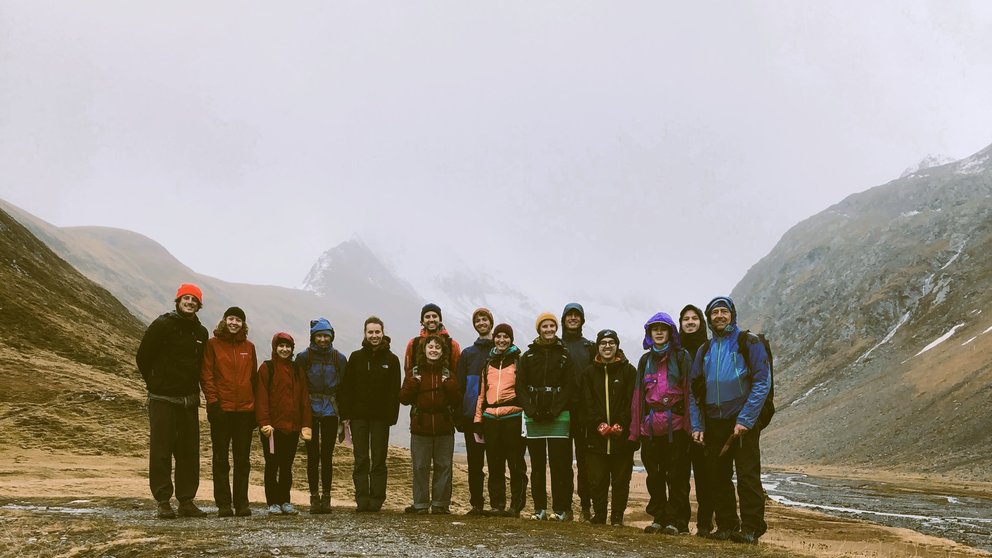
800871 EX Bildung für Nachhaltige Entwicklung im Geiste der Humboldt Brüder. Eine (selbst-)reflektierende Expedition in den Alpenraum: As part of the “Education for Sustainable Development” initiative, Sabrina Bacher (Institute for Teacher Education and School Research) and David Segat (Institute of Geography) at the University of Innsbruck designed an interdisciplinary course in the form of an excursion. Entitled "Education for Sustainable Development in the Spirit of the Humboldt Brothers. A (self-)reflective expedition in the Alpine region," the course combined geographical and educational perspectives to bring sustainable development to life. The aim of the course was to promote a holistic, interdisciplinary understanding of nature in the spirit of Alexander von Humboldt. This was intended to sensitize students to issues of sustainability and strengthen their critical thinking and reflective abilities with regard to human-environment relations. The excursion made it possible to experience theoretical concepts in real contexts and to link interdisciplinary perspectives. A three-pillar didactic approach was developed specifically for the course: (1) Wilhelm von Humboldt's educational ideal and ideas on tertiary education and its didactic further development by Wolfgang Klafki (2) findings from nature, experiential, and adventure education, and (3) the university didactic competency framework LOUIS (Learning Outcomes in University for Impact on Society). A phenomenologically influenced concept of learning formed the basis, according to which learning is understood as a holistic process of experience and meaning-making, focusing on perception, physicality, and subjective experience. Through interactive, experience-based learning, students were encouraged to reflect on their responsibility for sustainable development and to see themselves as multipliers of sustainable practices. The teaching concept combines science, practice, and personal development and makes a valuable contribution to university education for sustainability. Awarded the Ars Docendi State Prize for Excellence in Teaching (main prize 2025).
Suggested topics
Greenhouse gases and their emission Energy, agriculture and industry-related greenhouse gas emissions
Climate change-related hazards leading to disasters like drought, weather extremes, etc. and their unequal social and economic impact within households, communities and countries and between countries Sea-level rise and its consequences for countries (e.g. small island states)
Migration and flight related to climate change
Prevention, mitigation and adaptation strategies and their connections with disaster response and disaster risk reduction
Local, national and global institutions addressing issues of climate change
Local, national and global policy strategies to protect the climate
Future scenarios (including alternative explanations for the global temperature rise)
Effects of and impacts on big eco-systems like forests, oceans, glaciers and biodiversity Ethics and climate change
Examples of learning approaches and methods
Perform a role-play to estimate and feel the impact of climate change related phenomena from different perspectives
Analyse different climate change scenarios with regard to their assumptions, consequences and their preceding development paths
Develop and run an action project or campaign related to climate protection
Develop a web page or blog for group contributions related to climate change issues
Develop climate friendly biographies Undertake a case study about how climate change could increase the risk of disasters in a local community
Develop an enquiry-based project investigating the statement “Those who caused the most damage to the atmosphere should pay for it”
External Links
Department of Economic and Social Affairs, United Nations
Targets and Indicators of Goal 13