
Our profile
We reflect on the big questions of life: God and the world, life and death, creation and sustainability, justice and mercy, peace and freedom, dialogue and truth. We shape current academic and social discourse. We learn from history and prepare for the future. We practise theology and philosophy relevant to life.

The Faculty is a centre for education and training in philosophy and theology, which attracts students from western Austria, South Tyrol and southern Germany, but also from all over the world. Academically sound, spiritually rooted and in dialogue with the world, it fosters knowledge through encounter and debate with other denominations, religions and world views. Characterised by its close ties to the Jesuit order, the Faculty seeks to contribute to the positive impact of faith on society through teaching and research. With its interdisciplinary outlook, it shares the apostolic commitments of the Society of Jesus to spirituality, young people and future generations, the poor and disadvantaged and the environment.
The Faculty actively supports students with the potential to play key rolls in academy, society and church in less developed countries, especially in the Global South.
The Faculty's research has traditionally been characterised by a focus on philosophy, philosophy of religion and systematic theology (Emerich Coreth SJ, Karl Rahner SJ, Raymund Schwager SJ and others), but we have not lost sight of historical and practical theology or Biblical studies (Hugo Rahner SJ, Josef A. Jungmann SJ, Herlinde Pissarek-Hudelist). Our present work is characterised by the awareness that confessional theology, in dialogue with the other disciplines, has a mission to fulfil for the sustainabel development of society as a whole. We try to realise this in particular at the Faculty's research centres.
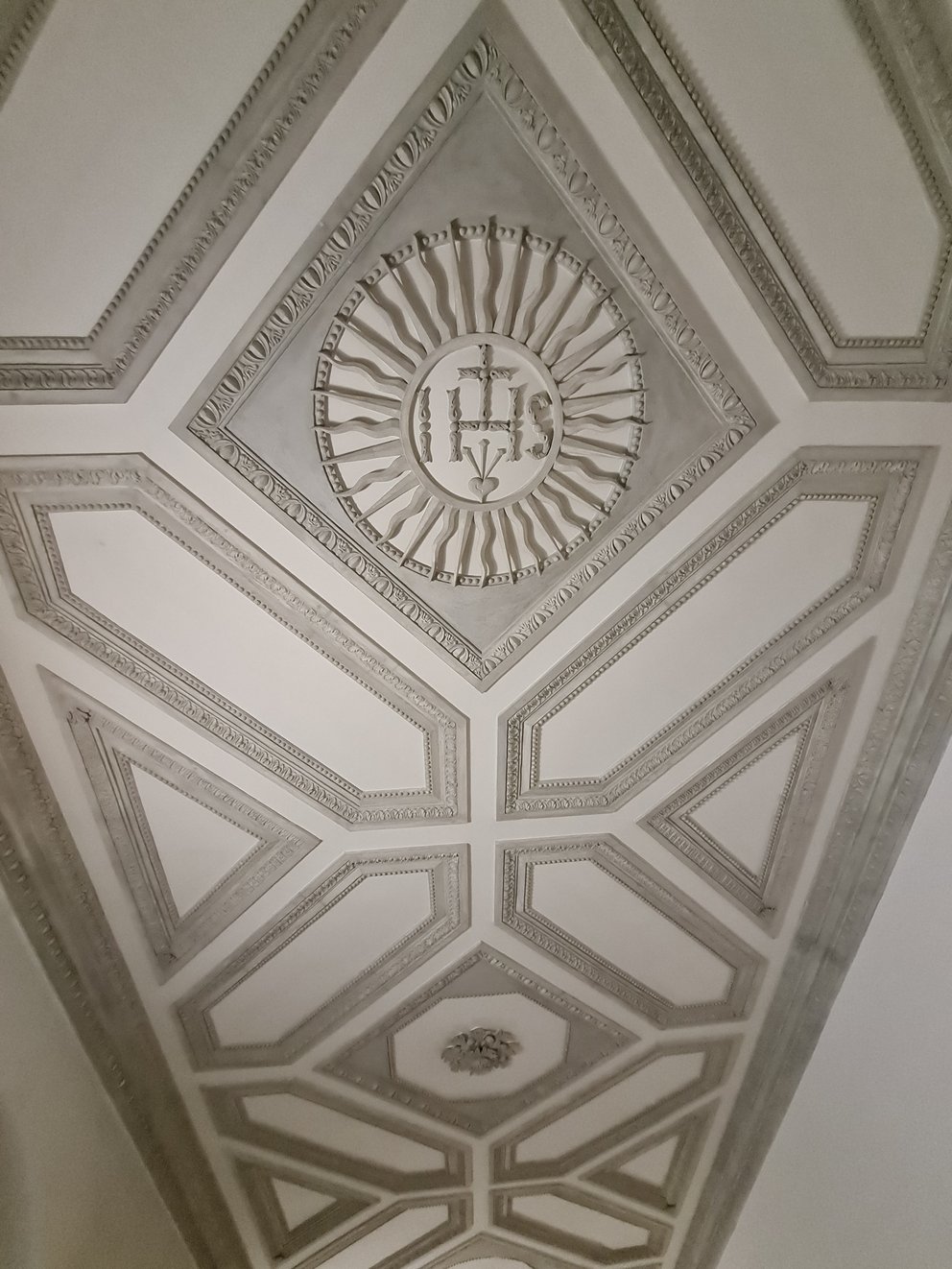
The Faculty of Catholic Theology was one of the four founding faculties of the University of Innsbruck, alongside the Faculties of Philosophy, Law and Medicine. The establishment of the University was authorised by Emperor Leopold I in 1669.
The professors of Philosophy and Theology were mostly members of the Jesuit order, which had been present in Innsbruck since 1562. The Jesuit, Peter Canisius, had founded a college and a grammar school here.
Shortly after the order was abolished by the Pope (1773), the entire university moved from Herrengasse to the now vacant Jesuit College in today's Universitätsstraße. However, Emperor Joseph II downgraded the university to a Lyceum, which could not award academic degrees (doctorates, postdoctoral qualifications). The training of theologians was transferred to a so-called general seminary and during the Napoleonic era, there was even no university at all in Innsbruck, but instead higher education was offered in Munich.
In 1826, the University of Innsbruck was re-established by Emperor Franz I. However, the full restoration of the medical and theological faculties took some time. In 1857, the latter was completely transferred to the responsibility of the Jesuit Order, which had been re-authorised by the Pope in 1814.
It was at this time that the international orientation of the Faculty began to develop. As the diocesan clergy were educated in Brixen and Trento, the Innsbruck Faculty was to dedicate itself to research and attracting students from abroad. To this day, the Collegium Canisianum in particular continues to focus on gathering international students.
The Faculty remained part of the state university, but the special relationship between the Society of Jesus and the Faculty was made legally binding in 1934 by the Concordat between the Republic of Austria and the Holy See.
Immediately after the so-called Anschluss of Austria to the German Reich in 1938, the Faculty of Theology in Innsbruck was the only one in the entire territory of the Reich to be abolished. The Jesuit College was dissolved and its property expropriated. Some professors were able to continue their work in Switzerland with international students from the Collegium Canisianum.
This made it possible to quickly re-establish the Faculty after the Second World War.
In the academic year 1945/46, 163 of the more than four thousand students at the University of Innsbruck were enrolled at the Faculty of Catholic Theology. In the following decades, the Faculty was characterised by the work of important theologians such as Josef Andreas Jungmann and Karl and Hugo Rahner, whose theology was reflected in the documents of the Second Vatican Council.
In 1989, Herlinde Pissarek-Hudelist became the first woman in the world to be elected Dean of a Faculty of Catholic Theology. Nevertheless, until the end of the twentieth century, the professors were mostly Jesuits. This has fundamentally changed, due to structural changes in the church as a whole and the growing proportion of lay theologians. Today, lay people make up the majority of students and teaching staff. The last time a Jesuit served as Dean was 2003 and since 2013 the Dean has been a lay person.
The Faculty was restructured as part of the 2002 Universities Act and now consists of four departments. In the course of a general refurbishment completed in 1999, the historic buildings at Universitätsstraße and Karl-Rahner-Platz were restored to their former splendour and the new faculty library was built.
Student numbers have levelled off at around four hundred after a high around the turn of the millennium.


Some personalities from the history of the faculty
Karl Rahner (1904-1984) - a theological life
Roman Siebenrock
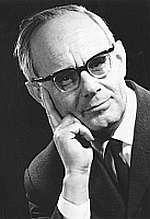
When Fr Karl Rahner SJ was asked to report on the experiences of a Catholic theologian in his home town of Freiburg at the end of his life, he described his experiences as those of "a man who was commissioned to be a theologian, but did not really know whether he had done justice to this mission". This self-effacement that characterises him does not only stem from personal inadequacy, but above all from a fundamental overtaxing of theology, because it has to speak of the incomprehensibility of God and his lovingly approached mystery.
In his theological existence, we are not confronted with a planned life for Catholic theology, a life that is simply self-determined or aimed at by private academic motives. A basic biographical orientation is quickly given and essentially coincides with the stages of his religious life and the resulting theological, academic and ecclesiastical work. He was capable of many things, and his training would also have enabled him to fulfil various roles and fields of work.
Karl Rahner was born in Freiburg im Breisgau on 5 March 1904. Like his brother Hugo before him, he joined the Society of Jesus (1922). After the usual religious training (novitiate 1922-1924; philosophy 1924-1927; practical experience as an educator 1927-1929; theological studies 1929-1933; ordination to the priesthood 1932 and tertianship 1933-1934), he completed specialised philosophical studies in his home town because he was to become a professor of the history of philosophy. There he was also able to experience Martin Heidegger as a teacher (1934-1936). Before completing his studies, he was 'reassigned' to theology by his religious superiors. For this reason, he obtained his doctorate (1936) and habilitation (1937) in Innsbruck. He also began lecturing here (1937/1938), but this was soon interrupted by the National Socialists' abolition of the Faculty of Theology (1938) and the Gau ban on Jesuits (1939). From 1939 to 1944 he worked at the pastoral care institute in Vienna and in an unofficial theological training programme in the order. As a pastor in Lower Bavaria (1944/1945), he lived to see the end of the war. As a professor (1945-1948 in Pullach near Munich; 1948-1964 in Innsbruck; 1964-1967 in Munich as Romano Guardini's successor at the Faculty of Philosophy; 1967-1971 in Münster again as a dogmatist), he made a significant contribution to the awakening of Catholic theology in this century. As a council advisor to Cardinal König and then as an official council theologian, he placed himself at the disposal of the great event of the Catholic Church in this century, the Second Vatican Council, for which he - without having the slightest thought of such a council - helped to develop essential perspectives and set the course beforehand: in his "Schriften zur Theologie", in the publication of the "Quaestiones disputatae" and above all in the second edition of the "Lexikon für Theologie und Kirche".
The last years of his academic career and the time of his retirement in Munich (1971-1981) were filled with the struggle for a contemporary reception of the Council in theology and the church. In 1981 he returned to Innsbruck, where he died shortly after his 80th birthday on 30 March 1984. Fr Karl Rahner SJ is buried in the crypt of the Jesuit Church in Innsbruck.
The dynamic, even dramatic nature of his life resulted from the social and ecclesiastical upheavals of his lifetime, which he courageously faced, especially as a professor of dogmatics in Innsbruck, and never withdrew from until the end of his life: the need for faith in the diaspora situation of Christians, the challenges of modernity in technology, science, pluralism and its fundamental question of the meaning of the human subject, but also the inner-Christian questions of an ecumenism of Christian denominations and the relationship of Christianity to other religions and world views. Above all, however, he asked: How can the Church, in accordance with its origins and in continuity with its binding tradition, convincingly proclaim its message of God's self-communication in Jesus Christ and in the Holy Spirit, who has been poured out on all flesh, as its salvation to a world that has become secular and increasingly agnostic and pluralistic? In his opinion, efforts are needed to achieve this, including a structural change in the church. Questions - almost too many for one lifetime; perspectives - (still) too bold for his and our church? He has brought about a change for the better in Catholic theology, which in his spirit can be more humane and more worthy of God. The future will show that he has opened doors into the next millennium for the Christian faith and the world church that is already emerging today. It is up to us to take the plunge.
Hugo Rahner (3 May 1900 to 21 December 1968; SJ 1919) lectured as a historian of dogma, patrologist and church historian in Innsbruck from 1935. The abolition of the faculty by the Nazi regime and the war forced its relocation to Switzerland (Sion). After the re-establishment of the faculty in Innsbruck (1945), he was Rector Magnificus of the entire university (1949/50). His work is characterised by contributions to patrology, Ignatius research and the spiritual situation of the present. A serious illness forced his early retirement (1962).
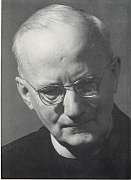
Josef Andreas Jungmann (16.11.1889-26.1.1975), 1930 associate university professor, 1934-1956 associate university professor of pastoral theology, 1956 honorary professor, became internationally known above all as a liturgical historian, especially for his work "Missarum Sollemnia. Eine genetische Erklärung der römischen Messe" (2 vols. Vienna 1st ed. 1948; 5th ed. 1962). His expertise earned him appointments to committees in which he was able to work for liturgical reform, most recently to the commissions of the Second Vatican Council (1960: Preparatory Commission, 1962 Council Commission) and to the Council for the Implementation of the Liturgical Constitution (1964). Jungmann's central concern - outlined as early as 1915 in an unpublished essay and in 1936 in the book "Die Frohbotschaft und unsere Glaubensverkündigung" (The Good News and Our Proclamation of Faith) - encompassed more than the church service: Christianity was to be proclaimed and lived anew from its centre - Jesus Christ. Jungmann pursued historical research for the sake of this goal. It made it possible to distinguish between the enduring and the time-bound and thus to uncover the principles on which a renewal of the entire religious life could be built.
In mid-November 1991, the Senate's decision to erect a memorial plaque to Ignacio Ellacuria (1930-1989) and Segundo Montes (1933-1989) at the Leopold Franzens University memorial was put into practice in a small ceremony initiated by Prof. Dr Gerhard Oberkofler.
The two Spanish Jesuits had studied theology in Innsbruck (from 1958 to 1962 and from 1961 to 1964 respectively) and were ordained priests here by Bishop Paulus Rusch (1903-1986).
The memorial plaque commemorates the massacre of 16 November 1989, in which six Jesuit priests and two women were brutally murdered by an elite army unit at the Central American University (UCA) in the Salvadoran capital San Salvador - as a lengthy investigation, which was only driven forward by international pressure, revealed.
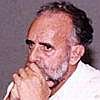
P. Ellacuría (59), philosopher and rector of the UCA, was one of the leading liberation theologians in Central and Latin America. The superior of the Jesuit community, Fr Montes (56), a sociologist and director of the Human Rights Institute, had recently received a human rights award from the US Congress. Her blood, that of her confreres and the two house employees has become the seed for people who live their Christian faith even more resolutely - and put it into practice effectively in society, for more peace and justice.
The ceremony took place under the then Dean Univ.-Prof. Dr Herlinde Pissarek-Hudelist (1932-1994). The memorial is located on Christoph-Propst-Platz am Innrain, named after a member of the resistance group - a medical student at the time.
Shortly after her 62nd birthday, Professor Dr Herlinde Pissarek-Hudelist died of cancer on 19 June 1994. Her tireless commitment to religious education and her dedication to the Faculty during her time as Dean were honoured at her funeral, at the Faculty of Theology's church service, in numerous letters of condolence and in many personal conversations. In particular, it has become clear for how many women inside and outside the church she has become a beacon of hope.
Herlinde Pissarek-Hudelist was a theologian and religious educator with heart and soul. She began studying theology in Innsbruck in 1950. After gaining her doctorate in 1960, she worked as a university assistant at various institutes and as a freelance contributor to the "Zeitschrift für Katholische Theologie". Over the course of her life, she taught religious education at a total of nine different types of school. In 1978, she took over practical school exercises at the Faculty of Theology and became a contract teacher in 1981. In 1984, she became the first full professor and head of the newly established Institute for Catechetics and Religious Education, which she managed with great care. A great challenge for her - as the first woman in the world - was her election as Dean of a Faculty of Catholic Theology for the academic years 1989/90 and 1990/91 and her re-election for a successful second term of office for the academic years 1991/92 and 1992/93. She did not shy away from conflicts and difficulties and always endeavoured to achieve cooperation and consensus on a broad basis in all disputes. She was particularly pleased when the student representatives unexpectedly presented her with a certificate of thanks as an expression of appreciation at a celebration on 6 June 1993.
In an autobiographical article entitled "Life in abundance", she herself briefly and aptly characterised her professional path in a subheading: "Theology as a passion or: the adventure of keeping head, heart and spirituality together and acting accordingly." In her case, it is clear to see how much she embarked on this adventure throughout her life as a pioneer of feminist theology and as a courageous champion of a fraternal church. Her vitality and energy, her characteristic humour and her open-mindedness will remain in our grateful memories.
R. Schwager never saw himself as a theological lone wolf. He worked early on to set up intra-theological and interdisciplinary discussion groups and research programmes that would deal with the pressing problems of the time in a "dramatic" struggle for the truth. Particular importance was attached to dealing with the problem of violence and peace, which was also of fundamental importance for Schwager's own (biblical) theological approach. He was one of the co-founders of the international and interdisciplinary "Colloquium on Violence and Religion" (COV&R) in 1990; he was elected its first president in 1991. As early as the mid-1980s, he and others began to set up the theological research centre "Religion-Violence-Communication-World Order" (RGKW); the interfaculty Research Platform "World Order-Religion-Violence" (WRG), now "Politics, Religion, Art" (PRK), also goes back to R. Schwager's initiative. From 1984 to 1990, he was the first chairman of the university senate working group "Science and Responsibility"; from 1992 to 1996, he was chairman of the working group of dogmatists and fundamental theologians in the German-speaking world. Schwager's theological approach was adopted by his numerous students and colleagues in various theological disciplines (Christian social theology, fundamental theology, exegesis, biblical theology, etc.) and continued - in some cases in a revised form. He died unexpectedly only a few weeks after his retirement at 27 February 2004. His academic legacy was then reviewed and systematically organised in the "Raymund Schwager Archive" at the Faculty of Theology in Innsbruck and thus made available for research. The research project is largely based on the material catalogued there.
Christian Marte SJ
Appointment as honorary senator: 18 October 2024
Christian Marte, born in 1964, studied philosophy in Munich and theology in London and Innsbruck. He is rector of the Jesuit College and the Jesuit Church in Innsbruck as well as a prison chaplain. Marte also received the title of Honorary Senator as a representative of the Jesuit Order, which continuously provides 40 doctoral scholarships at our faculty as part of the Collegium Canisianum.
Luis Gutheinz SJ
Award of the honorary doctorate: 27.06.2014
Luis Gutheinz, born 1933, professor from 1974-2005 at the Faculty of Theology of Fujen Catholic University in Taipei/Taiwan, commitment to leprosy patients in Taiwan and China, editing, editing and translation of theological lexicons into Chinese
José Casanova
Awarded an honorary doctorate: 12.06.2010
José Casanova, born 1951, one of the world's leading sociologists of religion, Professor at the Department of Sociology at Georgetown University, Washington D.C., and Director of the Berkeley Center's Program on Globalisation, Religion and the Secular
Georg Sporschill SJ
Award of the honorary doctorate: 11.06.2005
P. Georg Sporschill, born 1946, founder of Concordia, social commitment to the poor and people neglected by society, development of a care network for street children and neglected young people in Eastern Europe (Romania, Bulgaria, Moldova)
Ludger Honnefelder
Awarded an honorary doctorate: 05.06.1999
Ludger Honnefelder, born 1936, Professor of Philosophy at the Faculty of Theology of the University of Trier, at the Free University of Berlin, at the University of Bonn; after his retirement (2005-2007), the newly created Guardini Professorship for Philosophy of Religion and Catholic Worldview at the Humboldt University of Berlin.
Deceased honorary doctors
Josef Neuner SJ
Awarded an honorary doctorate on 23.06.2001, died on 03.12.2009
Karl Cardinal Lehmann
Awarded an honorary doctorate on 08/06/1991, passed away on 11/03/2018
Cardinal Karl Lehmann, born 1936, Bishop of Mainz, Chairman of the German Bishops' Conference (1987-2008) was Professor of Dogmatics and Ecumenical Theology at the University of Freiburg i. Br., long-time colleague of Karl Rahner
René Girard
Awarded an honorary doctorate on 11.06.1988, died on 04.11.2015
René Girard, born 1923, literary scholar, cultural anthropologist and philosopher of religion, professor emeritus at Stanford University; member of the Académie française, founder of mimetic theory
Johannes Wagner
Awarded an honorary doctorate on 16.12.1983, died on 25.11.1999
Walter Brugger
Awarded an honorary doctorate on 28.06.1980, died on 13.05.1990
Rudolf Schnackenburg
Awarded an honorary doctorate on 05/06/1970, passed away on 28/08/2002
Heinrich Schlier
Awarded an honorary doctorate on 05/06/1970, passed away on 26/12/1978
Vincenzo Monachino
Awarded an honorary doctorate on 05.06.1970, died on 11.09.2000
Henri Cardinal de Lubac
Awarded an honorary doctorate on 05/06/1970, died on 04/09/1991
Joseph Lortz
Awarded an honorary doctorate on 05/06/1970, died on 21/02/1975
Franz Cardinal König
Awarded an honorary doctorate on 05/06/1970, died on 13/03/2004
Piet Fransen
Awarded an honorary doctorate on 05/06/1970, died on 02/12/1982
Karl Rahner SJ
Awarded an honorary doctorate on 05.06.1970, died on 30.03.1984
Oswald von Nell-Breuning SJ
Awarded an honorary doctorate on 25.06.1960, died on 21.08.1991
Franz Schreibmeyer
Awarded an honorary doctorate in 1958, died on 17/11/1985
Klemens Tilmann
Awarded an honorary doctorate in 1958, died on 21.12.1984
Dean Raymund Schwager reformed the Faculty’s organisation and curricula in far-reaching ways, before passing away far too early. He was also eager to open the Faculty to the outside world and communicate with society.
In addition to the faculty newspaper, Baustelle Theologie, and the development of a corporate identity by the agency, ARGE Sutterlüty & Rettenbacher, he aimed to make the rooms, which had been restored to their former splendour during the renovation, accessible to a wider public.
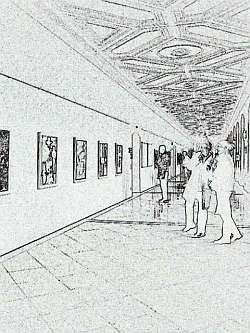
In 1999, we began to use the over one hundred metre-long corridor on the first floor of the faculty building for exhibitions. Theologians were to encounter art, and a public interested in artistic expression.
The Kunst im Gang initiative became a brand with its own logo (büro54, Lilly Moser). It earned itself an esteemed place in Innsbruck's cultural scene. Exhibiting artists included Günter Lierschof, Peter Blaas, Gabriela Nepo-Stieldorf, Irmengard Schöpf, Annamaria Gelmi, Peter Raneburger, Beatrix Salcher, Reiner Schiestl, Maurizio Bonato, Hans Dragosits, Norbert Pümpel, Gitti Schneider and Lois Salcher.
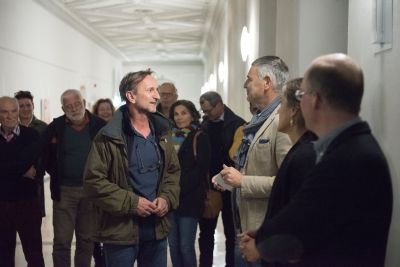
With the retirement of Bernhard Braun in 2020, the twenty-year faculty initiative Kunst im Gang, presenting around forty-five exhibitions, ended with an exhibition by Susanne Loewit. The Dean of the Faculty, Josef Quitterer, celebrated this farewell on the occasion of the last exhibition.
The exhibitions
Susanne Loewit
Anima
Eröffnung: 08. November 2019
Siegfried Antonello Schwendtner
Klangfarben – Farbtöne
Eröffnung: 07. Juni 2019
Günter Lierschof
Domodossola – Stadt der Liebe
Ein Märchen für Erwachsene
Zeichnungen mit Text (2008-18)
Eröffnung: 09. November 2018
Anna Maria Mackowitz Elisabeth Melkonyan
LOOP - raum zwischen erinnern und vergessen
Eröffnung: 23. März 2017
Further exhibitions
- 8.4-3.5.2003: Paolo Gallerani, Beatrix Salcher, Peter Raneburger, Leiden.schaft (see also article from Construction site theology year 6 (1))
- 2.11-21.21.2001: Special exhibition "The Way of the Cross of Osor"
- 5 - 31 October 2001: Special exhibition together with the Tyrolean Folk Art Museum: With Sceptre and Pilgrim's Staff. Austrian presence in the Holy Land since the days of Emperor Franz Joseph
- 2 Oct. - 30 Nov. 1999: Günter Lierschof, The Intelligence of the Painter
- 18 March - 2 April 1999: Christian C. Haider, The Gospel according to Luke (special exhibition on the 2nd floor of the longitudinal wing)
- 4-30 June 1998: Maurizio Bonato, Giotto's Picture Language (Project: In-Gang-Setzung)