
Formation processes
Natural and human-made formation processes are crucial for interpreting the archaeological record. These are analysed through fine-stratigraphic excavation methods.
Excavations in the city centre
A detailed investigation of site-formation processes was carried out in the more recent excavations at the macellum and the commercial forum.
The results—especially for the natural processes—are applicable to the entire city. For example, removing the post‑antique flood deposits, which reached a maximum thickness of about 3 m above the ancient ruins, showed that Aguntum’s inundation resulted from multiple flood events.
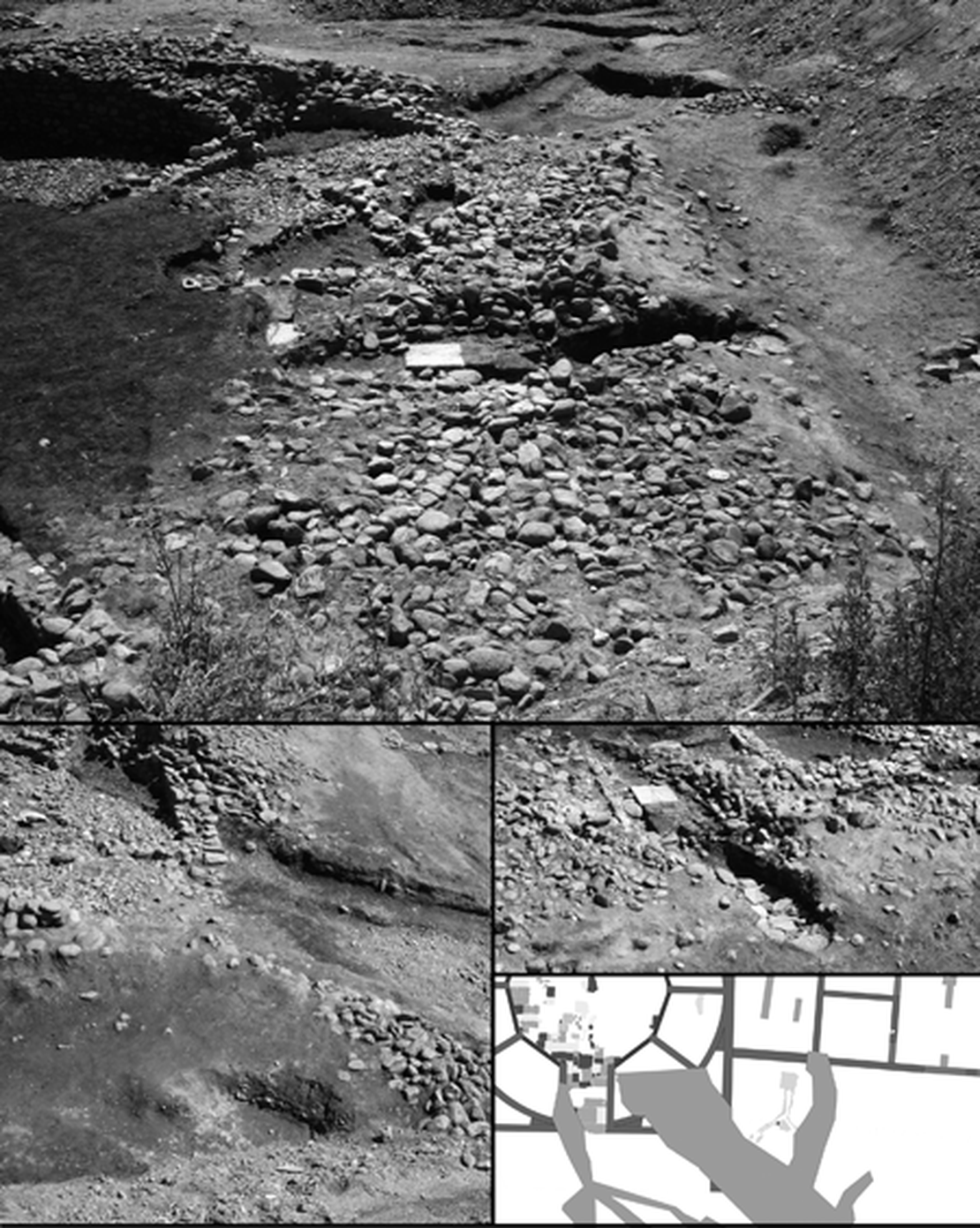
Contrary to earlier assumptions, gravitational mass movements (“mudflows”/debris flows) were not solely responsible for flooding the city. The stratified deposits near the city center demonstrate, on the one hand, incised channels of various streams that cut through all ancient layers, and on the other hand, successive massive beds of sand and gravel that attest to several distinct flooding episodes. The resulting natural landscape was thus a post‑antique “alluvial terrain,” characterized by shifting stream courses of varying depths and periodic inundation. Some of these events were so severe that recurrent debris flows caused major destruction to ancient structures. According to current research, this primarily affected the eastern part of the city in the area of the city wall north of the decumanus maximus and the suburb.

Erosional cuts caused by stream channels in the macellum area
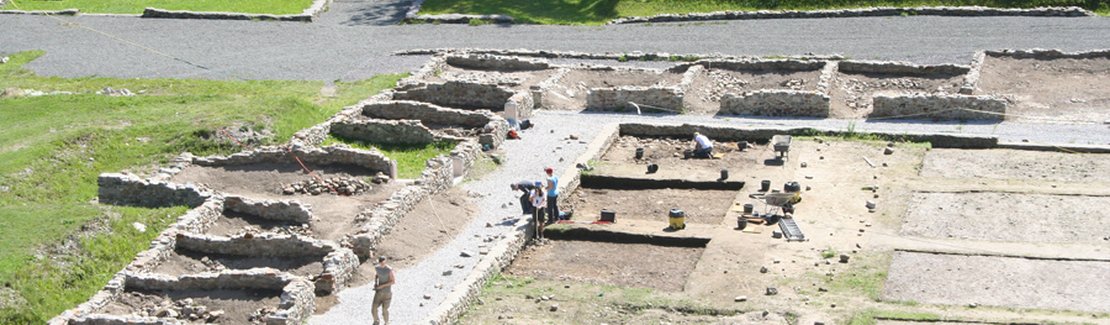
In addition to these natural formation processes, anthropogenic deposition processes were analyzed at the commercial forum. Extensive site preparation was already required during construction, resulting in terracing of the building ground. Determining the building’s use during its main phase is difficult based on the finds within the rooms themselves, as most were empty at the time of the fire (mid-3rd century AD). The courtyard, however, allows certain conclusions about the use of the central space, based on finds scattered across and embedded in the gravelly–humic subsoil. As the largest area of the complex, the courtyard can be regarded as the focal point of the building’s use-history.
Detailed documentation of the precise locations of all small and very small finds makes it possible to reconstruct activity in the eastern quarter of the courtyard. In the 1st and 2nd centuries, rock-crystal fragments accumulated alongside pottery, indicating the importance of the rock-crystal trade during this phase. From the 3rd—and especially the 4th—century, however, bronze and copper fragments, and in some areas slagged glass, became more frequent. These materials are associated with metalworking and glassworking and can be interpreted as late antique recycling processes in the city-center area.

Excavations at the courtyard of the commercial forum
Literature
M. Auer / F. Bleibinhaus / M. Tschurtschenthaler / M. Unterwurzacher, Municipium Claudium Aguntum. Geophysikalische Prospektion auf geologisch schwierigem Terrain, Jahreshefte des Österreichischen Archäologischen Instituts 82, 2013 (2014), 7-21.
M. Auer, Municipium Claudium Aguntum. Das macellum, Ager Aguntinus. Historisch-archäologische Forschungen 6 (Wiesbaden 2025).
Archaeozoological Investigations of Casual Losses from the Atrium House
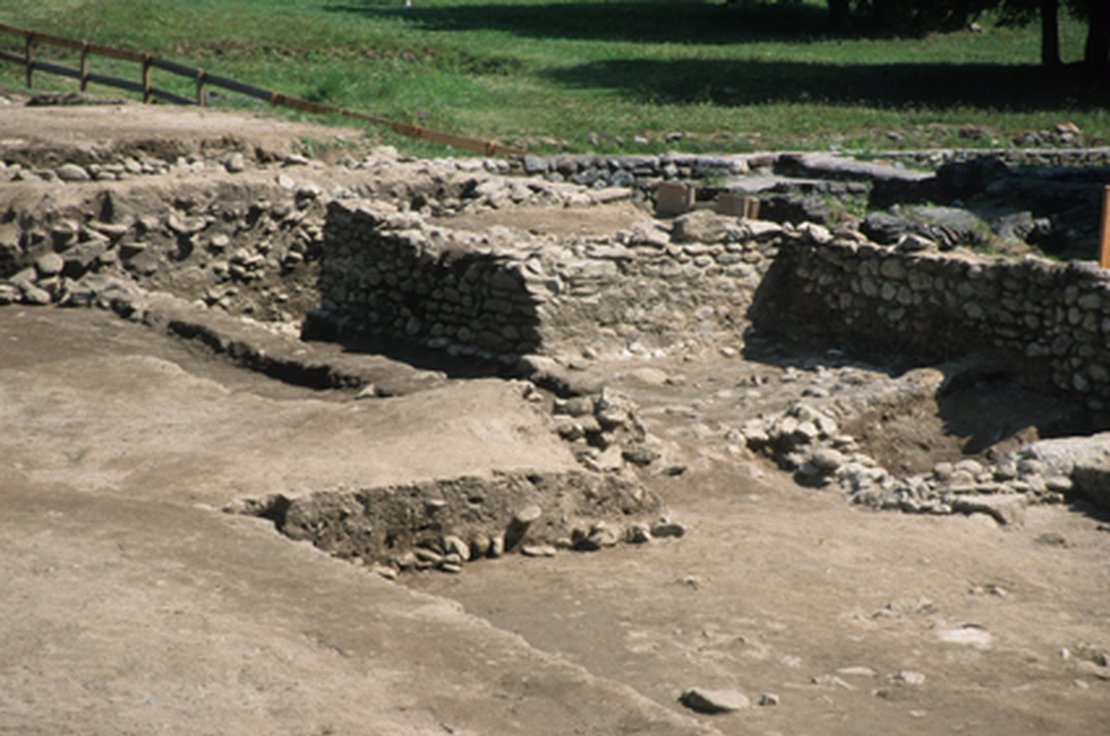
In the course of analyzing the finds from the atrium house at Aguntum (FWF P20846‑G02), it was noted that highly fragmented find categories could be recovered from the building’s garden area that do not occur elsewhere in the assemblage. These artifacts—interpreted as casual losses—thus provide a diachronic insight into the material culture of the atrium house’s occupants, whereas preservation within the house itself depends heavily on reconstruction measures and fill layers. For example, there is scarcely any material from the 3rd century AD in the atrium house, which is likely due to the absence of significant structural alterations during this period and, consequently, a lack of accumulated refuse. On this premise, the animal-bone assemblage from the garden was also examined for compositional particularities by Dr Sabine Deschler-Erb.

Westlicher Garten des Atriumhauses
Overall, the assemblage broadly corresponds to animal remains recovered from other refuse layers. Notable, however, is the presence of ibex, bear, and hare—taxa that are comparatively rare in the other finds from the atrium house. It also became evident that hardly any larger bone elements were discarded in the garden, which was therefore kept largely clean. As with the other finds from the garden area, the animal bones were heavily fragmented. A particularly interesting detail is the discovery of a fetal bovine, indicating that cattle were kept in the garden area.
Literature
S. Deschler-Erb / M. Auer, In cibo veritas - Zur wechselhaften Geschichte des Atriumhauses von Aguntum/Tirol (1.-4. Jh. A.D.) im Spiegel der Speisesitten, Annalen des Naturhistorischen Museums in Wien, Serie A, Band 120, 2018, 321-333.