
Archaeological field research
Since 1991, the Department of Archaeology has conducted annual excavation campaigns in Aguntum in close collaboration with the Curatorium Pro Agunto. In addition, project-based work is carried out at the Iron Age and Late Antique settlement of Lavant, an important component of the region’s archaeological landscape.
Excavations at Aguntum
Beginnings
The earliest modern references to the ruins of Aguntum—mistakenly identified as the remains of ancient Loncium—date to the first half of the 16th century. In the centuries that followed, there are frequent reports of excavations and treasure hunts carried out by farmers, interested laypeople, and scholars in the Aguntum area. Only with the excavations conducted by the Franciscan priest and teacher Innozenz Ploner and the archaeologist Rudolf Egger in 1912/13 were the scientific standards of modern excavation met—at least to a degree that marks the beginning of modern field-archaeological research in Aguntum.

Übersichtsplan zu den römischen Bauten in Aguntum

Until 1990
In 1912/13, Innozenz Ploner carried out targeted investigations to determine the location and extent of Aguntum. Among other findings, he uncovered sections of the city wall and the large public baths. Also in 1912—likely inspired by Ploner’s successes—the Austrian Archaeological Institute in Vienna (ÖAI) began its excavations in East Tyrol under the direction of Rudolf Egger. Near graves discovered in the 19th century, Egger identified what remains the only Early Christian church known in Aguntum to date. This work was interrupted by the First World War and the ensuing economic crisis.
As part of the rerouting of the B100 federal road, Erich Swoboda continued the ÖAI’s excavations in Aguntum from 1931 to 1935 on the initiative of the Lienz Museum Association. He investigated approximately 170 meters of the eastern city wall, including the city gate, as well as several residential buildings and an Early Christian burial structure about 110 meters east of the gate. Operating under the (later disproven) assumption that the town lay east of the exposed wall, he conserved some of the uncovered houses, the city gate, and portions of the wall, and developed the area as the first Aguntum open-air museum.
The Second World War subsequently delayed the continuation of archaeological work. Restoration measures were undertaken in 1947, and excavations were resumed by the ÖAI Vienna in 1950. Under the direction of Franz Miltner, the city wall and adjacent buildings on both sides were excavated until 1955. During this period, the first parts of a building—at the time not yet recognized as an atrium house—were also uncovered. In 1953/54, the first museum and an adjoining conservation workshop were constructed north of the B100 federal road.
From 1956 to 1990, Wilhelm Alzinger directed the excavations on behalf of the ÖAI Vienna. Under his leadership, the atrium house on both sides of the B100 embankment, sections of the so‑called decumanus maximus, the residential buildings to its north (including parts of “House I”), and the area he termed the “craftsmen’s quarter” were partially investigated. Beginning in the late 1960s, the public baths were also uncovered. As a result, the archaeological park was expanded, and a full-scale (1:1) reconstructive shelter was erected over the impluvium of the atrium house.

Reconstruction shelter at the Atrium house.

Since 1991
In 1991, a contract between the Republic of Austria and the Province of Tyrol entrusted the Institute for Classical and Provincial Roman Archaeology at the University of Innsbruck (now the Department of Archaeology), under the direction of Elisabeth Walde, with the continuation of research at Aguntum. At the same time, local excavation management was assigned to Michael Tschurtschenthaler, who served as the scientific director of the Aguntum excavations until 2020. Since his retirement in 2020, the excavations have been led by Martin Auer. Together with the Curatorium pro Agunto (chair: Dr. Leo Gomig), which was reorganized as an association in 1994, efforts were made to revive and significantly expand the excavation activities at Aguntum, which had largely come to a standstill in Alzinger’s later years due to his serious illness. The focus of the University of Innsbruck’s excavation work was shaped by several factors, some of them external. In the early years (1991–1993), buildings previously excavated by Alzinger (“House I,” “Prunkbau”) were further uncovered.
These efforts came to a temporary halt in 1994/95, when construction of the B100 federal road through the middle of Aguntum necessitated rescue excavations. The works affected parts of the city wall, two houses to its east, and especially the central area of the atrium house. The latter had been concealed by the modern road embankment until 1994; during the excavations that then became possible, an ornamental marble basin was discovered, prompting the construction of a bridge that spans this section of the building. The atrium house was subsequently uncovered almost in its entirety between 1996 and 2005.
In the late 1990s, the Curatorium pro Agunto association succeeded in acquiring the so‑called “Tschappelergrund” in the middle of the archaeological park, where the town center of Aguntum had been suspected since the 1970s. Since 2006, excavations have focused on this area. Between 2006 and 2009, the macellum—a circular market building—was uncovered. From 2009 to 2025, work concentrated primarily on the area of the commercial forum, whose function as a combined work-and-living space is the current focus of ongoing excavation and finds processing. At the same time, it was possible to continue the work begun in the early 1990s on the so‑called “Prunkbau”.

Marble Basin in the Peristyle of the Atrium House

Since 1991, archaeological excavations and associated research have focused on both residential and public buildings. Investigations have covered simple houses (“House I,” dwellings directly east of the city wall, areas of the so‑called “craftsmen’s quarter”) as well as the atrium house—the “palace” of what was likely Aguntum’s wealthiest citizen—with a built-up area of more than 6,000 m². Particular attention has been paid to the public buildings at the center of the ancient city (city wall, decumanus maximus, decumanus I sinister, the so‑called “Prunkbau” [= forum], macellum, commercial forum [= Händlerforum]).
Current field archaeological research at Aguntum

Aerial View of Buildings in the City Center of Aguntum

The excavations in the commercial forum were completed in summer 2025. The building uncovered here is organized around a nearly square courtyard. Accommodation rooms were identified along the south, west, and east sides, while larger work areas were located to the north. In the center of the courtyard, a water basin measuring approximately 7 x 9 m and 1.5 m deep was constructed in the earliest phase. A unique finding is the clear evidence for trade in rock crystal in the commercial forum—a commodity not documented in comparable quantity at any other site in the Roman Empire. Among the roughly 2,000 rock-crystal fragments, flakes predominate, indicating on-site processing of the raw material.
The “Prunkbau” (="Prestigious Building") adjoining the commercial forum to the west—so named in the 1970s for its rich marble decoration—was partially excavated under W. Alzinger. Current evidence suggests that it represents the eastern end of the main forum, where the city’s administrative and cult buildings are presumed to have been located. This zone is separated from the commercial forum by a continuous wall, meaning that trade/crafts and the administrative center of the city were clearly separated not only functionally but also spatially. Alongside work in previously untouched areas, a further focus of field research has emerged since 2017 with excavations in the craftsmen’s quarter and at the baths. Work in the forum area and the thermae is ongoing and will continue from 2026.
Literature
A.B. Mayer / A. Unterforcher, Die Römerstadt Agunt bei Lienz in Tirol. Eine Vorarbeit zu ihrer Ausgrabung (1908).
P. I. Ploner, Agunt, die alte Kelten- und Römerstadt bei Lienz in Tirol, und Prof. Ploners Ausgrabungen daselbst (1912).
R. Egger, Ausgrabungen in Noricum 1912/13. ÖJh 17, 1914, Beibl. 5-16.
R. Egger, Frühchristliche Kirchenbauten im südlichen Norikum (1916).
E. Swoboda, Aguntum. Ausgrabungen bei Lienz in Osttirol. 1931-33, ÖJh 29, 1935, suppl., 5-102.
F. Miltner, Aguntum. Vorläufiger Bericht über die Ausgrabungen 1950 -1952, ÖJh 40, 1953, suppl. 93-156.
F. Miltner, Aguntum. Vorläufiger Bericht über die Grabungen in den Jahren 1953 und 1954, ÖJh 42, 1955, suppl. 71-96.
W. Alzinger, Aguntum. Vorläufiger Bericht über die Grabungen in den Jahren 1955 bis 1957, ÖJh 44, 1959, suppl. 75-140.
W. Alzinger, Aguntum und Lavant. Führer durch die römerzeitlichen Ruinen Osttirols5 (1994).
M. Tschurtschenthaler, Feldarchäologische Forschungen in Aguntum seit 1991. Osttiroler Heimatblätter 62, 5 (1994).
M. Tschurtschenthaler, Municipium Claudium Aguntum: römischer Wohnluxus in den Alpen, in: L. Dal Ri / St. di Stefano (Hrsg.), Littamum – Una mansio nel Noricum / Eine Mansio in Noricum, BAR International Series 1462 (Oxford 2005) 106-126.
F. Müller, Der „Museumsverein für Lienz und Umgebung“ und die Gründung des ersten „Museums Agunt“, in: F. Müller, Graben, Entdecken, Sammeln. Laienforscher in der Geschichte der Archäologie Österreichs (Münster/Hamburg/Berlin/Wien/London/Zürich 2016) 217-257.
M. Auer / H. Stadler (Hrsg.), Von Aguntum zum Alkuser See. Zur römischen Geschichte der Siedlungskammer Osttirol, Ager Aguntinus. Historisch-archäologische Forschungen 1 (Wiesbaden 2018).
M. Auer, Municipium Claudium Aguntum. Excavations in the city centre (2006-2015), in: M. Janežič / B. Nadbath / T. Mulh / I. Žižek (Eds.), New Discoveries between the Alps and the Black Sea. Results from Roman Sites in the period between 2005 and 2015. Proceedings of the 1st International Archaeological Conference, Ptuj. 8th and 9th October 2015. In memoriam Iva Mikl Curk (Ljubljana 2018) 93–113.
M. Auer, Municipium Claudium Aguntum, in: J. Horvat, St. Groh, K. Strobel, M. Belak (Hrsg.), Roman Urban Landscape. Towns and minor settlements form Aquileia to the Danube, Opera Instituti Archaeologici Sloveniae 47 (Ljubljana 2024) 243-268.
M. Auer, Municipium Claudium Aguntum - Das Macellum, Ager Aguntinus. Historisch-archäologische Forschungen 6 (Wiesbaden 2025).
Excavations in the Iron Age and Late Antique settlement of Lavant
Beginnings
The first comments on the archaeological potential of the Kirchbichl in Lavant were made by Oswald Menghin in the 1940s, when he identified the successor and predecessor settlement of Aguntum . The first excavations followed in 1948 under the direction of Franz Miltner, who interpreted the settlement at Kirchbichl as a late antique "Fliehburg". Essential to his interpretation is the dating of sparse remains of a fortification wall to late antiquity, which subsequent research has been able to refute. According to current knowledge, the fortification of the hill is more likely to be connected with the Görz Defence Order of 1444. The rectangular building under the church of St Peter at the highest point of the hill, which is sometimes interpreted in the literature as a Celtic cult building, must also be correctly linked to the Görz fortifications.

Kirchbichl von Lavant (Blick von Norden nach Süden)

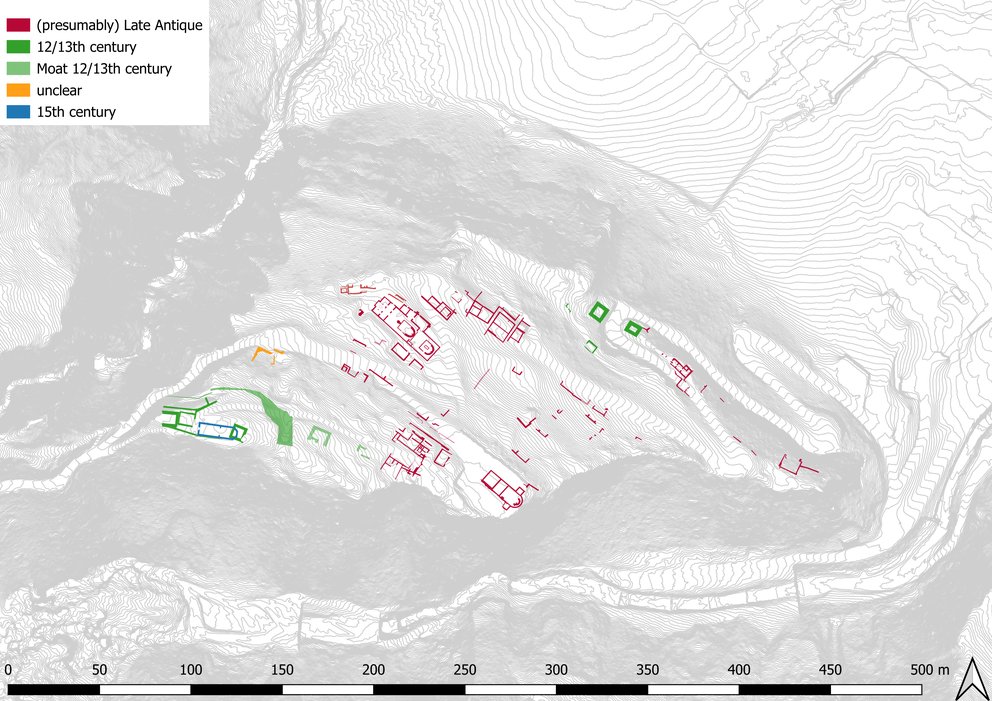
From 1950 to 1952, Franz Miltner uncovered the most important building on the Lavanter Kirchbichl to date. The early Christian church, which Miltner referred to as the bishop's church, was discovered during the construction of a new road leading up the hill. Within a few weeks, Miltner had the entire complex excavated and partially reconstructed during the excavation. Although several construction phases were identified, numerous questions remained unanswered after this initial excavation. With the aim of answering these, several follow-up investigations were carried out between 1966 and 1981 under the direction of Wilhelm Alzinger, but only some of these were published.
Until 2017
For a long time, archaeological research at Lavanter Kirchbichl concentrated on the so-called bishop's church. Only the construction of a new access road to the modern Ulrichskirche church in 1985 led to a systematic, large-scale excavation. The investigations, which lasted until 1991, were able to prove the Bronze and Iron Age, but above all late antique, settlement of the hill. In the following years, various construction measures on Kirchbichl enabled detailed archaeological investigations. In addition to several late antique residential buildings, the most significant new find was another early Christian cult building uncovered in 1994 and 1995 below the present-day parish church of St Ulrich.
Current research
In 2017, excavation work was resumed as part of a restoration project initiated by the Federal Monuments Office and the province of Tyrol on the so-called Bishop's Church. The poor condition of the masonry and the marble parts of the church made extensive conservation work necessary. This forms the starting point for the current archaeological excavations in the bishop's church, which aim to clarify the construction phases of this extremely important early Christian church building. Following initial preparatory work in 2017, larger excavation campaigns were carried out between 2018 and 2025, making it possible to reorganise the construction phases of the church. According to this, the first building did not have an apse to the east, as assumed in older literature, but had a rectangular end (hall church).

"Bischofskirche"

The apse only follows in a further remodelling, although this was originally fitted with a mosaic floor and probably served as a memorial chapel. This was eventually abandoned and replaced by the construction of a significantly larger memorial church, creating a double church complex. A final phase of reconstruction led to a monumentalisation of the building, the central priest's bench was significantly enlarged and the entire church was richly decorated with marble, most of which came from the cemetery of the Roman municipium of Aguntum.
With the completion of the work inside the so-called "bishop's church", work began in 2023 to examine the surrounding buildings in more detail. The construction phases of the building to the south of the church, which Miltner referred to as the "House of the Deacon", were clarified and work began to the west of the church. A late antique burial ground was also discovered here recently (2025), the extent of which will be further investigated in the coming years.
Literature
P. Gleirscher, Zur zeitlichen und kulturellen Stellung der Schale aus dem Brandgrab von Lavant in Osttirol, Der Schlern 59, 1985, 712-721.
P. Gleirscher, Tongeschirr der Fazies Laugen-Melaun an Drau und Mur, in: P. Gleirscher / L. Andergassen (eds.), Antiquitates Tyrolenses. Festschrift für Hans Nothdurfter zum 75. Geburtstag, Veröffentlichungen des Südtiroler Landesmuseums Schloss Tirol 1 (Innsbruck 2015) 31-51.
P. Geirscher / H. Stadler, Die Notgrabungen auf dem Kirchbichl von Lavant in Osttirol 1985. Ein Vorbericht, Publications of the Tyrolean Provincial Museum Ferdinandeum 66, 1986, 5-31.
O. Menghin, Archaeological research in East Tyrol in 1943 and 1944, Schlern 23, 1949, 232-242.
F. Miltner, Die Ausgrabungen auf dem Kirchbichl von Lavant in Osttirol, Jahreshefte des Österreichischen Archäologischen Instituts 38, 1950, supplement, 37-102.
F. Miltner, The excavations in Lavant/East Tyrol. Second preliminary report, Jahreshefte des Österreichischen Archäologischen Instituts 40, 1953, supplement, 15-92.
F. Miltner, Die Grabungen auf dem Kirchbichl von Lavant/Osttirol. Third preliminary report, Jahreshefte des Österreichischen Archäologischen Instituts 41, 1954, supplement, 43-84.
F. Miltner, Die Grabungen auf dem Kirchbichl von Lavant/Osttirol. Vierter vorläufiger Bericht, Jahreshefte des Österreichischen Archäologischen Instituts 43, 1956-58, supplement, 89-124.
K. Winkler, Die Ausgrabungen im Inneren der Pfarrkirche St. Ulrich, Gemeinde Lavant, Osttirol, in: Th. Lorenz / G. Erath / M. Lehner / G. Schwarz (eds.), Akten des 6. Österreichischen Archäologentages (Graz 1996) 185-188.
M. Pizzinini / M. Tschurtschenthaler / E. Walde, Der Lavanter Kirchbichl. A sacred mountain in Tyrol. Archaeological Studies and Church Guide (Lavant 2000)
G. Grabherr / B. Kainrath (eds.), Die spätantike Höhensiedlung auf dem Kirchbichl von Lavant. An archaeological and archival search for traces, Ikarus 5 (Innsbruck 2011).
M. Auer / J. Rabitsch / S. Deschler-Erb, Worauf Christen bauen - Schaufenster in das 1. Jahrtausend v. Chr. unter einer frühchristlichen Kirche in Lavant, Osttirol, in: M. Kohle / P. Trebsche / J. Wallner / S.-J. Wittmann u.a. (eds.), Die Alpen im 1. Jahrtausend v. Chr. Beiträge der internationalen Tagung der AG Eisenzeit in Innsbruck 2023. Innsbruck Archaeological Studies Volume 1 (Innsbruck 2025) 259-273.
P. Bayer / St. Karl, From the burial ground to the church. Components of pilaster-structured enclosure walls in the so-called bishop's church at Lavanter Kirchbichl, in: M. Auer / G. Grabherr, Frühes Christentum im Archäologischen Befund, Ager Aguntinus 8, Historisch-Archäologische Forschungen (Wiesbaden 2025) 47-60.
M. Auer, Der Baubefund der "Bischofskirche" von Lavant - erste Ergebnisse einer Neubewertung, in: M. Auer / G. Grabherr, Frühes Christentum im Archäologischen Befund, Ager Aguntinus 8, Historisch-Archäologische Forschungen (Wiesbaden 2025) 83-102.
J. E. Rabitsch, The so-called bishop's church of Lavant (district of Lienz/A). Fundmaterial und Baudatierung, in: M. Auer / G. Grabherr, Frühes Christentum im Archäologischen Befund, Ager Aguntinus 8, Historisch-Archäologische Forschungen (Wiesbaden 2025) 103-126.
L. C. Formato, Die marmornen Bauteile des nördlichen, frühchristlichen Kirchenkomplexes auf dem Kirchbichl von Lavant (Komplex H) - Neubearbeitung und aktuelle Datierungsansätze, in: M. Auer / G. Grabherr, Frühes Christentum im Archäologischen Befund, Ager Aguntinus 8, Historisch-Archäologische Forschungen (Wiesbaden 2025) 127-139.