

GOAL 15 Life on Land
Protect, restore and promote sustainable use of terrestrial ecosystems, sustainably manage forests, combat desertification, and halt and reserve land degradation and halt biodiversity loss
SDG 15 seeks to protect, restore and promote the conservation and sustainable use of terrestrial, inland water and mountain ecosystems. This includes efforts and financial resources to sustainably manage forests and halt deforestation, combat desertification, restore degraded land and soil, halt biodiversity loss and protect threatened species.
SDG 15 also calls for sharing the benefits from the utilisation of genetic resource and promoting access to such resources as well as reducing the impact of invasive alien species on land and water ecosystems. Integration of ecosystem and biodiversity values into planning processes and poverty reduction strategies and international cooperation for combating poaching and trafficking of protected species are also seen as a priority for protecting life on land.
Monitoring SDG 15 in an EU context focuses on progress made in improving the status of ecosystems, in decelerating land degradation and in preserving biodiversity.
Education for Sustainable Development Goals
Suggestions for the development of specific sustainability competencies from the action-oriented, transformative educational and learning outcome-oriented guide Education for Sustainable Development Goals, UNESCO (2017)
Suggested learning outcomes
Cognitive learning outcomes
- The learner understands basic ecology with reference to local and global ecosystems, identifying local species and understanding the measure of biodiversity.
- The learner understands the manifold threats posed to biodiversity, including habitat loss, deforestation, fragmentation, overexploitation and invasive species, and can relate these threats to their local biodiversity.
- The learner is able to classify the ecosystem services of the local ecosystems including supporting, provisioning, regulating and cultural services and ecosystems services for disaster risk reduction.
- The learner understands the slow regeneration of soil and the multiple threats that are destroying and removing it much faster than it can replenish itself, such as poor farming or forestry practice.
- The learner understands that realistic conservation strategies work outside pure nature reserves to also improve legislation, restore degraded habitats and soils, connect wildlife corridors, sustainable agriculture and forestry, and redress humanity’s relationship to wildlife.
Socio-emotional learning outcomes
- The learner is able to argue against destructive environmental practices that cause biodiversity loss.
- The learner is able to argue for the conservation of biodiversity on multiple grounds including ecosystems services and intrinsic value.
- The learner is able to connect with their local natural areas and feel empathy with nonhuman life on Earth.
- The learner is able to question the dualism of human/nature and realizes that we are a part of nature and not apart from nature.
- The learner is able to create a vision of a life in harmony with nature
Behavioral learning outcomes
- The learner is able to connect with local groups working toward biodiversity conservation in their area.
- The learner is able to effectively use their voice effectively in decision-making processes to help urban and rural areas become more permeable to wildlife through the establishment of wildlife corridors, agro-environmental schemes, restoration ecology and more.
- The learner is able to work with policy-makers to improve legislation for biodiversity and nature conservation, and its implementation.
- The learner is able to highlight the importance of soil as our growing material for all food and the importance of remediating or stopping the erosion of our soils.
- The learner is able to campaign for international awareness of species exploitation and work for the implementation and development of CITES (Convention on International Trade in Endangered Species of Wild Fauna and Flora) regulations.
Suggested topics
Ecology: competition, predator-prey, community dynamics, energy flow through food webs, dispersal and ranges.
Specific ecosystems – local and global native ecosystems and also human-made ones, e.g. managed forestry plantations
Threats to biodiversity: habitat loss, deforestation, fragmentation, invasive species and overexploitation (caused by unsustainable production and consumption practices, unsustainable technologies, etc.)
The dangers of extinction: Individually endangered species, how extinction is forever, the long time needed to form species, and the six mass extinctions
Restoration of wildlife and seeing humans as a healing force
Climate change and biodiversity, ecosystems as carbon sinks, disaster risk reduction and ecosystems (ecosystems as a natural barrier to natural hazards)
Soil and its formation and structure Desertification, deforestation and efforts to combat them
The human’s connection with nature – the natural self
Ecosystem services (cultural, provisioning, regulatory and supporting) Evolution and genetics, genetic resources, ethics
Examples of learning approaches and methods
Map the local area, mark areas of various wildlife populations as well as barriers, such as dispersal barriers like roads and invasive species populations
Perform a bioblitz – an annual day when the community comes together to map as many different species in their area as possible
Run a composting workshop and show organic material formation
Take an excursion to a nearby parkland for cultural purposes, e.g. recreation, meditation, art
Plant a wildlife garden for wild animals, e.g. bee-friendly flowers, insect hotels, ponds, etc. in urban areas
Celebrate Earth Day (April 22) and/or World Environment Day (June 5)
Develop an enquiry-based project: “Why is biodiversity important?”
Examples
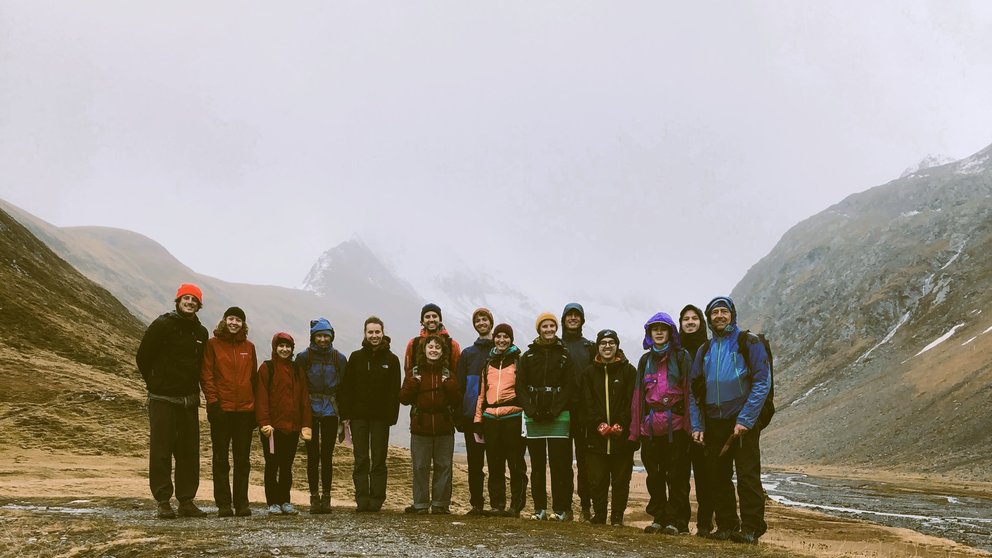
800871 EX Bildung für Nachhaltige Entwicklung im Geiste der Humboldt Brüder. Eine (selbst-)reflektierende Expedition in den Alpenraum: As part of the “Education for Sustainable Development” initiative, Sabrina Bacher (Institute for Teacher Education and School Research) and David Segat (Institute of Geography) at the University of Innsbruck designed an interdisciplinary course in the form of an excursion. Entitled "Education for Sustainable Development in the Spirit of the Humboldt Brothers. A (self-)reflective expedition in the Alpine region," the course combined geographical and educational perspectives to bring sustainable development to life. The aim of the course was to promote a holistic, interdisciplinary understanding of nature in the spirit of Alexander von Humboldt. This was intended to sensitize students to issues of sustainability and strengthen their critical thinking and reflective abilities with regard to human-environment relations. The excursion made it possible to experience theoretical concepts in real contexts and to link interdisciplinary perspectives. A three-pillar didactic approach was developed specifically for the course: (1) Wilhelm von Humboldt's educational ideal and ideas on tertiary education and its didactic further development by Wolfgang Klafki (2) findings from nature, experiential, and adventure education, and (3) the university didactic competency framework LOUIS (Learning Outcomes in University for Impact on Society). A phenomenologically influenced concept of learning formed the basis, according to which learning is understood as a holistic process of experience and meaning-making, focusing on perception, physicality, and subjective experience. Through interactive, experience-based learning, students were encouraged to reflect on their responsibility for sustainable development and to see themselves as multipliers of sustainable practices. The teaching concept combines science, practice, and personal development and makes a valuable contribution to university education for sustainability. Awarded the Ars Docendi State Prize for Excellence in Teaching (main prize 2025).
The Atlas of Good Teaching (available in German only) showcases, among other things, examples from all higher education sectors with a focus on Education for Sustainable Development (SDGs).
External Links
Department of Economic and Social Affairs, United Nations
Targets and Indicators of Goal 15