
Fram3S
Sub-seasonal and seasonal prediction of snow cover dynamics in complex mountain terrain: integrating snow simulations with weather forecasts and satellite-based snow data
In the project Fram3S we will develop an integrated modelling framework to predict the sub-seasonal and seasonal dynamics of the mountain snow cover. The system combines downscaled and bias-adjusted extended-range and long-range forecast weather data, and the spatially distributed physically-based openAMUNDSEN snow model which makes use of an ensemble-based assimilation scheme for satellite-based snow data. It will be applied to the EUREGIO Tyrol–South Tyrol–Trentino. This project is funded by the Euregio Science Fund (Project No. 10.55776/TST2378624).
Im Projekt Fram3S entwickeln wir einen integrierten Modellierungsrahmen, um die sub-saisonale und saisonale Dynamik der Gebirgsschneedecke vorherzusagen. Das System kombiniert herunterskalierte und bias-korrigierte Wetterdaten aus erweiterten und langfristigen Vorhersagen mit dem räumlich verteilten, physikalisch basierten Schneemodell openAMUNDSEN, das ein ensemble-basiertes Assimilationsverfahren für satellitengestützte Schneedaten nutzt. Der Ansatz wird in der EUREGIO Tirol–Südtirol–Trentino angewendet. Das Projekt wird durch den Euregio Science Fund gefördert (Projektnr. 10.55776/TST2378624).
Nel progetto Fram3S svilupperemo un quadro di modellazione integrato per prevedere la dinamica sub-stagionale e stagionale della copertura nevosa montana. Il sistema combina dati meteorologici previsionali a medio ed a lungo termine, downscalati e corretti per il bias, con il modello di neve openAMUNDSEN, fisicamente basato e spazialmente distribuito, che utilizza uno schema di assimilazione basato su ensemble per dati nivali da satellite. L’approccio sarà applicato all’EUREGIO Tirolo–Alto Adige–Trentino. Il progetto è finanziato dall’Euregio Science Fund (Progetto n. 10.55776/TST2378624).
The overall aim of Fram3S is to develop and apply a modelling framework to predict the spatio-temporal snow dynamics (including snow cover and amount) from weeks to months in advance and to evaluate its performance for different lead times and spatial resolutions. State-of-the-art statistical, physical and data assimilation algorithms as well as AI methods are combined to address the following research questions:
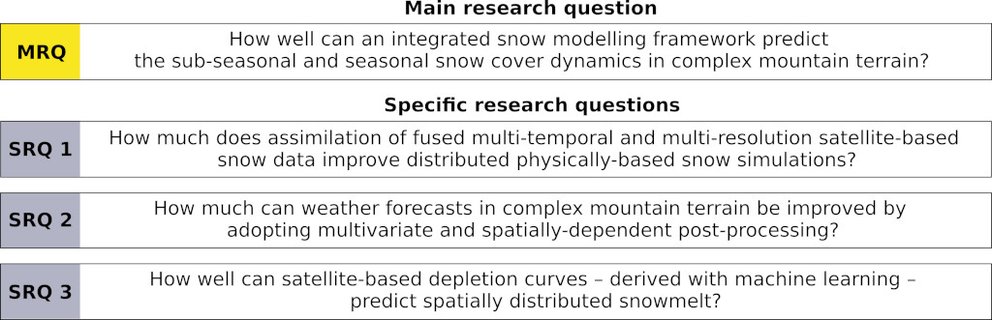
Main research question (MRQ) and specific research questions (SRQs) addressed in the project Fram3S.
Das übergeordnete Ziel von Fram3S besteht darin, einen Modellierungsrahmen zu entwickeln und anzuwenden, um die räumlich-zeitliche Schneedynamik (einschließlich Schneebedeckung und -menge) Wochen bis Monate im Voraus vorherzusagen und seine Leistung für verschiedene Vorlaufzeiten und räumliche Auflösungen zu evaluieren. Moderne statistische, physikalische und Datenassimilationsverfahren sowie KI-Methoden werden kombiniert, um die folgenden Forschungsfragen zu adressieren:
Zentrale Forschungsfrage (MRQ) und spezifische Forschungsfragen (SRQs), die im Projekt Fram3S behandelt werden.
L’obiettivo generale di Fram3S è sviluppare e applicare un framework per prevedere la dinamica nivale spazio-temporale (inclusa la copertura nevosa e la quantità di neve) con un anticipo da settimane a mesi e valutarne le prestazioni per diversi lead time e risoluzioni spaziali. Metodi statistici e fisici all’avanguardia, algoritmi di assimilazione dei dati e tecniche di IA vengono combinati per affrontare la seguente domande di ricerca:
Domanda di ricerca principale (MRQ) e domande di ricerca specifiche (SRQs) affrontate nel progetto Fram3S.
The following methodolocical approaches will be combined: (i) downscaling and bias-adjustment of meteorological variables from weather models, (ii) physically-based simulation of the snow dynamics with the openAMUNDSEN snow model and (iii) processing and assimilation of satellite data. These methods will be combined to an integrated modelling framework by forcing the snow model with the weather forecast data and by assimilating satellite-based snow cover area and wet snow maps by means of an ensemble-based data assimilation method. An attempt will also be made to (iv) compute satellite-based depletion curves to predict the evolution of the snow cover.
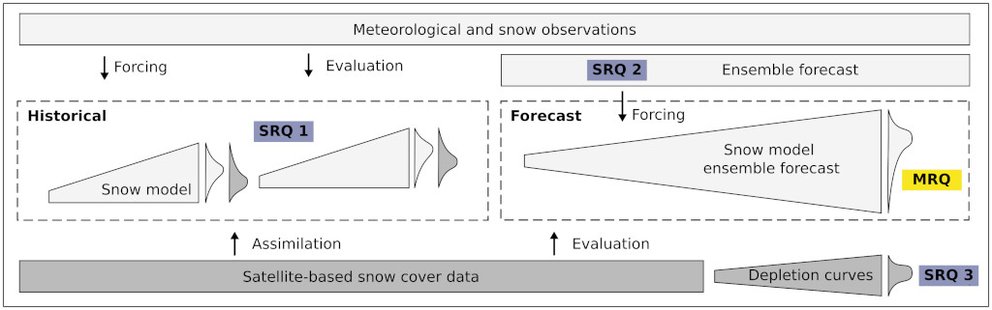
Conceptual framework of the Fram3S project including main and specific research questions (MRQ and SRQs).
Die folgenden methodischen Ansätze werden kombiniert: (i) Herunterskalierung und Bias-Korrektur meteorologischer Variablen aus Wettermodellen, (ii) physikalisch basierte Simulation der Dynamik der Schneedecke mit dem openAMUNDSEN-Schneemodell und (iii) Verarbeitung und Assimilation von Satellitendaten. Diese Methoden werden zu einem integrierten Modellierungsrahmen zusammengeführt, indem das Schneemodell mit Wettervorhersagedaten angetrieben und satellitenbasierte Schneebedeckungs- und Nassschneekarten mittels eines ensemblebasierten Datenassimilationsverfahrens assimiliert werden. Darüber hinaus wird untersucht, (iv) wie man satellitenbasierte Depletionskurven berechnet, um die Entwicklung der Schneedecke vorherzusagen.
Konzeptioneller Rahmen des Fram3S-Projekts mit Haupt- und spezifischen Forschungsfragen (MRQ und SRQs).
I seguenti approcci metodologici saranno combinati: (i) downscaling e correzione del bias delle variabili meteorologiche provenienti dai modelli meteorologici; (ii) simulazione fisicamente basata della dinamica nivale con il modello di neve openAMUNDSEN; e (iii) elaborazione e assimilazione dei dati satellitari. Questi metodi saranno integrati in un quadro di modellazione unificato forzando il modello di neve con i dati delle previsioni meteorologiche e assimilando mappe satellitari di area coperta da neve e di neve bagnata mediante un metodo di assimilazione dati basato su ensemble. Si cercherà inoltre di (iv) calcolare curve di esaurimento basate su dati satellitari per prevedere l’evoluzione della copertura nevosa.
Quadro concettuale del progetto Fram3S con la domanda di ricerca principale (MRQ) e le domande di ricerca specifiche (SRQs).
Project team
- Universität Innsbruck: Prof. Ulrich Strasser, Dr. Erwin Rottler, MSc Franz Wager
- EURAC Research: Dr. Carlo Marin, Dr. Valentina Premier, MSc Katharina Scheidt
- Università di Trento: Prof. Bruno Majone, Dr. Michael Matiu