
Publications
Vanessa Maria Carlone, Leonie Hasenauer, Elias Knapp (eds.), Kommen und Gehen, damals und heute. The Influence of Migration on (Old) Austria's Society, Economy and Cultural Landscape (Austrian Studies/Innsbrucker Beiträge 1), Innsbruck 2023.
Spatial mobility in its various forms is a constant in human history. A variety of motives and causes have repeatedly prompted people to leave their place of birth and familiar centre of life. Migration' cannot be seen as a simple snapshot in time. Rather, this spatio-temporal phenomenon must be understood and analysed as a dynamic process that takes into account not only 'coming' and 'going', but also 'staying'. This results in a multifaceted field of tension that has had a lasting impact on Austria's (cultural) landscape - even far from current national borders. The contributions in this volume open up different thematic and methodological-theoretical approaches to 'migration(s)'. The diversity of perspectives and research approaches of the disciplines involved in the doctoral programme "Austrian Studies" should thus be shown and encourage a broad consideration of 'migration'. https://shop.falter.at/detail/9783991060925/kommen-und-gehen-damals-und-heute
Martin Rohde: National science between two empires. The Ševčenko Society of Sciences, 1892-1918. V&R unipress, Vienna University Press, 2021 (Wiener Galizien-Studien, vol. 6).
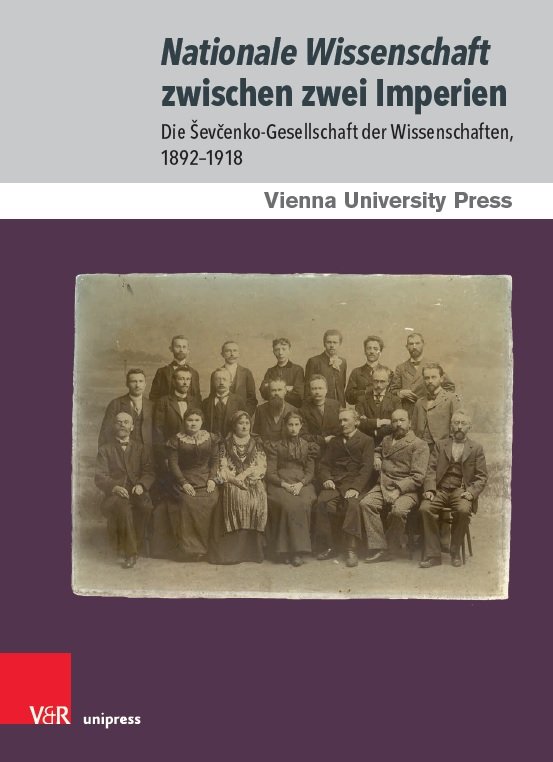
What factors influenced the knowledge production of non-dominant groups in hierarchised contact spaces? This volume explores this question by examining the Ukrainian Ševčenko Society of Sciences in Habsburg Galicia in the late 19th/early 20th century, when the Ukrainian scientific landscape was almost monocentrically centred on this society. Through the prism of the association's activities, the burgeoning Ukrainian-language science can therefore be researched with a focus on imperial and transnational exchange processes. This history of European entanglement works out the possibilities, limits and boundaries of Ukrainian science, which characterised it in its aim to scientifically justify the existence of Ukraine.
Which factors influenced the knowledge production of non-dominant groups in hierarchised contact zones? This question is discussed with the example of the Ukrainian Shevchenko Scientific Society in Habsburg Galicia during the late nineteenth and early twentieth centuries. This young institution was the only centre of the Ukrainian scholarly community during this period, enabling investigation into nascent Ukrainian science through the history of this association. Although this book deals with a group of nationalising scholars, the focus is not exclusively on conflicts, but rather on European entanglements as well as the possibilities, limits, and delineations of Ukrainian science in its pursuit of justifying the existence of Ukraine.
Sieglinde Klettenhammer, Kurt Scharr (eds.): What does Austria mean? Reflections on the field of Austrian Studies in the 21st century. Klagenfurt: Wieser Verlag, 2022 (wieser wissenschaft).
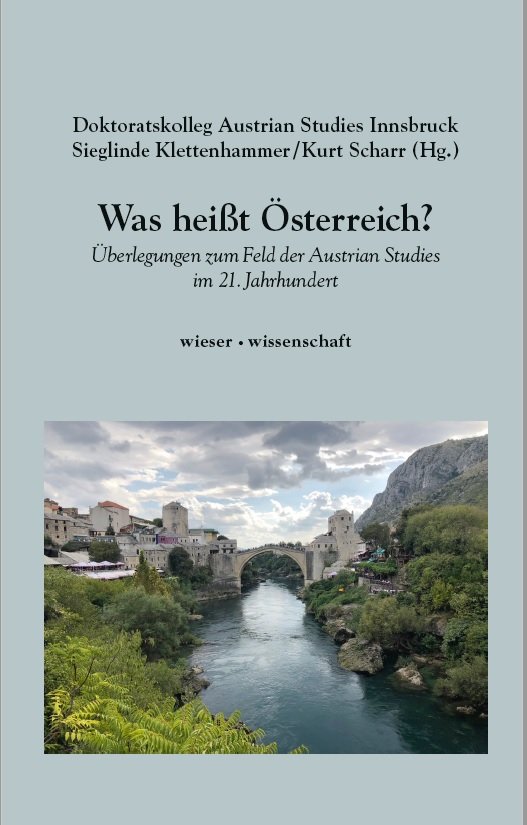
The shortest connection to the Adriatic runs from Sarajevo via Mostar through the Dinaric Alps. To this day, the bridge near Mostar divides and connects at the same time, both symbolically and in reality. In September 2019, members of the Innsbruck doctoral programme "Austrian Studies" visited the capital of the Herzegovina-Neretva canton in the Federation of Bosnia and Herzegovina. The intention was to provide both an internal and external perspective on Austrian Studies.
The central question "What does Austria mean?", which the Centre addressed at an international conference in Innsbruck in 2019, cannot be expected to provide a definitive and comprehensive answer here or anywhere else - especially considering the perspective of Mostar. Rather, it is an ongoing invitation to reflect, to discuss and to change perspective(s) - in terms of subject, content, time and space. The question "What does Austria mean?" should therefore not be posed in order to provoke a one-size-fits-all answer. On the contrary. It is intended to scrutinise superficial certainties from the perspective of various disciplines of knowledge and to open our eyes to ambiguities in the past and scope for the future. And it is also intended to draw attention and research interest to the various spaces that this concept occupies: Austria can not only be 'located' topographically and geographically in changing historical contexts, but from a cultural studies perspective Austria is also to be understood as a space of fiction and memory, which literature, the visual arts, music and architecture have produced and continue to produce in a wide variety of representations and which can be found in various functions. This volume aims to provide fundamental suggestions and new insights.
Martina Schmidinger (ed.): Austria interdisciplinary. Contributions from the Innsbruck doctoral programme "Austrian Studies". Austria - History, Literature, Geography (ÖGL), 65th Vol. (2021), H. 1.
Three years after the foundation of the Doctoral Programme Austrian Studies, a thematic issue of the journal Österreich - Geschichte, Literatur, Geographie of the Department of Geography was published in 2021, documenting the results of the interdisciplinary cooperation within the DK. The articles are based on the lectures given in four workshops conceived and organised by the doctoral students between 2019 and 2020.
The contributions will be made available in full text in early 2022.