
Spare Parts. A Transnational History of Automobility
Research Project | Duration: June 2026–May 2029
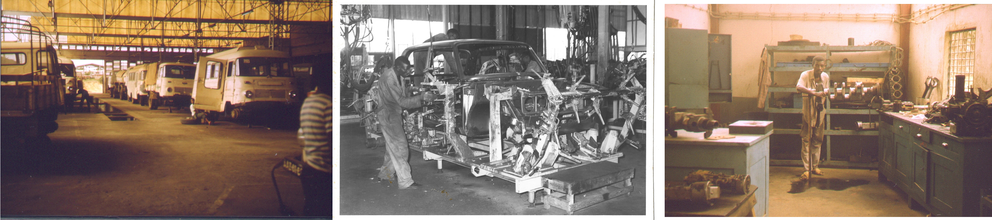
The project Spare Parts. A Transnational History of Automobility, Innovation and Transformation in Eastern and Southern Africa, 1961–1991 examines transnational cooperation between the European automotive industry and the post-colonial states of Tanzania and Zambia – with a particular focus on the role of spare parts, wear parts and consumables in the functioning of road transport and the transport economy. At the heart of the project is the thesis that the management of spare parts and the equipping of workshops became a key bottleneck: a lack of parts and limited repair capacity took thousands of buses and lorries financed through credit lines out of service, with significant economic and social consequences.
The project combines a comparative, multi-scalar and entangled Afro-European perspective on parastatal bus operators and state-run as well as private transport companies with the experiences of mechanics, drivers, managers and passengers.
Methodologically, it combines multi-archival research with oral history interviews to trace the “biographies” of exported vehicles and their spare parts supply chains. This global history of transport is framed by the guiding principles of Ujamaa (Tanzania) and humanism (Zambia), as well as both countries’ self-image as members of the Non-Aligned Movement, which sought an affordable, state-led and, as far as possible, self-reliant transport system – yet, as post-colonial states, Tanzania and Zambia found themselves confronted with the major challenges of (neo-)colonial path dependencies and a barely developed local automotive and supplier industry.
Manufacturer case studies
- Leyland Motors/British Leyland (United Kingdom): Whilst Leyland’s monopoly position dating back to the colonial era secured it exclusive export opportunities in both countries, the company came under considerable pressure from other European manufacturers from the late 1960s onwards. The research examines how Leyland and both state-owned and private transport companies in Tanzania and Zambia organised spare parts and repair networks, and what consequences this had for availability and service. Archival research is being conducted at the British National Archives, amongst other sources.
- Fiat (Italy): The study reconstructs corporate strategies, parts logistics and local repair infrastructures in collaboration with African partner companies; this also includes assembly activities in Livingstone (Zambia) and a tractor factory in Tanzania. Archival work at the Fiat Historical Centre in Turin forms an important basis for this.
- Industrieverband Fahrzeugbau (IFA, GDR): Building on experience with the W50 truck model, the project examines the training of mechanics, the supply of spare parts and their impact on the operational capability of these vehicles in Zambia.
- Fap Famos/Rudnap (Yugoslavia): The study examines Yugoslav-Zambian cooperation in the commercial vehicle sector – including operations on the “Hell Run” – as well as the organisation of spare parts supply chains and training programmes.
Country Studies
- Tanzania: The project will examine how the government expanded road construction and bus transport whilst striving to establish an affordable, state-run system; it highlights the consequences of spare parts shortages and inadequate workshop capacity, which brought vehicles to a standstill and restricted mobility, but also showcases innovations in times of severe scarcity.
- Zambia: Within the framework of Kaunda’s humanism, the focus is on the performance of parastatal transport and freight companies; the study examines cooperation with European manufacturers, staff training and the management of spare parts supply chains.
The comparative, transnational approach highlights differences and commonalities and situates East and Southern Africa within an entangled Afro-European history of automobility, repair and (im)mobility.
Contact:
University of Innsbruck
Innrain 52d, 6020 Innsbruck
