
Provincializing coloniality: A global history of 20th century Tyrol
Research project | Duration June 2026 - May 2031
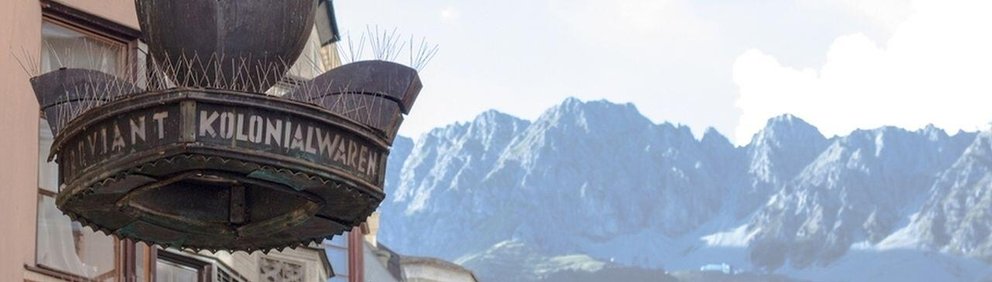
Nasenschild der Firma „Unterberger & Comp.“ mit der Aufschrift „Kolonialwaren“, Herzog-Friedrich-Straße 26 in Innsbruck.
Based on archival research and interviews, the project "Provincializing Coloniality" sheds light on Tyrol's transregional dimensions and thus opens up new perspectives for a productive interweaving of regional and global history. In the project, Tyrol's history in the 20th century is reread through an intertwined perspective in order to find out how even regions that had no colonies themselves and were far away from capitals were involved in imperialist constellations as well as decolonization processes.
A first focus concerns institutions that had the aim of intervening in other regions of the world in contexts of mission, colonization or development. Such institutions emerged in different periods from the First Republic to Austrofascism to the post-war period. One example is the African Institute in Innsbruck, which was founded in 1924 by Albert Drexel and dealt with the study of cultures and languages in Africa and was converted into a mission college in 1928 to prepare missionaries for practical use. Another case study deals with the settlement Dreizehnlinden/Treze Tílias (Brazil), founded in 1933 by Austrian emigrants, and the ongoing intensive relations with Tyrol, not least in the context of development aid from the 1960s onwards.
The second focus of the project is on colonial entanglements in popular culture and consumption in the first half of the 20th century. It examines how colonial ideas and narratives have been anchored (but perhaps also challenged) in advertising, consumer goods, and cultural practices – both in cities and in rural areas. In the late 19th and early 20th centuries, for example, the carnival tradition in Telfs, the Telfer Schleicherlaufen, referred to geographically distant events such as the Boer War in South Africa (1899-1902). As an example of economic interdependencies, the project examines colonial goods stores (Kolonialwarenläden) that offered products such as coffee, tea and tobacco from overseas (not necessarily from colonies) and relied on exoticizing strategies for advertising.
The third focus of the project is on initiatives against colonialism and racism as well as references to the global process of decolonization more generally. The focus here is on the 1950s to 1980s, when the independence of countries in Africa and the fight against apartheid in South Africa were also discussed in Tyrol and South Tyrol. One case study concerns the activities of the anti-apartheid movement in Tyrol, which not only drew attention to human rights violations in South Africa, but also pointed out the involvement of Tyrol’s political and economic elites.
In sum, the project takes a new look at regional history with a view to global interdependencies as well as colonial and anti-colonial aspects.
Project team: Dr. Clara Torrão Busin, Julia N. Müller, BA, Alina Nederegger, MA

Nederegger, Burton, Torrão Busin, Müller
Eric Burton is a global historian, associate professor at the Department of Contemporary History at the University of Innsbruck and PI of the project Provincializing Coloniality. A Global History of 20th Century Tyrol (2026-2031). After pursuing graduate courses in Development Studies and Cultural and Social Anthropology in Vienna and Dar es Salaam, he wrote his PhD thesis on the relations between Tanzania, West Germany and East German in the framework of the research project Experts in “Development” and “Socialist Aid”. In 2018 and 2019, he held research and teaching fellowships in Leipzig (Leibniz Science Campus Eastern Europe – Global Area) and Exeter (research project Socialism Goes Global) as well as at the University of Ghana. In 2025, he received his venia docendi with a thesis on Cairo, Accra and Dar es Salaam as “Hubs of Decolonization” and received the FWF ASTRA Award for the project Provincializing Coloniality. Together with Konrad Kuhn he edited the WebApp / city map Innsbruck postkolonial: Spuren – Orte – Geschichten. His research interests include the history of decolonization, anti/colonial dimensions of contemporary Austrian history, East-South relations, educational mobility, and socialisms during the Cold War. More information and a list of publications on his personal profile page.
Clara Torrão Busin is a historian. She studied African and European Studies at Sciences Po Paris before completing a Franco-German Master's degree in History at the École des hautes études en sciences sociales (EHESS) in Paris and Heidelberg University. In her PhD research at the EHESS, she examined the colonial border between Mozambique and Tanzania from a transimperial perspective. Her work reconstructed border-making not as the drawing of a static line but as a dynamic process shaped by administrative practices, missionary activities, and the agency of borderland inhabitants. Since June 2026, she has been a postdoctoral researcher at the University of Innsbruck as part of the Provincializing coloniality project. There, she researches Tyrol's global and colonial institutional connections. A key focus of her research is the Dreizehnlinden / Treze Tílias case study, in which she examines the founding of this Austrian colony in Brazil from a decolonial perspective, as well as its connections to Tyrol—particularly during the period after Treze Tílias came under Brazilian administration. Further information can be found on her personal profile page.
Julia Nora Müller studied History and Philosophy at the University of Innsbruck and is currently pursuing a Master's degree in History, specialising in Contemporary History, at the Ludwig Maximilian University of Munich. Her research focuses on the colonial, cultural, and gender history of the nineteenth and twentieth centuries. In previous research, she examined Bertha von Suttner's conception of Europe from a postcolonial perspective and explored state-funded travel grants for German Siedlerfrauen to the former East African colonial territories as an example of settler colonialism without colonies. Within the research project Provincializing Coloniality, she investigates Tyrol's colonial and anti-colonial entanglements since 1955. Her research examines the ambivalent regional resonances of global decolonisation in a range of social contexts, from Christian missionary projects and student protest movements to anti-apartheid solidarity and the adoption of anti-colonial narratives and argumentative frameworks in the South Tyrol conflict. More information on her personal profile page.
Alina Nederegger studied History, Gender Studies, and Art History at the University of Innsbruck. Her research interests include gender history, the regional history of Tyrol, and the social and economic history of the nineteenth and twentieth centuries. She is also particularly interested in social inequalities and epistemic violence. These research interests are reflected in her two master's theses, which examine factory workers in Tyrol and epistemic violence in relation to museums. As part of the research Provincializing Coloniality, she investigates the colonial entanglements of everyday life and popular culture in Tyrol during the first half of the twentieth century. Her research focuses on how colonial ideas were taken up and negotiated through cultural practices, political discourses, and patterns of consumption. Drawing on case studies of Tyrolean solidarity movements supporting the Boers, colonial references in Carnival traditions, ethnic shows, and colonial goods stores, she analyzes how these colonial entanglements manifested themselves in everyday regional life. More information on her personal profile page.
- Burton, Eric / Dreidemy, Lucile / Hacker, Hanna (eds.), “Brüder, zur Sonne“? Entwicklung, Dekolonisierung und sozialistische Solidarität in den österreichischen 1960ern. zeitgeschichte 52, no. 3 (2025). DOI: 10.14220/9783737018494.251.
- Burton, Eric, Das Globale im Regionalen. In: Welthaus der Diözese Innsbruck (ed.), Ötztal Weltweit talaus talein. Geschichten aus der Ausstellung (Innsbruck: Welthaus der Diözese Innsbruck, 2024), 40-44. Online.
- Föger, Katharin / Burton, Eric, Kleines Land, großer Dienst: Anti/Kolonialismus, Anti/Rassismus und Entwicklung in Zeitschriften des Österreichischen Gewerkschaftsbundes, 1953–1968. zeitgeschichte 52, no. 3 (2025), 305–334. DOI: 10.14220/9783737018494.305.
- Dreidemy, Lucile / Burton, Eric, Collective Colonialism for European Integration. The Rise of the Paneuropean Movement in Post-Imperial Austria. In: Bernhard Schär / Mikko Toivanen (eds.), Integration and Collaborative Imperialism in Modern Europe. At the Margins of Empire, 1800-1950 (London: Bloomsbury, 2024), 201-221. DOI: 10.5040/9781350377370.ch-011.
- Burton, Eric / Kuhn, Konrad, Innsbruck postkolonial: Spuren – Orte – Geschichten. WebApp, in cooperation with Stadtmagistrat Innsbruck, 2023. Online: http://www.innsbruck.gv.at/innsbruck-postkolonial.
- Burton, Eric, Postkolonialismus. In: Gräser, Marcus / Rupnow, Dirk (eds.): Österreichische Zeitgeschichte / Zeitgeschichte in Österreich. Eine Standortbestimmung in Zeiten des Umbruchs (= Böhlaus Zeitgeschichtliche Bibliothek 41) (Vienna: Böhlau, 2021), 321-347. DOI: 10.7767/9783205209980.321.
- Rohstoffe, Handel und koloniale Verflechtungen in der Regionalgeschichte, ca. 1800-1950. 24./25. September 2026, Wirtschaftskammer Vorarlberg, Feldkirch. Organisiert vom Wirtschaftsarchiv Vorarlberg in Kooperation mit der Universität Innsbruck (Ute Hasenöhrl, Institut für Geschichtswissenschaften und Empirische Kulturwissenschaft; Eric Burton, Institut für Zeitgeschichte). Programmheft: https://www.wirtschaftsarchiv-v.at/images/tagungen/2026-09/Programmheft_2026.pdf
Contact:
assoc.-Prof. Mag. Dr. Eric Burton
Department of Contemporary History
University of Innsbruck
Innrain 52d, 6020 Innsbruck
