

Text by Louis Quilley, Francine Marleau, Knud Jahnke
In March 2025 ESA and the Euclid Consortium released the first 63 square degrees of calibrated Euclid science images and catalogues, the Q1 release. At the same time, a set of descriptive technical articles and first scientific papers were released to the public. A second set of publications is now ready and has just been released – the EC issued a press release on this.
We have been using this occasion to dip into the more than 20 million galaxies observed for the Q1 release to re-construct a very classical display of extragalactic astronomy: the so-called ‘Morphological Tuning Fork’ – as seen by Euclid.
What is this? Let’s take a step back.
Galaxies come in a stunning variety of shapes and structures that reveal their origins and evolution. From smooth ellipticals to graceful spirals and chaotic irregulars, each form shows how galaxies grow, create stars, and interact over cosmic time. Euclid, with its exceptional depth and sharpness, is capturing these shapes for tens and even hundreds of millions of galaxies across one third of the sky over its six-year mission. This will help astronomers understand how a galaxy’s structure relates to its mass, activity, and surroundings. Even the smallest and faintest dwarf galaxies are now visible in remarkable detail, offering key clues to how larger systems like our own galaxy, the Milky Way, formed.
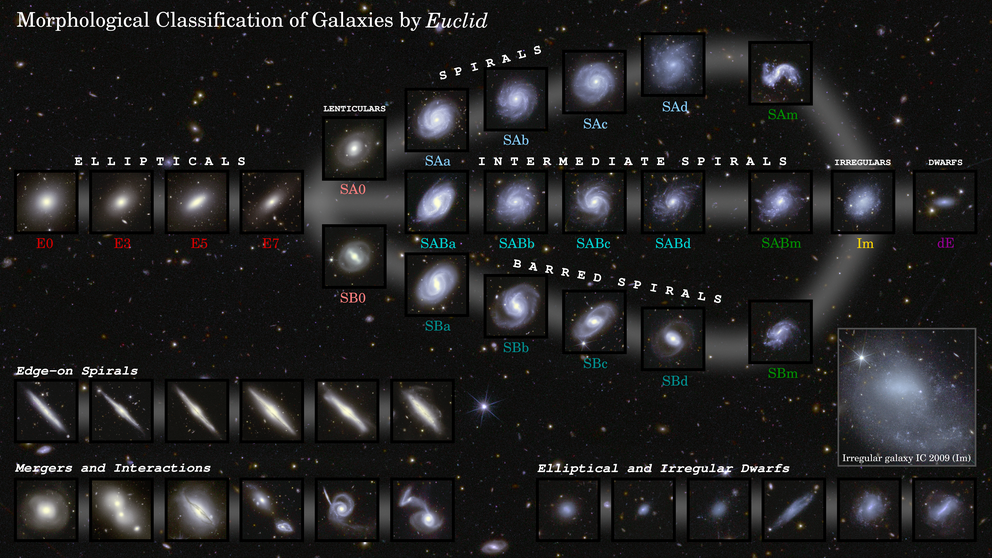
The “Morphological Tuning Fork” of galaxy classifications, re-created using Euclid’s high-resolution images from data release Q1.
Credit: Diagram: ESA/Euclid/Euclid Consortium/NASA, Diagram by J.-C. Cuillandre, L. Quilley, F. Marleau. Images alone: ESA/Euclid/Euclid Consortium/NASA, image processing by J.-C. Cuillandre, E. Bertin, G. Anselmi
So a galaxy’s structure is a sign of its formation history and the environment it lives in. Since early on, astronomers have ordered galaxies according to their visible structure – as a basis to understanding the underlying physics: This panorama of galaxies’ structure shows the ‘classical’ morphological sequence from ellipticals (E, left) to lenticulars (S0) through spirals (S) to irregulars and dwarfs (right). The fork divides barred and unbarred spiral families: originally only SA (unbarred) and SB (barred) galaxies were arranged in a ‘tuning fork’ layout, the addition of SAB (weakly barred) galaxies as a third branch is making this term increasingly challenging to use. Lowercase letters a to d indicate progressively later spiral stages (tighter to looser arms), the trailing m (e.g., SAm) denotes Magellanic, very-late-type systems (patchy, often one-armed). The Milky Way is classified as an SBc galaxy.
Below the main sequence we added three auxiliary panels showing objects not represented in the fork: (1) spiral galaxies seen edge-on, with varying bulge-to-disk ratios and warps; (2) interacting and merging galaxies illustrating gravitationally driven morphological change; and (3) the morphological diversity of dwarf galaxies.
For the original article, which includes an interactive version of the image and high-res download options, visit the Euclid Consortium website at: https://www.euclid-ec.org/euclid-morphological-tuning-fork
Related articles from the March 2025 paper release:
Euclid Consortium: Louis Quilley et al., 2025, “Euclid Quick Data Release (Q1). Exploring galaxy morphology across cosmic time through Sersic fits”, accepted for publication in Astronomy & Astrophysics, https://arxiv.org/abs/2503.15309
Euclid Consortium: Francine Marleau et al., 2025, “Euclid Quick Data Release (Q1). A census of dwarf galaxies across a range of distances and environments”, accepted for publication in Astronomy & Astrophysics, https://arxiv.org/abs/2503.15335