
The AstroMundus Master Programme
AstroMundus is a two-year Erasmus+: Erasmus Mundus Joint Masters Degree Course in Astronomy and Astrophysics. This Course is based on the expertise of the Universities of Innsbruck, Padova, Roma, and Göttingen, and the University of Belgrade as a Partner-Country member of the Consortium. The programme further benefits from the participation of the associated partners: Astronomical Observatory of Belgrade, INAF-Astronomical Observatories of Padova and Roma, INFN-Gran Sasso Science Institute (L'Aquila), and Max Planck Institute for Solar System Research (Göttingen).
Objectives
The main objectives of the Master are initiation in scientific research and applied training in Astronomy and Astrophysics. Emphasis is put on the application of modern techniques both in the observational and theoretical/computational domain. The various specialities of the partner institutions result in an increased offer of pathways for the students: Theoretical Astrophysics, Models, Simulations and Computation, as well as Observational Astrophysics based on data from the ground and from space and on the exploitation of modern data archives.
Organization of the Masters Course
The programme lasts for two years. The AstroMundus consortium adopts the European Credit Transfer System (ECTS). Students will earn a minimum of 120 ECTS during their master studies.
The programme is regulated by a Consortium Agreement and the student participation is regulated by a Student Agreement.
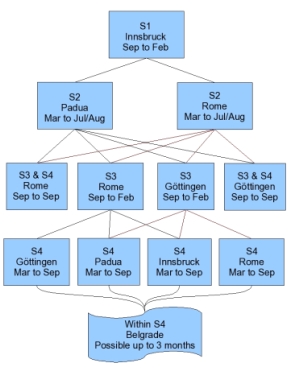
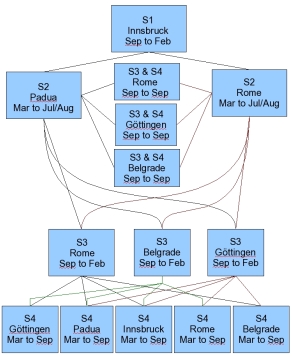
During the first semester the students attend courses at the entrance university (University of Innsbruck). The second semester is spent at a second University of choice among the 2 Italian partner Universities (Padova and Rome). The third semester is spent in one of the three partner institutions at Rome, Göttingen, or Belgrade depending on the astrophysical branches which the students will select to specialise on (but see important note below!). Finally the fourth semester is mainly devoted to the Master’s thesis (30 ECTS) that can be accomplished in any of the partner institutions, with the possibility of joint supervision by a member of another of the partner universities. Students are given the possibility to attend additional advanced courses/seminars during the 4th semester, especially on topics related to their thesis work. The first semester is focused on basic learning in Astronomy and Astrophysics, while the subsequent ones offer to the students the possibility to specialise in different branches. The organization in semesters is summarised in the table below. The detailed lists of courses offered at the various universities in the relevant semesters are available in the section Curricula.
Important note: Although the students can choose their mobility path through the consortium universities from the second semester onward, in order to ensure an excellent quality of the course a maximum fraction of students per site is allowed. Therefore, at mid-course of each semester students will be asked to give their preference(s) for the subsequent semester. The Selection Committee may re-direct some students to sites different from their chosen ones when the maximum capacity of one or more sites is reached. Maximum capacities are indicated in the table below in terms of maximum fraction of students per site.
| Hosting Institution | 1st term | 2nd term | 3rd term | 4th term |
|---|---|---|---|---|
| Innsbruck | X | X | ||
| Padova | X | X | ||
| Rome | X | X | X | |
| Göttingen | X | X | ||
| Belgrade | X | X | ||
| maximum fraction of students per site | n.a. | 60% | 40% | 25% |
Examples of possible study paths
| Partner-Country (Cat A) scholarship holders | Programme-Country (Cat B) scholarship holders | Students without scholarship |
|---|---|---|
|
Must visit minimum 2 Progrmme-Country AstroMundus Universities. S3 in Belgrade: allowed only with course modules in blocks from beginning of October to end of December (3 months is the maximum duration of the stay). Periods in Belgrade are not covered by scholarship for Serbian students. |
If Belgrade: not less than 3 months. Must visit minimum 2 Programme-Coountry AstroMundus Universities. |
Must visit minimum 2 Programme-Country AstroMundus Universities. |
Language and admission policies
Courses will be taught in English. Intensive tutoring of Master students will be assured during the whole course of their Master studies. Also, English will be the language of choice for tutoring and examinations. However, students will have access to language courses within each of the partner Universities. Up to forty students can be involved in the programme for each cycle of Master. Admission criteria include a Bachelor’s degree in physical or mathematical sciences or an equivalent degree (180 ECTS) and depends mainly on academic qualifications. Admitted students will be required to sign a Student Agreement.
Final degree
Students who successfully complete the requirements of the programme will be awarded a Joint Master Degree by the Consortium universities where they accomplished the various parts of their Master studies. In addition they will receive a Diploma Supplement.
Agreements
The AstroMundus programme is regulated by a Consortium Agreement between the participating Institutions, which include an agreement about the awarding of a Joint Degree.
Students who participate in the programme must sign a Student Agreement that defines the terms and conditions of their participation.
The Consortium Agreement and templates of Student Agreement are provided at this link.
Last updated on May 24th, 2016